
Bus & Subway Accidents
What to Do After an Escalator Accident in New York: Preserve Evidence Before Drawing Conclusions
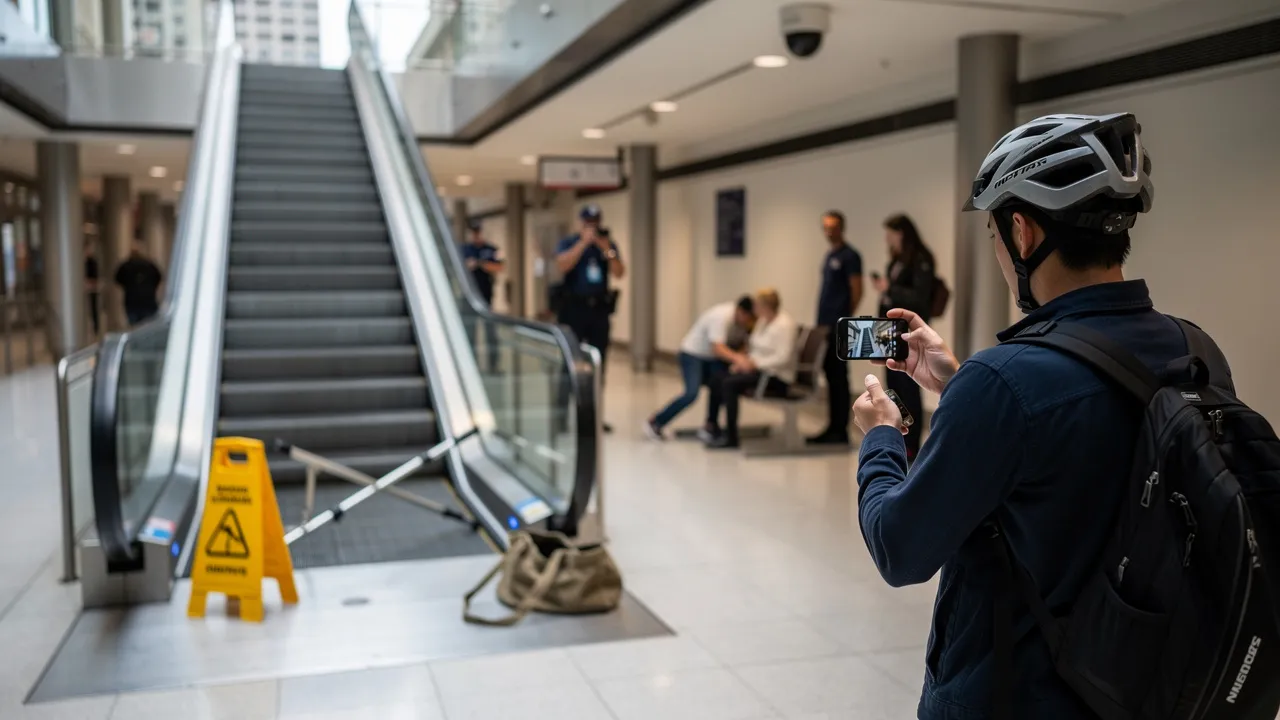
Start with preservation, not a liability conclusion
An escalator accident gives you facts to preserve, not a ready-made answer about responsibility. A fall, sudden stop, trapped clothing, gap, unusual movement, wet surface, damaged step, or other event may justify careful documentation, but the event alone does not establish a defective escalator, negligent maintenance, a responsible property owner, manufacturer liability, insurance coverage, or a valid injury claim.
Your first objective is to keep the important facts from becoming harder to identify. That objective applies whether the escalator was in a Bronx subway station, another New York City transit location, a store, an office building, a hospital, or another private facility. The location matters because the party that owns, operates, maintains, leases, or controls the equipment may not be the same party you first encounter at the scene.
Preservation is practical rather than conclusive. A photograph can show what appeared at a particular time; it does not decide why the condition existed. A witness account can identify what someone observed; it does not settle every disputed detail. A medical record can document care; it does not by itself determine who is legally responsible.
The immediate decision path is straightforward:
- Get to a position where you can receive help without creating another risk, as far as your condition permits.
- Obtain medical care rather than deciding from the appearance of the injury that care is unnecessary.
- Report the incident to the appropriate authority and preserve the identifying details of the location.
- Photograph and describe the escalator, surrounding area, clothing, footwear, and other conditions that may later be disputed.
- Save names, phone numbers, reports, records, and communications in one organized file.
- Seek prompt legal review when the injury is serious, the accounts conflict, a public entity may be involved, or video or other evidence may disappear.
These steps preserve options. They do not announce that you have proved a claim.
Protect the person, obtain medical care, and report the incident
Your safety and medical care come before a detailed legal assessment. After a fall, The Law Offices of Evan W. Kohn recommends seeing a doctor, reporting the fall, photographing the hazard, collecting witness names and phone numbers, preserving shoes and clothes, and calling a lawyer before speaking with an insurance company.
Use that sequence without trying to diagnose yourself. Tell medical staff that the symptoms followed the escalator incident and describe what happened in ordinary terms. Keep the discharge paperwork, treatment instructions, prescriptions, bills, and later appointment information. Your account should remain accurate: record what you felt and what care you received, rather than assigning a medical label that a clinician has not given you.
An incident report creates a contemporaneous record, but reporting the event does not establish responsibility. Tell the station employee, security officer, property manager, store manager, or other appropriate authority what occurred. Ask how the report can be identified later, and write down the name, title, location, and time of the person who received it.
Describe the event without arguing the legal conclusion. For example, record whether you fell while stepping on, riding, or leaving the escalator; whether the movement appeared to stop or change; whether you noticed liquid, an object, a gap, damage, or another condition; and where you landed. Use words such as “I observed” or “I felt” when the detail comes from your own experience. Do not turn an uncertain observation into a statement that the equipment was defective.
Insurance contact requires care. The Law Offices of Evan W. Kohn recommends calling a lawyer before speaking with an insurance company after a fall. Preserve letters, emails, text messages, forms, recorded-statement requests, and voicemail messages instead of deleting them or responding from memory. Do not assume that a request for information proves coverage, responsibility, or an obligation to pay.
If you need emergency assistance or immediate medical attention, do not delay that assistance in order to complete photographs or paperwork. The record can be built after you are out of immediate danger and receiving appropriate care.
Record the escalator and surrounding conditions
Photographs of the escalator and surrounding area can preserve what appeared at the scene. The Law Offices of Evan W. Kohn recommends taking photographs of the cause of an injury, including an apparent broken step or wet platform. A photograph should document the condition without labeling it a legal defect.
If you can do so without worsening an injury or creating another hazard, capture several views:
- The full escalator and the direction in which you were traveling.
- The step, landing, handrail, side panel, comb plate, floor, or other area involved in the event.
- The surrounding floor, platform, stairs, signs, barriers, lighting, and nearby objects.
- Any liquid, debris, visible damage, unusual gap, clothing entanglement, or other condition you actually observed.
- Station, store, building, platform, or entrance details that identify the location.
Take close and wider photographs. Keep the original files and avoid relying only on cropped or edited versions.
Your contemporaneous notes can preserve details that photographs cannot show. Write down the date, approximate time, exact location, direction of travel, where your feet and hands were positioned, what happened immediately before the fall, what happened afterward, and when you first noticed pain or another physical change. Separate what you personally saw from what another person later told you.
Clothing and footwear can also matter to the factual record. The Law Offices of Evan W. Kohn recommends preserving shoes and clothes after a fall. Do not wash, repair, discard, or alter those items before receiving advice about preserving them. Store them in a way that keeps them identifiable, and note what you wore and whether any item was damaged during the incident.
A condition that looks unusual may have more than one possible explanation. A wet surface may have appeared before or after the fall. A damaged step may have been noticed only after the event. A photograph may show a condition without showing how long it existed or who controlled the area. Preserve the image and the uncertainty together.
Your description should not overstate what the photograph proves. Use a neutral caption such as “right side of escalator at Bronx station, photographed after fall” rather than “defective escalator.” Neutral descriptions make it easier to compare your account with later reports, witness accounts, maintenance records, or video.
Capture the equipment identity before leaving the scene
An MTA escalator has an equipment identifier that can help distinguish the specific escalator involved from other equipment at the same station. The MTA states that the identifier is on the right-hand side below the handrail and begins with “ES,” followed by three numbers.
If you can safely read it, record the identifier exactly as displayed. Photograph the identifier in place and write down the station, platform or entrance, direction of travel, and approximate time. Check the photograph against your written note before leaving the location. If you cannot reach or clearly read the identifier, record the surrounding location instead and explain that the equipment number was unavailable.
The equipment identifier connects your description to a particular piece of MTA equipment, but it does not establish why the accident occurred or who may be responsible. Treat it as an organizing detail for a report and later review.
For a non-emergency problem involving MTA station or vehicle equipment, the MTA says its online form is the most efficient reporting method. Use the equipment identifier in the report when the form requests it. Keep a copy or screenshot of what you submitted, the submission date, and any confirmation number or response you receive. A report records your notice and description; it does not decide liability.
The MTA identifier instructions apply to MTA station or vehicle equipment. Do not assume that an escalator in a shopping center, private building, hospital, or other facility uses the same numbering system. Record the name of the facility and the specific entrance, level, or area instead, then identify the operator or property contact if that information is available without delaying medical care.
Use the reporting route that matches the location
Use the station and equipment details you recorded rather than guessing the name of the responsible party.
A possible City or City-contractor matter follows a different reporting route. NYC311 provides a way to report a personal-injury or property-damage claim against the City or a City contractor. That option is relevant when the facts point toward a City-controlled location or a City contractor, but an escalator accident description alone does not establish that the City owns or controls the equipment.
Record why you believe the location may involve the City, MTA, a contractor, a landlord, a store, or another operator. Keep the report number and the copy of what you submitted. Do not select a responsible entity merely because its name is visible at the station or building.
A private-property incident should be reported to the facility or property authority identified at the scene. Ask for the incident-report process and the contact information for the person who receives your report. Preserve your own written account even if staff prepare a report, because the report may use different wording or omit details you consider significant.
When the location is unclear, separate the known facts from the ownership question. Write down the facility name, address, station entrance, nearby businesses, signs, and the names of staff who assisted you. The unresolved identity of the responsible party is a reason to preserve more information, not a reason to state that a particular party is liable.
Build an evidence file that can be identified later
An organized evidence file lets you connect each item to the event, the source, and the question it may help answer. The Law Offices of Evan W. Kohn recommends preserving photographs, witness information, shoes and clothes, medical records, and reports after a fall. The Law Offices of Evan W. Kohn also investigates cases by gathering police reports, photographs, witness statements, and medical records.
Create folders or a written index for these items:
- Your timeline, including the location, time, movement of the escalator, fall, assistance, report, and medical care.
- Original photographs and videos, with the date, time, location, and what each file shows.
- Witness names, phone numbers, and a short note about what each witness personally observed.
- The incident report, MTA or NYC311 submission, report number, confirmation, and follow-up communications.
- Medical records, bills, prescriptions, treatment instructions, and work or school records connected to the incident.
- The shoes, clothing, bag, mobility device, or other items involved in the event, preserved without alteration.
- Information about cameras, nearby businesses, station staff, security personnel, and any request or response concerning video.
- Insurance letters, forms, emails, text messages, and recorded-statement requests.
Use consistent file names. A simple format such as “date-location-item” helps you identify what each file is without opening it.
Evidence identification matters if material is later offered in a New York proceeding. In New York proceedings, offered non-testimonial evidence or conversation evidence generally must be authenticated or identified unless it is self-authenticating. In practical terms, preserve enough context to explain what a photograph, recording, message, physical item, or conversation is and how you obtained it.
Keep original files when possible. Do not remove messages from the conversation in which they appeared, rename a file so that its original context disappears, or rely only on a screenshot when the underlying file is available. Record who took the photograph, who sent the message, when you received it, and what device or account held it. Those details do not prove the claim; they help identify the item accurately.
Video deserves early attention because you may not control the camera system or know how long a recording remains available. Note every camera you saw near the escalator, platform, entrance, store, elevator, or security desk. Write down the name of the facility or staff member who discussed video with you, the date of any request, and the response.
Do not state that video exists, shows the fall, or supports your account unless you have seen it and can accurately describe it. State the narrower fact: a camera appeared to be present, or staff said that a recording might exist. Tell a legal reviewer about that possibility promptly so the preservation question can be assessed.

Separate the accident from the questions a claim would require
An escalator accident and a legally supportable claim are different questions. Your account may establish that an event occurred, while further review must address the location, the equipment, the responsible parties, the condition, the available notice, the injury, and your own conduct.
Use these questions to organize the facts without answering them prematurely:
- Where exactly did the event occur, and who appeared to own, operate, maintain, lease, or control that area?
- What did you observe before, during, and after the event, and which details came from another source?
- Was there a visible condition, warning, barrier, report, complaint, repair, inspection, or other record connected to the area?
- What evidence could show when the condition appeared or when someone may have learned about it?
- Did the event involve a component, an object, clothing, footwear, a passenger, or another circumstance that requires separate review?
- What medical care followed, what records exist, and how closely do those records describe the symptoms and treatment?
- What did you do immediately before the event, and what facts about your movement, attention, footwear, or response remain disputed?
These are investigation questions. They are not findings that a hazard existed or that another party acted wrongfully.
Notice is one example of a question that cannot be answered from the accident description alone. In Malave v. State of New York, the State argued that constructive notice required a defect to be visible and apparent and to exist long enough before the accident for employees to discover and remedy it. That passage records the State’s argument in that case; it does not decide the facts of your accident or supply a universal answer for every escalator claim.
For your file, preserve information that may bear on timing and notice: earlier complaints, maintenance requests, inspection or repair information, incident reports, photographs taken before the event, witness observations, and communications with staff. Do not describe a condition as known, longstanding, visible, or apparent unless the available facts support that wording.
Your own conduct should be recorded accurately rather than hidden or exaggerated. Note whether you were carrying an item, using a phone, helping another person, holding the handrail, stepping on or off the escalator, responding to a warning, or reacting to another event. A fact that may be unfavorable does not answer every other question, and omitting it can make the account less reliable.
The same discipline applies to injury information. Record the care you sought, the symptoms you reported, the restrictions given to you, and the bills or lost-work records you actually have. Do not calculate compensation or describe a diagnosis from an article. Let the medical record and a case-specific legal review address the questions that require professional judgment.
Keep public-entity, private-party, and product issues distinct
The identity of the possible responsible party changes what your evidence file should emphasize. An MTA or City location, a private facility, and a possible product issue should not be treated as interchangeable categories.
- Public entity or public contractor: Record the station, agency or facility name, equipment identifier, report details, staff contacts, and every fact that may show who controlled the area. Use that reporting route when the facts support it, but do not assume that a visible City or transit name proves ownership or control.
- Private owner or operator: Preserve the facility name, address, management contact, incident report, warning signs, photographs, and any information about maintenance or complaints. Ask a legal reviewer to identify which private parties and records require attention; do not name a private party as liable merely because the accident occurred on its premises.
- Possible product or component issue: Preserve the equipment identifier, photographs, physical items, manufacturer or model information if available, and any report describing the equipment. Do not call the escalator or a component defective based only on the accident or an unusual appearance.
Use the branch that matches the known facts, and keep unresolved ownership or control as an open question.
Product-safety context does not prove a product defect in your case. The Consumer Product Safety Commission says it addresses risks involving the 15,000 product types under its jurisdiction through hazard identification, standards, compliance work, recalls, investigations, and public information. That description explains the agency’s public-safety activities; it does not establish that a particular escalator, part, or manufacturer caused your accident.
If the event appears to involve equipment rather than only a condition at the location, preserve the equipment identity and describe the event neutrally. Record what moved, stopped, caught, separated, or appeared unusual only if you actually observed it. Do not dismantle, repair, discard, or alter a component. Let a qualified legal review determine whether a product-related question belongs in the investigation.
The notice question also remains distinct from the product question. In Malave, the State argued that constructive notice required a visible and apparent defect that existed long enough for employees to discover and remedy it. A possible component issue may call for different factual questions about the equipment, records, manufacturer, or distribution chain; the cited argument does not answer those questions.
Preserve the evidence that distinguishes the possibilities. Keep the location records for a premises or maintenance question, the equipment details for a product or component question, and your medical and witness records for the event and injury questions. Do not collapse all of those issues into the single statement that “the escalator caused the injury.”

Treat missing evidence and timing as reasons for prompt review
Prompt legal review may be important when the injury is serious, the accounts conflict, a public entity or contractor may be involved, or video and other records may disappear. Those circumstances do not establish a claim. They signal that waiting may make it harder to identify the location, preserve a record, understand the responsible parties, or compare competing accounts.
Contact a qualified legal professional promptly if any of these situations applies:
- You needed substantial medical care, have continuing symptoms, or cannot explain the medical and legal consequences of the event.
- Staff or witnesses disagree with your account, the incident report omits important details, or another account blames you.
- The escalator may belong to or be controlled by the MTA, the City, a public facility, or a contractor.
- Cameras, maintenance records, inspection information, clothing, footwear, or another physical item may be unavailable later.
- You received an insurance communication, release, recorded-statement request, or other document that you do not understand.
- You do not know who owns, operates, maintains, or controls the escalator or surrounding area.
New York deadlines and notice requirements should not be guessed from a general article. The applicable requirements can vary with the claimant, defendant, location, public or private status, and type of claim. A City or other public-entity matter may require attention to requirements that do not apply in the same way to a private-property matter, while a product-related investigation may raise a different set of records and parties.
Preserve your file today, record the dates you already know, and raise every timing concern during legal review. Do not wait for a deadline calculation from memory, and do not treat a report to station staff, a facility, MTA, or NYC311 as proof that every legal notice or filing requirement has been satisfied.
A prompt review is a chance to identify unresolved questions, not a prediction of eligibility or outcome. Bring the facts as they exist, including uncertainty, unfavorable details, missing records, and conflicting accounts. Clear boundaries make the review more useful: an accident description is not a liability conclusion, and a consultation is not a guarantee that a claim will succeed.
Prepare a focused consultation request
A focused consultation request begins with a short, chronological account rather than a conclusion about fault. Prepare the date, approximate time, exact location, direction of travel, what you observed, what happened, who responded, what you reported, and what medical care followed. Attach or organize the photographs, equipment identifier, incident reports, witness details, medical records, preserved clothing or footwear, video information, and insurance communications.
The Law Offices of Evan W. Kohn handles transit injury cases involving falls on broken subway stairs or escalators, wet or icy platforms, train-platform gaps, bus crashes, and sudden stops. We investigate cases by gathering police reports, photographs, witness statements, and medical records. Those stated areas of work describe the matters we handle; they do not determine whether your facts support a claim or predict an outcome.
Use the meeting to identify what remains unresolved. Ask which facts may require confirmation, which records may be important, which party or parties need further identification, whether the public or private location changes the review, and what should be preserved next. Bring facts that do not fit your preferred explanation as well as facts that support it.
A consultation can help organize a possible New York escalator injury claim without deciding liability in advance. A qualified legal professional must assess individual suitability, legal requirements, and the significance of the available evidence for your circumstances. No general guide can make that assessment for you.
The Law Offices of Evan W. Kohn offers free consultations and operates 24/7. We can arrange home or hospital visits for clients who cannot travel. If your records are incomplete, bring the information you have and identify what is missing; a clear account of the gaps is more useful than a confident guess about what happened.
What should you know after an escalator accident?
What should I record if an escalator accident happened in an MTA station?
Record the station, entrance or platform, direction of travel, approximate time, and the escalator identifier if safely available. MTA escalator identifiers are on the right-hand side below the handrail and begin with “ES” followed by three numbers. Photograph the identifier and surrounding area, keep a copy of any report or submission, and do not assume the identifier proves a defect or establishes responsibility.
Who should receive a report after an escalator accident in New York?
Use the reporting route that matches the location. For non-emergency MTA equipment problems, the MTA says its online form is the most efficient method. NYC311 provides a way to report a personal-injury or property-damage claim against the City or a City contractor. At a private facility, report the event to the property manager, store, building operator, or other appropriate authority. Reporting preserves a record but does not determine liability or satisfy every legal requirement.
How can I preserve escalator-accident evidence if I do not control the video or equipment?
Write down where cameras appeared to be located and ask the facility or staff member how video can be preserved, without claiming that footage exists or supports your account unless you have seen it. Keep original photographs, messages, reports, clothing, footwear, and other physical items without altering them. Record who created or provided each item, when you received it, and what it shows. Those details can help identify evidence later, although they do not prove a claim.
Are there different deadlines for public and private escalator injury claims in New York?
Potential deadlines and notice requirements can vary according to the claimant, defendant, location, public or private status, and type of claim. A matter involving the City, MTA, another public entity, or a contractor may require attention to requirements that do not apply in the same way to a private facility. Do not rely on a general deadline or assume that reporting to station staff, a property manager, MTA, or NYC311 satisfies every legal requirement. Preserve your records and obtain prompt, case-specific legal review.
Hurt like this?
We handle Bus & Subway Accidents cases in the Bronx.
Evan W. Kohn, Esq. — more than 35 years of Bronx personal-injury practice. Reading about it only goes so far; a free consultation tells you what actually applies to your case.