
Rideshare & Taxi Accidents
Lyft Accident Attorney in the Bronx: How to Prepare for a Consultation
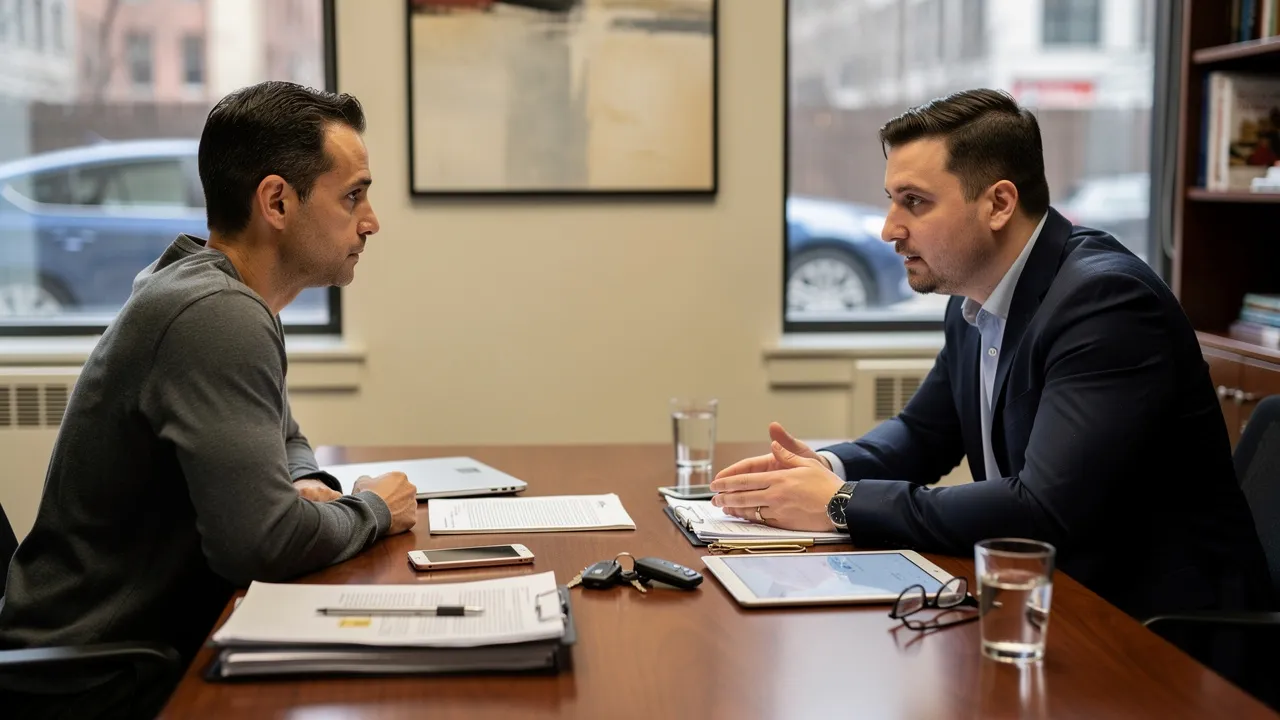
Decide whether an unresolved Lyft-crash question makes consultation useful
A Lyft crash consultation can be useful before you have proved who was responsible, identified every applicable insurer, or collected every medical record. The immediate purpose is narrower: organize what happened, identify what remains uncertain, and place insurance, treatment, evidence, and timing questions in front of counsel.
That approach matters after a crash in the Bronx or elsewhere in New York City because a rideshare collision can leave you dealing with several connected questions at once. You may know that you were a passenger, driver, or another person involved in the collision, yet still be unsure about the Lyft trip status, which insurer has received information, what treatment records exist, or how the crash has affected your work and daily life. You do not need to solve those questions before asking for a case-specific conversation.
A consultation is especially worth considering when one or more of these conditions applies:
- You are unsure which vehicle or insurance information should be connected to the No-Fault process.
- You were hurt but have not yet gathered the accident report, treatment records, or insurer correspondence.
- The sequence of events, trip status, or identity of the responsible party is disputed or incomplete.
- You are receiving medical care, missing work, or trying to track expenses while the claim questions remain open.
- You are approaching a time-sensitive insurance or evidence issue and do not know what should be handled first.
The goal is not to label your claim from a short description. The goal is to arrive with a clear factual snapshot and a short list of questions that can be answered after the relevant facts are reviewed. This article gives you a way to build that snapshot before you contact us.
Why Lyft crashes require a rideshare-specific review
A Lyft crash may require a transportation-network-company review rather than an automatic assumption that ordinary taxi or for-hire vehicle rules answer every question. New York guidance cited by the state Insurance Department treats transportation-network-company vehicles as a distinct category from taxicabs, livery vehicles, black cars, limousines, and other listed for-hire vehicles. The same guidance says that a transportation network company and its driver are not deemed to provide taxicab or for-hire vehicle service while operating under Article 44-B.
The cited guidance also states that transportation-network-company vehicles are intended to be exempt from the intercompany loss-transfer provisions in Insurance Law section 5105. That is a specific description of New York insurance treatment, not a conclusion about your coverage, fault, benefits, or case value. Your consultation should therefore focus on the facts that determine which legal and insurance questions need review.
Start with the trip phase. Write down what you know about whether the Lyft driver was waiting for a request, traveling to pick up a passenger, carrying a passenger, or involved in another part of the trip. If you were not in the Lyft vehicle, record your position in the crash and how the Lyft vehicle was involved. Do not turn a missing trip detail into a guess about coverage. Mark it as an open question.
A rideshare-specific review is useful for three practical reasons:
- The vehicle category matters. The state guidance identifies transportation-network-company vehicles separately from the listed taxi and for-hire categories.
- The trip facts need to be identified. The time, place, occupants, trip phase, and vehicles involved give counsel the starting points for reviewing the situation.
- The insurer question should remain open until the facts are examined. A Lyft name on an app screen does not, by itself, tell you which policy or claim route applies to every person involved.
Bring the trip receipt, ride information, screenshots, text messages, and other records that you already have. Their immediate value is factual: they may help show the trip description, timing, people involved, and communications surrounding the crash. They do not by themselves establish liability or coverage. Keep those conclusions for the case-specific review.
Overview
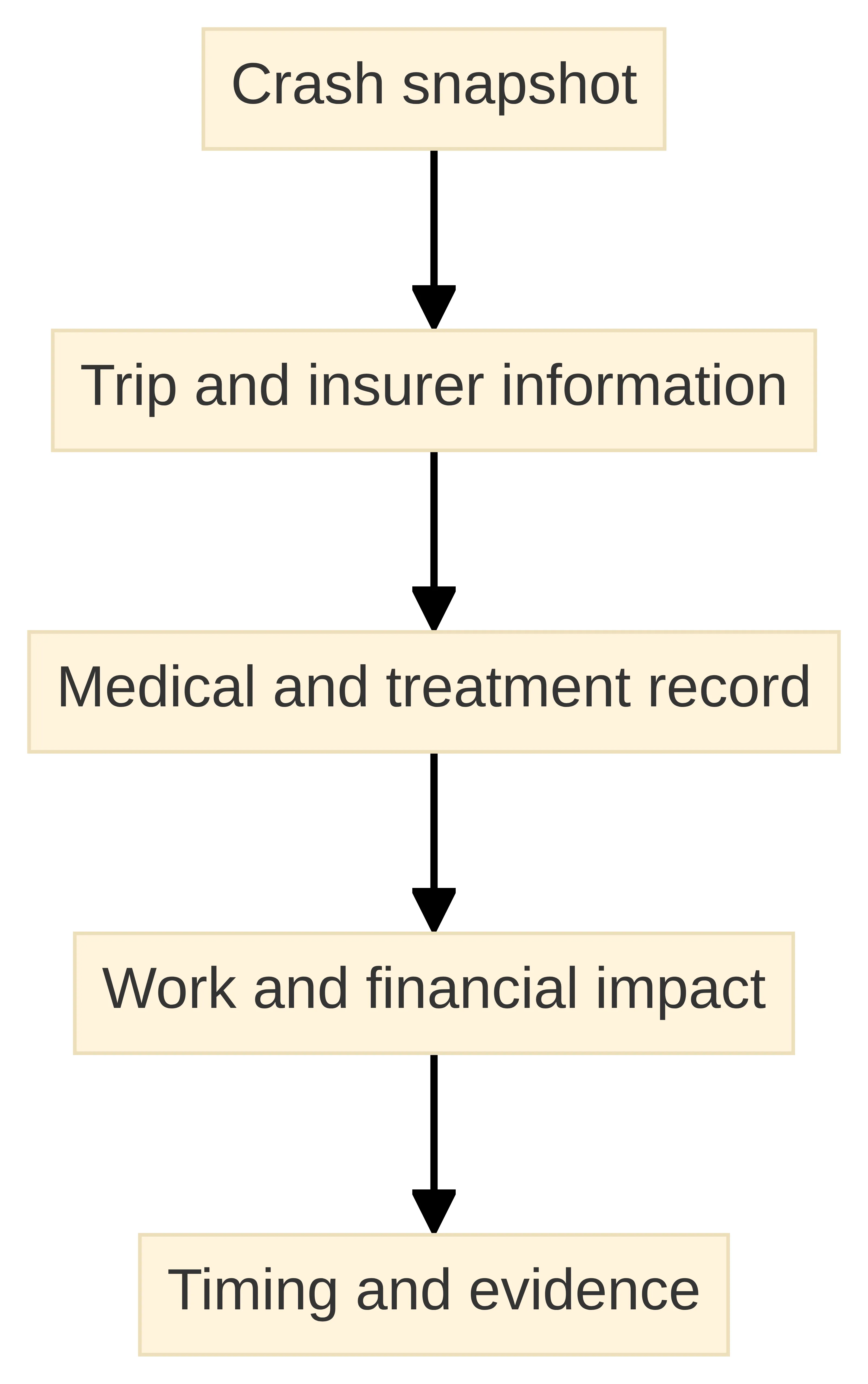
A useful consultation file can be organized into five connected parts. Each part answers a different question, so you can keep known facts separate from assumptions and unresolved issues.
- Crash snapshot: What happened, where it happened, when it happened, which vehicles and people were involved, and what you personally observed.
- Trip and insurer information: What the Lyft trip records show, which insurance names or claim numbers you have, and which policy questions remain unanswered.
- Medical and treatment record: What symptoms or injuries you reported, where you received care, what appointments are scheduled, and which records or bills are available.
- Work and financial impact: What work or activities changed, which dates you missed, and what pay or expense records you can gather without estimating figures you cannot support.
- Timing and evidence: The accident date, notice dates, correspondence dates, available photographs or video, and any records that may become harder to obtain with time.
Use the categories in this order when you prepare. The crash snapshot gives the conversation a factual base. The trip and insurer section identifies the route questions. The medical and loss sections show what has happened since the collision. The timing section keeps early deadlines and evidence concerns visible.
You do not need a polished legal theory. A dated list with clear labels is more useful than a confident conclusion that does not match the records. Write known information as fact, label an account as disputed when people describe it differently, and mark a missing document as missing. That structure lets the consultation address the open questions rather than spending the entire conversation reconstructing the basic timeline.
Build a factual Lyft-crash snapshot
A factual Lyft-crash snapshot should fit on a few pages and begin with the information you know firsthand. Start with the date, approximate time, and location. Identify the Bronx street, intersection, highway, parking area, or other place as precisely as you can. Note the borough or nearby New York City location if the crash occurred outside the Bronx.
Then write the event in sequence. Use short sentences rather than legal conclusions:
- Where were you immediately before the collision?
- Were you a Lyft passenger, the Lyft driver, an occupant of another vehicle, a pedestrian, or another person involved in the event?
- What movement did each vehicle make before contact, as you remember it?
- Where did the impact occur on the vehicles or roadway?
- What happened immediately afterward?
- Who remained at the scene, and who left before information was exchanged?
Add the trip details in a separate block. Record the pickup and destination if known, the approximate time the ride began, the name or identifying information shown for the driver and vehicle, and whether you have a receipt or trip history. If you do not know the trip phase or cannot access the account, write that plainly. Do not fill the gap with a theory about insurance.
Add a people-and-vehicles list. Include the Lyft driver, passengers, other drivers, pedestrians, witnesses, police or emergency personnel, and any vehicle owners identified in the materials you have. Record contact information only if you already possess it and can do so lawfully. Note whether an accident report, exchange-of-information sheet, photograph, video, or witness account exists.
The Law Offices of Evan W. Kohn’s consultation-preparation guidance advises bringing accident reports, medical-treatment records, and correspondence with insurance companies. Put those documents behind the factual snapshot, but keep your own account distinct from documents written by someone else. This gives counsel both your recollection and the records that may support, qualify, or contradict it.
Use three labels throughout the snapshot:
- Known: You saw it, received it, or can identify the record that shows it.
- Reported: Another person, an app record, police report, insurer, or medical provider supplied the information.
- Unknown or disputed: You need to locate the record, ask a witness, or have counsel evaluate conflicting accounts.
These labels are not admissions about fault. They are a way to prevent uncertainty from disappearing into a summary. A consultation can work with an incomplete account; it cannot work as efficiently when guesses are presented as established facts.
Separate missing records from disputed facts
Missing records and disputed facts are different problems. A missing record may exist but not be in your possession. A disputed fact means the available accounts or documents do not agree. Separating them helps you ask for the right kind of assistance.
Examples of missing records include an unavailable Lyft receipt, an accident report you have requested but not received, a medical bill still being processed, or an insurer letter that was sent to another address. Examples of disputed facts include different descriptions of the traffic signal, disagreement about where impact occurred, or uncertainty about whether a person was inside the Lyft vehicle at the time of the collision.
Create two columns before the consultation:
| Missing record or detail | Disputed fact or account |
|---|---|
| Lyft trip receipt is not accessible | Different accounts describe the vehicle movement differently |
| Police or accident report has not arrived | People disagree about who entered the intersection first |
| Medical records have not been received | The timing or severity of symptoms is described differently |
| Insurance correspondence is incomplete | The trip phase is unclear or reported differently |
The table is a sorting tool, not a finding about responsibility. A missing document may later clarify a disputed fact, and a document may still require interpretation. Keep both columns open. Do not delete information merely because it does not fit the first version of the event.
If you have already contacted an insurer, add the date, method, claim number, and a short description of what was requested or provided. Preserve the original correspondence. Avoid rewriting an insurer’s position in a way that makes it sound more definite than the actual letter. Bring the wording and your questions to counsel instead.
Preserve the information you already have
Preserving information starts with keeping what is already available in an organized form. Save accident photographs, videos, trip records, messages, emails, letters, bills, appointment information, and reports in a place where you can find them again. Keep the original files when possible and make a separate working copy for notes. Write down when you received each item rather than relying on memory later.
Our consultation-preparation guidance recommends practical crash steps that include staying at the scene when safe, checking on those involved, calling police, exchanging information, and documenting the incident. Apply those instructions to the facts that remain relevant after your crash. If the event has already happened, focus on gathering the records and accounts that still exist rather than trying to recreate information you do not have.
Use a simple preservation log:
- Item: What the file, message, photograph, or document is.
- Date received or created: When it came into your possession or was made.
- Source: Lyft, an insurer, a medical provider, police, a witness, or your own records.
- Location: Where the original and any working copy are stored.
- Related question: What part of the crash, injury, treatment, or loss it may help explain.
Do not annotate the original photograph or screenshot in a way that removes or changes the underlying information. Put explanations in a separate note. Do not forward private medical or identifying information more broadly than necessary. Bring the organized material to the consultation so you can discuss what each item is and what remains uncertain.
Look for evidence that can disappear from ordinary access: app details you can no longer open, messages in a phone thread, photographs stored on another device, dash-camera files, building or business video, and witness contact information. You do not need to decide whether an item will determine the case. Record that it exists or may exist, where it may be located, and what event it relates to. That gives counsel a concrete preservation question rather than a general concern that evidence might be missing.
Put New York No-Fault timing near the front of the conversation
New York Department of Financial Services guidance says a person injured in a motor-vehicle accident generally must give the No-Fault insurer written notice identifying the injured person and providing reasonably obtainable information about the accident’s time, place, and circumstances as soon as reasonably practicable and no later than 30 calendar days after the accident. The guidance also recognizes an exception when written proof provides clear and reasonable justification for late filing.
That is a time-sensitive issue to place near the beginning of a consultation. Write the accident date at the top of your file and make a separate list of any notice, claim, or insurer-contact dates. If 30 calendar days have passed, do not assume the question is settled. The cited guidance includes a written-justification exception, but whether it applies depends on the facts and the available proof. Bring the dates and explanation to counsel promptly.
For a New York crash, the same DFS guidance generally directs an occupant to file the No-Fault claim with the insurer of the vehicle the occupant was in. It separately directs a pedestrian generally to the insurer of the vehicle that struck the pedestrian. That general direction does not identify every policy question in a Lyft-related collision, so use your role in the crash as a starting fact rather than as a final answer.
Prepare this date sequence:
- Date and approximate time of the collision.
- Date and method of the first notice to an insurer, if any.
- Name of the insurer and claim number, if available.
- Date medical treatment began and dates of major follow-up care.
- Dates of letters, forms, requests, denials, or unanswered messages.
- Any approaching date that concerns you, with the document or reason behind it.
Do not wait to assemble a perfect file before raising timing. A short account with the accident date, your role, the insurer information you have, and the missing dates is enough to identify what needs prompt review.
New York Insurance Law section 5106 states that first-party and additional first-party benefits are paid as the loss is incurred. It states that a supported amount is overdue if it is not paid within 30 days after the claimant supplies proof of the fact and amount of loss. The statute also states that overdue first-party benefit payments bear interest at 2% per month and gives claimants an option to submit certain first-party-benefit disputes to arbitration.
Those statutory statements do not determine whether a particular payment is owed, whether the proof is sufficient, or whether a dispute fits the described process. Keep the bills, forms, proof of loss, insurer responses, and dates together. Ask counsel to apply the statute to the specific benefit and records involved.
Bring the insurer information without guessing which policy applies
Insurance information is useful even when it is incomplete. Bring every policy name, claim number, letter, email, text message, form, and recorded date that you already have. Separate the documents by source so you can tell whether a statement came from your own insurer, the Lyft driver’s insurer, another vehicle’s insurer, or a representative connected with the crash.
Use an insurer worksheet with these fields:
- Insurer name and contact information.
- Person or vehicle connected with the policy.
- Claim number and date opened, if one exists.
- Date of each call, message, letter, or form.
- What you were asked to provide.
- What you supplied and how you supplied it.
- Response received, or no response received.
- Question still unanswered.
Do not guess which policy applies simply because a name appears on the Lyft receipt or an exchange-of-information sheet. New York DFS guidance generally directs an occupant to the insurer of the vehicle occupied for a New York No-Fault claim, while the transportation-network-company guidance addresses the vehicle category separately. Those points give you questions to organize; they do not resolve every policy or liability issue in a Lyft crash.
Communicate with care by keeping your account accurate and limited to what you know. If you do not remember a detail, mark it as unknown rather than supplying an estimated time, speed, distance, or sequence as though it were certain. Keep copies of what you send and receive. When an insurer uses a term or asks for a document you do not understand, preserve the request and place it on your question list rather than silently assuming what it means.
Bring these insurer questions to the conversation:
- Which facts identify me as a passenger, driver, occupant, pedestrian, or another participant for the issue being reviewed?
- Which insurer has received notice, and what written confirmation exists?
- Does the available trip information leave a question about the Lyft vehicle’s role or trip phase?
- What proof of loss or treatment has already been sent?
- Which response dates or missing documents need attention first?
A focused question is safer than a conclusion such as the Lyft policy must cover everything or the insurer has denied the whole matter. Let the documents show what was actually requested, accepted, disputed, or left unanswered.
Organize treatment, work loss, and financial impact
Treatment records give the consultation a timeline for what happened after the crash. Start with the first report of pain or other symptoms, the first medical visit, emergency or urgent care if applicable, later appointments, referrals, testing, therapy, medication, and any scheduled follow-up. Record the provider, date, reason for the visit, and whether the record or bill is in your file.
Our consultation-preparation guidance specifically advises bringing medical-treatment records and correspondence with insurance companies. Put those materials in date order, but do not edit a provider’s description to make it match your own account. Add a separate note when your memory, a medical record, and an insurer letter use different descriptions. The difference is a question for review, not a reason to discard any of the documents.
Organize treatment information in four groups:
- Care received: Providers, facilities, dates, and types of visits.
- Care still planned: Appointments, referrals, therapy, testing, or prescriptions that you know about.
- Expenses: Bills, receipts, payment notices, and insurer correspondence connected with care.
- Daily effects: Activities, household tasks, transportation, sleep, or other functions that changed after the crash.
Do not promise yourself that a symptom, bill, or treatment course will produce a particular legal result. The purpose of this file is to give counsel a reliable account of the medical and practical consequences for review.
Track work and income effects with the same discipline. List the dates you missed, reduced hours, changed duties, or used leave. Gather pay statements, employer notices, schedules, time records, or other documents that show the change. If you work for yourself, collect the ordinary business or payment records that relate to the affected period. Do not estimate a total when you can label the figure as unknown and identify the record needed to calculate it.
Separate lost income from out-of-pocket expenses. Transportation to medical care, prescription costs, equipment, household help, or other payments should have their own entries with dates and receipts when available. The consultation does not require every amount to be final. It does require a clear distinction between a documented amount, an amount you are still gathering, and an effect you can describe but not yet measure.
A compact loss log can use these columns:
| Date or period | Work or expense event | Record available | Amount known? | Question for counsel |
|---|---|---|---|---|
| Date or week | Missed shift, reduced work, or changed duty | Pay or employer record | Yes, no, or pending | What should be included? |
| Date | Medical, transportation, or other expense | Bill or receipt | Yes, no, or pending | Which document is missing? |
| Ongoing period | Daily activity affected | Personal note or provider record | Not yet measured | How should it be described? |
The log is an organizing aid. It does not establish causation, eligibility, or the amount of any recovery.
Turn uncertainty into focused questions for counsel
A consultation becomes more useful when your questions point to a fact, document, or date. Bring the unresolved items from each section and group them by subject instead of asking only whether you have a case.
Trip and crash facts
- What facts about the Lyft trip, vehicle, occupants, location, and collision sequence need to be confirmed?
- Which parts of my account are known, reported by someone else, missing, or disputed?
- What photographs, video, app records, witness information, or reports should I identify or preserve?
Insurance and No-Fault
- Based on my role in the crash and the available documents, which insurer questions should be addressed first?
- What written notice or proof has already been supplied, and what date controls the next review?
- How should the 30-calendar-day No-Fault notice guidance be considered if notice was late or incomplete?
- Is there a first-party-benefit dispute, and what records show the amount or proof involved?
Medical care and losses
- Which treatment records, bills, and provider information should be added to the file?
- How should I document work dates, reduced duties, income records, and out-of-pocket expenses?
- Which symptoms or daily effects need a clearer timeline?
Next steps and boundaries
- Which missing document should I try to obtain first?
- Which insurer communication needs a response, and what information should accompany it?
- What facts remain too uncertain for a conclusion today?
- What should I preserve while the review continues?
The point of these questions is to expose the work still required. New York law and insurance rules can depend on the specific role, vehicle, notice, proof, and records involved. A clear list helps counsel explain which questions can be answered from the documents and which require additional investigation.
Key Highlights
Keep these points in view as you decide whether to arrange a conversation:
- You do not need to prove fault, coverage, or case value before organizing a consultation. Start with known facts, missing records, disputed accounts, and questions.
- A Lyft crash deserves a rideshare-specific review because New York guidance treats transportation-network-company vehicles as a distinct category from listed taxi and for-hire vehicles.
- Trip status is a factual checkpoint, not a conclusion. Record what the app, receipt, messages, witnesses, and your own memory show without guessing about coverage.
- Build the file in five parts: crash snapshot, trip and insurer information, treatment, work and financial effects, and timing or evidence.
- New York DFS guidance generally places an occupant’s No-Fault claim with the insurer of the vehicle occupied and says notice should be given as soon as reasonably practicable and no later than 30 calendar days, subject to the stated written-justification exception.
- Put the accident date, notice dates, claim communications, and proof of loss near the front of the file. Do not wait for every medical or financial record before raising a time-sensitive question.
- Keep insurer correspondence, accident reports, medical records, receipts, photographs, videos, trip information, and witness details organized in their existing form.
- Use a documented amount, pending amount, or unknown label for losses. Do not turn an estimate into a fact.
- Bring a short question list that asks what is known, what is missing, what is disputed, and what should happen next.
A consultation is a review of your particular facts, not a shortcut around the records. Good preparation makes the unresolved questions visible.
Request a consultation with the prepared information
The Law Offices of Evan W. Kohn serves clients in all five boroughs, Westchester, Putnam, Rockland, and Nassau counties, and New Jersey. We serve Bronx clients and can arrange home or hospital visits for clients who cannot travel.
Bring the crash snapshot, trip information, insurer correspondence, treatment records, work and expense log, and questions about timing. If you are still missing records, bring the list of what you requested and the dates involved. The conversation can begin with an incomplete file as long as the gaps are identified clearly.
A qualified attorney must decide how the law applies to your individual facts after reviewing the circumstances and available records. This guide cannot determine coverage, fault, a deadline, eligibility, or compensation for your situation. If your Lyft-related injury falls within our stated rideshare-accident scope, take the organized information to the next conversation rather than waiting for every uncertainty to disappear.
Questions to raise before requesting Lyft-accident legal review
What should I bring to a consultation with a Lyft accident attorney?
It’s important to bring relevant documents such as accident reports, medical treatment records, and any correspondence with insurance companies to enhance your evaluation during the consultation.
How long does a consultation typically last?
Consultations usually last between 30 to 60 minutes, depending on the complexity of your case.
What are the key factors to consider when preparing for a Lyft accident consultation?
Prepare a factual snapshot of the crash, gather trip and insurer information, organize medical treatment records, document work and financial impacts, and note any timing or evidence concerns.
What types of questions should I ask during the consultation?
Focus on questions that clarify your role in the crash, the status of your insurance claims, any missing documents, and what steps you should take next.
Can I receive a consultation if I am unable to travel?
Yes, The Law Offices of Evan W. Kohn can arrange home or hospital visits for clients who cannot travel.
What areas does The Law Offices of Evan W. Kohn serve?
The firm serves clients in all five boroughs of New York City, as well as Westchester, Putnam, Rockland, Nassau counties, and New Jersey.
Hurt like this?
We handle Rideshare & Taxi Accidents cases in the Bronx.
Evan W. Kohn, Esq. — more than 35 years of Bronx personal-injury practice. Reading about it only goes so far; a free consultation tells you what actually applies to your case.