
Motorcycle Accidents
NYC Motorcycle Accident: What to Do After a Crash in the Bronx and New York City
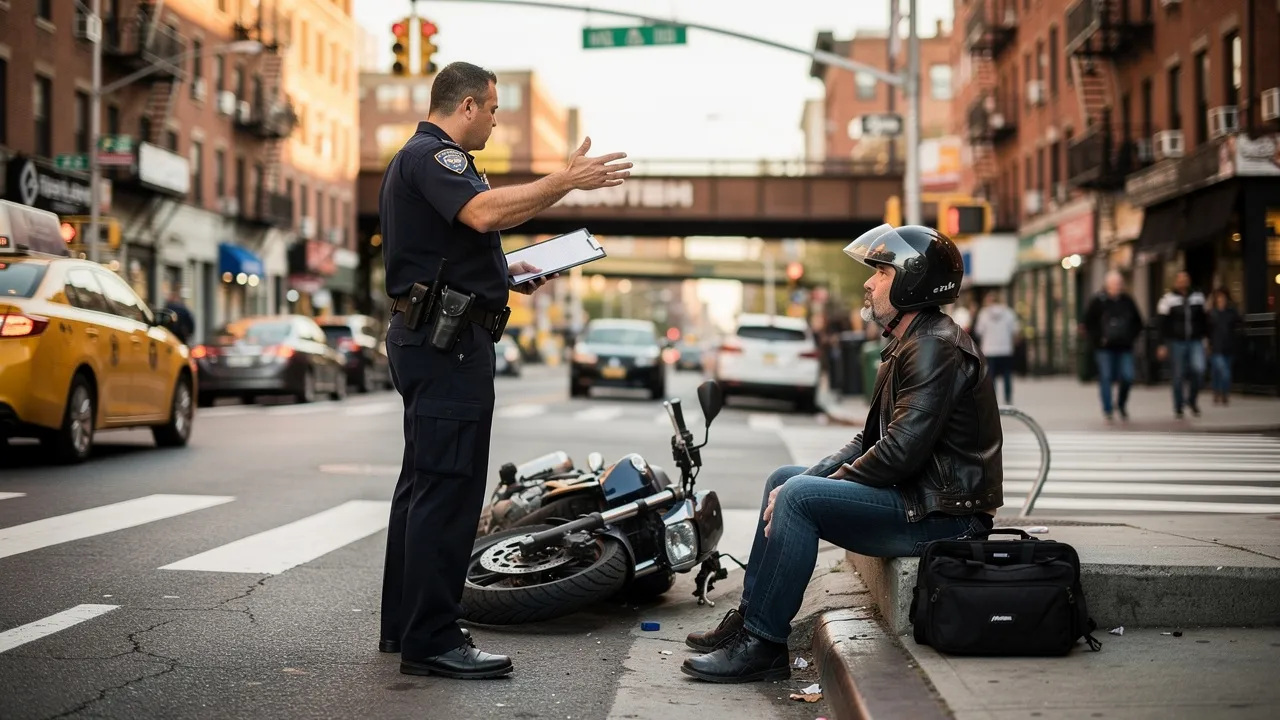
What should you do first after a Bronx motorcycle crash?
This guide helps you move through those steps before you deal with insurance, fault questions, deadlines, or legal assistance.
Get medical attention promptly. You may feel fine immediately after a motorcycle accident and later discover significant health issues hours or even days afterward. Internal bleeding, concussions, and soft tissue injuries may develop without immediate symptoms and can have serious long-term effects if left untreated.
Ask for police to come to the scene and file a report. Give a clear account of what happened, but do not guess about speed, distance, fault, or the extent of an injury that has not yet been evaluated. If you face immediate danger or life-threatening symptoms, contact emergency services or seek immediate emergency care before photographs, paperwork, or an insurer’s questions. If you are unsure what to do, contact a qualified professional or the responsible authority promptly.
Use this order:
- Move away from traffic or another immediate danger when you can do so safely.
- Obtain prompt medical attention, even if your symptoms seem limited at first.
- Ask police to attend the scene and prepare a report.
- Identify witnesses and preserve basic information without putting yourself back in danger.
- Avoid giving a substantive statement to the other driver’s insurer until you understand what is being asked and have considered qualified legal guidance.
Your health comes first. Evidence and insurance decisions can follow.
Broad NYC patterns can add context, but they do not decide what happened in your crash. An NYC analysis reports that driver inattention or distraction and failure to yield the right-of-way together caused 38% of motorcycle crashes in the analysis. The same analysis reports that June, July, and August accounted for 40% of motorcycle injury crashes, including 1,371 crashes during those three months.
That analysis also reports that 69% of motorcycle crashes occurred between noon and midnight, with 56% occurring after 3 p.m. These figures describe groups of crashes, not your individual circumstances. Start with your symptoms and immediate safety rather than trying to fit your crash into a general pattern.
What evidence should you preserve at the scene and afterward?
Your crash evidence includes more than a photograph of the motorcycle. Preserve the physical items, medical records, scene information, and communications that may later explain how the collision happened and how your injuries progressed.
If your condition and surroundings permit, record:
- The position of the motorcycle, other vehicles, traffic controls, lane markings, road surface, debris, and visible damage.
- Your helmet, riding gear, gloves, boots, and other equipment before cleaning, repairing, discarding, or altering them.
- Names and contact information for witnesses, along with what each person actually observed.
- Photographs of visible injuries as they change, provided taking them does not delay medical care.
- Discharge papers, imaging results, prescriptions, treatment notes, bills, and follow-up instructions.
- Messages, letters, claim numbers, recorded-message details, and notes about calls with insurers or other parties.
Preserve helmets, riding gear, photographs, and medical records before they are lost, discarded, or overwritten. Medical records can create a timeline of your injuries and help show how severe the damage was and how long it may continue. Keep original files when possible, and make a separate copy for working notes.
A report can be useful, but it is only one part of the record; photographs, witnesses, medical documentation, and physical evidence may address details the report does not resolve.
Timing can affect preservation. An NYC analysis reports that motorcycle crashes increased by 295% from winter to summer, reflecting increased warm-weather ridership and potentially less-experienced recreational riders. That pattern does not identify fault in a particular crash, but it reinforces the need to record the date, time, weather, lighting, traffic, and road conditions while those details are still available.
Published NYC payout figures also appear in some accident discussions. One source reports average motorcycle-accident payouts ranging from $150,000 to $500,000, median trial verdicts around $287,000, and minor claims closer to $25,000. Those are reported figures, not a valuation of your injuries or a substitute for preserving the underlying record.
How should you respond when an insurer contacts you?
Motorcycle insurance in New York does not work exactly like ordinary car coverage. New York Insurance Law §5102 excludes motorcycles from the definition of motor vehicle, so no-fault rules treat motorcycle riders differently from drivers. A New York motorcycle-insurance source likewise explains that motorcycle accident insurance differs sharply from standard auto coverage.
Do not assume that the no-fault process for a car will pay motorcycle-related medical bills in the same way. Identify every policy that may be involved, including the motorcycle policy, the other vehicle’s policy, and any policy connected to an owner or business vehicle. Coverage questions depend on the facts and policy terms.
When an insurer calls, take these steps:
- Ask for the caller’s name, company, claim number, and contact information.
- Ask whether the call is being recorded before answering substantive questions.
- Do not guess or minimize your symptoms.
- Do not agree that you caused the crash.
- Do not sign a release or accept a settlement before you understand what rights it may affect.
- Keep a written record of the call and any documents sent to you.
We recommend that motorcyclists contact a lawyer before making any statements to the driver’s insurance company. That recommendation concerns substantive statements about the crash, your injuries, and your claim. It does not prevent you from seeking emergency medical care or reporting basic identifying information.
Helmet questions may also arise during an insurance call. The National Highway Traffic Safety Administration estimates that helmets are 37% effective in preventing deaths of motorcycle operators and 41% effective for passengers.
Keep the helmet and related gear. Do not send them to an insurer or discard them simply because someone says they are unnecessary. Medical records, photographs, and the physical helmet may become relevant when the discussion turns to the nature or severity of an injury.

How can helmet use, driver conduct, and vehicle defects affect the claim?
Crash cause and injury severity are related questions, but they are not the same question. Evidence about traffic movement, visibility, right-of-way, vehicle condition, and road conditions addresses how the crash happened. Medical records, imaging, treatment notes, and the condition of your helmet and gear address what the crash caused.
In two-vehicle fatal crashes, 75% of the motorcycles involved were struck from the front, and multi-vehicle crashes frequently involve the other driver’s failure to see or yield to the motorcycle. That national pattern does not establish what happened in a Bronx intersection, lane change, or turn. Use it as a reason to preserve scene evidence, not as a conclusion about fault.
A motorcycle accident claim may involve the motorcyclist, the other motorist, or a manufacturer when a product defect caused or contributed to the accident. A tire blowout, steering issue, or defective brake may raise a different evidence path from a driver’s failure to yield. Keep the motorcycle in its post-crash condition until the relevant issues have been documented and evaluated.
Helmet use may affect how injury severity is evaluated, but it does not by itself resolve the claim.
Medical records, imaging studies, and expert opinions can become central to disputes over whether helmet use affected injury severity. Preserve the helmet, photographs, and treatment records. Do not make your own medical conclusion about whether helmet use caused or worsened a particular injury.
New York’s general comparative-fault rule is described as follows: your own culpable conduct does not automatically bar recovery, but your damages are reduced in proportion to your assigned fault. That means an allegation about speed, lane position, licensing, helmet use, or another action does not by itself answer the claim; the assigned share of fault matters.
A separate published law-firm source says that, as of May 26, 2026, New York enacted tort reform barring recovery in motor-vehicle personal-injury actions for a plaintiff found more than 50% at fault. Because that reported change is consequential, place it on your list of issues for prompt, case-specific review rather than relying on a general online explanation. Preserve evidence that bears on both the crash cause and the claimed injury.
What do published motorcycle settlement figures actually tell you?
Published motorcycle settlement figures show wide variation rather than a reliable price for a particular crash. A New York law-firm source reports general settlement ranges from $25,000 to $5,000,000, depending on injury severity, liability, available insurance coverage, medical documentation, and the long-term impact of the crash.
The same source says settlements for what an insurance company determines are minor injuries generally fall in the $5,000 to $100,000 range. It says severe and catastrophic injuries commonly reach $750,000 to $2,000,000 or more. Those descriptions reflect how that source groups cases; they do not tell you how an insurer, court, or lawyer will evaluate your facts.
The useful question is not which headline number looks familiar. Ask what facts drive the number:
- How serious are the injuries, and what treatment or recovery period do the medical records show?
- Is fault disputed, and what evidence addresses the rider’s conduct and the other driver’s conduct?
- Which insurance policies and coverage limits may be available?
- Do the records document medical care, lost work, continuing limitations, and other claimed losses?
- Did the crash involve a left turn, rear impact, lane change, hit and run, road condition, or possible vehicle defect?
- Is the long-term effect of the injury known, or is treatment still developing?
Reported settlement ranges are not a typical out-of-pocket cost or a fee quote: actual costs include medical bills, documented lost work, and other crash-related expenses, while any settlement depends on injury severity, liability, coverage, documentation, and long-term impact. To estimate your own documented costs, gather medical bills, records of lost work, and other actual expenses, then review the insurance coverage that may apply. Verify coverage-specific amounts with the insurer or a qualified professional. Use reported figures to understand why settlement value varies, then organize the facts that a qualified review would need.
How common are NYC motorcycle accidents, and who do they affect?
NYC motorcycle crash statistics describe a smaller vehicle group with a disproportionate share of traffic fatalities. Motorcycles are 2% of registered vehicles in New York City but are involved in 14% of all traffic fatalities. An NYC analysis reports a motorcycle fatal-crash rate of 89 per 100,000 registered motorcycles in NYC, compared with 46 per 100,000 in New York State and 56 per 100,000 nationally.
The same analysis reports that 56% of motorcycle rider fatalities in NYC involved riders under age 35, while 43% of fatality cases involved riders who were not properly licensed to operate a motorcycle. Those figures describe fatality populations, not the likely outcome of an injury claim and not the circumstances of your crash.
NYC recorded 35 motorcycle fatalities in 2025, a 10% decrease from 2024 and a 26% decrease from the 2023 peak of 47 fatalities. These are past citywide totals. They can provide context for the risks of urban riding, but they cannot establish fault, injury severity, insurance coverage, or compensation in an individual case.
Your next step should remain practical: obtain medical care, preserve the crash record, and identify the insurance and deadline questions that apply to your own collision.

Which deadlines and claim procedures require prompt attention?
Deadlines depend on who may be responsible and what type of claim you may have. Put the crash date, the date any report was filed, and every insurer contact on a calendar. Then sort the claim by defendant and procedure rather than relying on one general deadline.
Start with these checkpoints:
- A Notice of Claim is required before filing a lawsuit against a municipal or public entity for covered personal injury, property damage, or wrongful-death claims.
- Under the cited New York General Municipal Law provisions, a Notice of Claim generally must be served within 90 days after the accident or other event forming the basis for the claim.
- At least 30 days must elapse after a proper and timely Notice of Claim is served before a covered lawsuit against the government entity can begin.
- A personal-injury lawsuit against a driver for serious injuries generally must be filed within 3 years in New York.
These time periods measure different actions. The 30-day collision-report period concerns access to a report. The 90-day period concerns a Notice of Claim against a covered government entity. The 3-year period concerns a general lawsuit against a driver for serious injuries.
Government involvement can change the path. A crash involving a City vehicle, a public agency, a public road condition, or another government-related defendant may require a Notice of Claim before a lawsuit. A court may permit a late Notice of Claim in some circumstances, but the outside limit for an extension is one year and 90 days after the incident or event.
For a late Notice of Claim, the court may consider actual knowledge of essential facts, minority or incapacity, reliance on settlement discussions, an excusable identity error, and prejudice to the government’s defense. Those factors do not create an automatic extension. If a government entity, road defect, or public employee may be involved, treat the deadline question as an early issue and obtain a qualified review of the specific claim.

When should you seek a professional evaluation?
A professional evaluation may be useful when an unresolved issue could affect evidence, coverage, fault, or timing. Consider prompt review if:
- Your injuries are serious, continuing, or not yet fully understood.
- The other driver or insurer disputes how the crash happened.
- Helmet use, licensing, speed, lane position, or another rider action is being raised against you.
- The vehicle that caused the crash is unknown, uninsured, or connected to a business.
- A pothole, debris, road design, or other public condition may have contributed.
- A vehicle part may have failed or a product defect may be involved.
- You received a request for a recorded or substantive statement.
- A government vehicle, agency, or public road may be part of the claim.
- Evidence is missing, damaged, or at risk of being discarded.
- You are unsure which deadline applies.
A road-defect or hazardous-condition crash may involve a pothole, debris, or unsafe road design. One published source reports a general settlement range of $100,000 to $2,000,000 or more for that category and notes that shorter filing deadlines apply. Treat the possible deadline as the immediate issue, not the reported range.
A hit-and-run crash creates a different evidence and coverage problem because the at-fault driver leaves the scene. One published source reports a general range of $25,000 to $500,000 for hit-and-run cases and says recovery depends heavily on uninsured-motorist coverage. That range does not answer whether coverage exists in your situation.
Preserve photographs, witness information, the police report, vehicle descriptions, nearby-camera information, medical records, and every insurer communication. A focused evaluation can help identify which unanswered question deserves attention first.
What should you bring to a motorcycle-crash consultation?
Bring an organized file rather than trying to remember every detail during a conversation. Include:
- A one-page timeline with the crash date, location, vehicles, police response, medical visits, insurer calls, and work interruptions.
- Photographs and videos of the scene, motorcycle, other vehicle, road conditions, helmet, gear, and injuries.
- The collision-report information and witness names or contact details.
- Medical records, imaging reports, prescriptions, bills, treatment instructions, and upcoming appointments.
- Insurance policies, claim numbers, letters, emails, recorded-message details, and proposed releases.
- Pay records or other documents that show time away from work, if lost work is part of your concern.
- Questions about fault, helmet evidence, coverage, possible vehicle defects, government involvement, and deadlines.
We investigate cases by gathering police reports, photos, witness statements, and medical records. We serve clients in the Bronx and can arrange visits to you at home or in the hospital if you cannot travel. We offer free consultations, operate 24/7, and only charge if you win.
Use the discussion to identify what remains unresolved. Ask which evidence addresses the crash cause, whether more than one insurance policy may apply, whether helmet or comparative-fault issues need medical proof, and whether a government entity or road condition changes the procedure. Ask which dates matter and what must be preserved immediately.
You can also use the crash pattern to frame focused questions. A rear-end collision occurs when a rider is struck from behind while stopped or slowing; one published source reports a general settlement range of $50,000 to $500,000 for that category. A lane-change or sideswipe crash occurs when a driver merges into a rider’s lane without checking; the same source reports a general range of $75,000 to $600,000. Those figures are categories from a published source, not answers about your claim.
If a Notice of Claim may be required, ask about the general 90-day service period after the accident or other event and the procedure that applies to the possible government defendant. Bring the exact accident date so the discussion can begin with dates rather than estimates.
How can you request a consultation with the organized file?
After a Bronx or New York City motorcycle crash, organize the facts that need an answer: your medical timeline, scene evidence, insurer communications, possible fault issues, available coverage, and every deadline you have identified. A concise file makes it easier to focus on what must happen next and what remains uncertain.
This is general information, not legal advice. A qualified New York lawyer must decide how the law applies to your specific facts, injuries, insurance, and deadlines.
Bring the organized file and your questions to a focused discussion about the next step.
What should you ask before discussing your motorcycle-crash claim?
What insurance may apply if the driver who hit me is uninsured or cannot be identified?
If the striking vehicle is unknown or uninsured, you may be able to seek coverage through an auto policy held by a household family relative. If no household auto policy exists, the New York Motor Vehicle Accident Indemnification Corporation may be involved. Report the crash and review the available policies promptly because coverage depends on the facts and policy terms.
Does New York no-fault insurance cover motorcycle-crash medical bills the same way as car insurance?
Not necessarily. New York law treats motorcycles differently from ordinary motor vehicles for no-fault purposes, so you should not assume a car driver’s process will cover your medical bills in the same way. Identify every potentially relevant policy and obtain qualified guidance about the bills and coverage involved.
What happens if a motorcycle crash involves a City vehicle, public agency, or road defect?
A claim against a municipal or other public entity may require a Notice of Claim before a lawsuit. Under the cited New York rules, that notice generally must be served within 90 days after the accident or event, and at least 30 days must pass after service before the lawsuit begins. Treat possible government involvement as an early deadline issue and verify the applicable procedure promptly.
Can I still have a motorcycle injury claim if I was not wearing a helmet?
Possibly. New York requires motorcycle operators and passengers to wear qualifying helmets, and a violation is a traffic infraction. Not wearing one may affect how injury severity or fault is evaluated, but it does not automatically eliminate a claim; medical records and other evidence may be important in assessing the issue.
Hurt like this?
We handle Motorcycle Accidents cases in the Bronx.
Evan W. Kohn, Esq. — more than 35 years of Bronx personal-injury practice. Reading about it only goes so far; a free consultation tells you what actually applies to your case.