
Slip & Fall
What Is a Slip and Fall in the Bronx? An Evidence Map for Unsafe-Premises Injuries
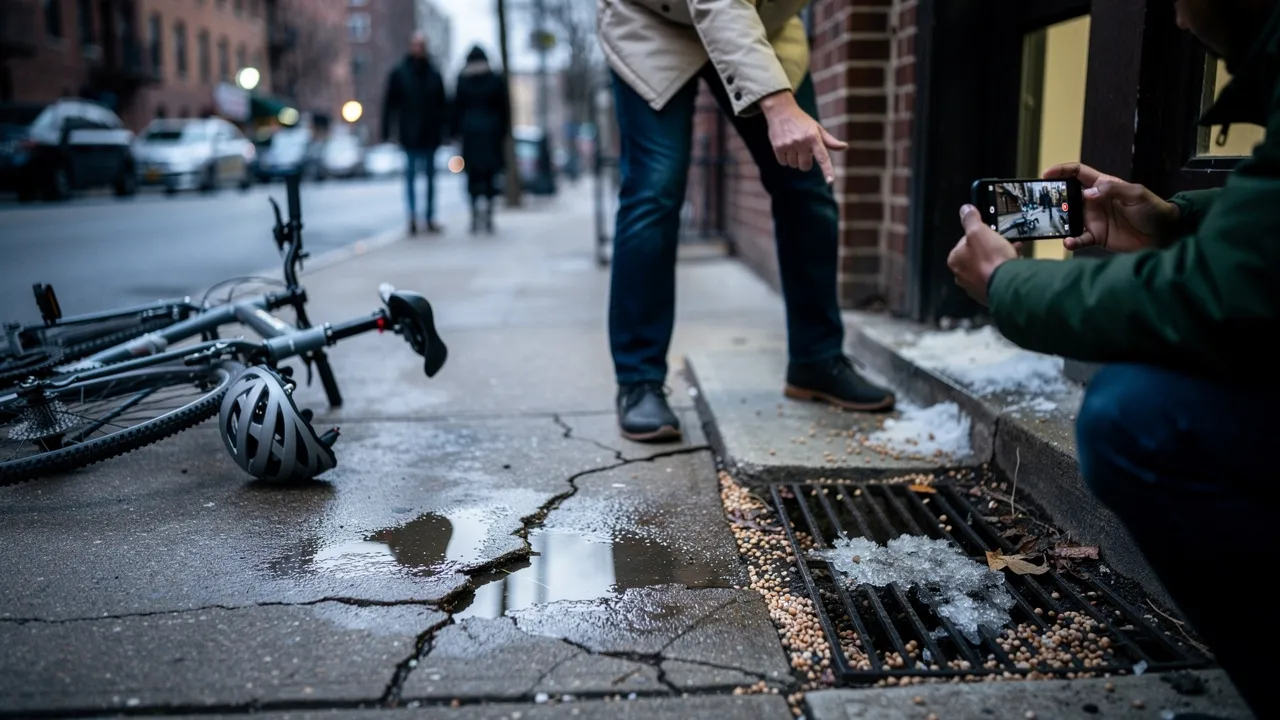
What a Bronx slip and fall can involve—and what to preserve first
Use five connected questions to organize what happened:
- Fall: What movement occurred, and where were you when you lost balance?
- Hazard: What condition was on or affected the walking surface?
- Notice: Who may have known, or should have known, about the condition before the fall?
- Causation: How does the condition connect to the fall rather than merely exist nearby?
- Injury: What medical care and records document the harm you experienced?
Do not try to answer every question from memory alone. Start by preserving the scene, identifying witnesses, recording the location, and collecting medical information while the details remain available.
Separate the fall from the hazardous condition
A hazardous condition is the physical feature that may have caused you to slip, trip, lose balance, or fall. In a Bronx store, that could be water near an entrance or a slick area in a produce aisle. On a sidewalk, it could be ice, a hole, a crack, or another defect. Indoors, soap, oil, or a recently mopped floor may matter, particularly when there is no adequate warning or barrier to help you avoid the slippery area.
The condition and the fall are related but separate parts of your account. Write down exactly where your foot was, what you felt or saw, and how the surface looked before you moved away. If fallen food created a slick area, record that detail. If a broken step or uneven surface contributed to the loss of balance, describe its location and appearance. Specific descriptions are more useful than a general statement that the floor was unsafe.
A dangerous condition may be relevant without establishing who is legally responsible. The NYC Bar describes a store spill as potentially significant when the owner knew or should have known about the water and did nothing to clean it before the fall. That example identifies a question about knowledge and response; it does not decide what happened in your incident.
Separate these questions in your notes:
- What was on, under, or beside the walking surface?
- How did that condition affect your movement?
- Was there a warning, barrier, cleanup effort, or other response?
- What injury followed?
That separation keeps a visible hazard from being treated as a complete legal conclusion.

Connect the hazard to notice and surrounding conditions
Notice asks what the property owner or responsible party knew, or should have known, about the condition before you fell. A store’s water spill may matter when the owner knew or should have known about it and did nothing to clean it before the fall. Your evidence map should therefore include more than the fact that water was present. Record when you noticed it, whether it appeared fresh or established, whether employees or other people were nearby, and whether anyone reported or addressed it.
Treat those details as questions to investigate, not answers you must prove from your first recollection. A witness may have seen the condition earlier. A store report may record a complaint. A photograph may show the area after the fall. Each item can help place the hazard in time and location.
A New York court found that evidence of wet steel, snow on the ground, and rapidly increasing temperatures raised questions about constructive notice of slippery work-site conditions. The example involved a work site and a beam, not an ordinary Bronx store or sidewalk. Its practical lesson is narrower: surrounding conditions can help show how a slippery condition developed and whether it may have existed long enough to be discovered.
For your incident, preserve the surrounding facts without turning them into a conclusion. Note recent weather, melting or refreezing, cleaning activity, construction, lighting, foot traffic, and changes made after the fall when those details are part of what you observed. Then connect each detail to a source: your own photograph, a witness, a report, or another record.
Route Bronx sidewalk falls through the property and condition questions
A Bronx sidewalk fall requires you to identify both the condition and the property arrangement around it. Under NYC Administrative Code § 7-210, an abutting property owner may face liability for negligent failure to maintain a public sidewalk in a reasonably safe condition. That rule frames a legal question; it does not identify the responsible party in every sidewalk fall.
Start your record with the exact location. Save the street address or nearest intersection, identify the side of the sidewalk, and photograph the condition in relation to the building, curb, entrance, and nearby features. Note whether the surface was cracked, raised, icy, wet, obstructed, or otherwise difficult to use. Preserve the date and time as accurately as you can.
The cited NYC sidewalk-liability rule exempts one-, two-, or three-family residential property that is partly or wholly owner occupied and used exclusively for residential purposes. Whether that description applies depends on facts about the property, its use, and its ownership. Do not assume that a building’s appearance answers those questions.
Snow and ice create another condition question. A property owner may face liability for a snow or ice condition when snow or ice removal made the natural condition more hazardous or a special use caused the defect. That is narrower than saying that every icy sidewalk creates responsibility. Preserve what you saw, including the ice pattern, nearby snow, drainage or melting signs, and any evidence of removal, while leaving the legal application for individualized review.
Match the condition to evidence instead of speculation
A condition becomes easier to evaluate when each important part of your account has a source. The cited New York decision states that speculation alone may be insufficient and required admissible evidence connecting snow removal to the sidewalk condition. If you believe shoveling, plowing, salting, or another effort caused or worsened the ice, identify what supports that connection instead of relying only on what seems possible.
Evidence that may help connect snow removal to an icy sidewalk condition includes witness testimony, photographs, meteorological evidence, or expert proof. You may not have every type of evidence. Start with what you can preserve promptly and label it with the location, date, and what it shows.
Use the evidence map as a working checklist:
- Put each photograph beside the condition it depicts.
- Write each witness’s name and what that witness may have seen.
- Keep weather information with the date and location it concerns.
- Separate what you personally observed from what another person told you.
- Mark questions that remain unresolved rather than filling them with guesses.
This approach helps distinguish a documented connection from an assumption. It also shows which part of the incident needs more information before anyone can assess responsibility.
Preserve the scene before the condition changes
A wet floor may be cleaned, ice may melt, a broken step may be repaired, and clothing may be washed before the incident is evaluated. We recommend taking practical preservation steps after a fall:
- Photograph the hazard and surrounding area. Include the cause of the injury, such as a broken step or wet platform, along with enough surrounding detail to show where it was.
- Report the fall to the appropriate authority. Keep the date, location, person contacted, and any report or reference information you receive.
- Record witness information. Note witnesses’ names and phone numbers while those details are available.
- Preserve the shoes and clothes involved. Keep them in the condition they were in after the incident rather than discarding or altering them.
- Get medical care. Keep the records connected to the treatment you receive.
- Speak with a lawyer before talking to an insurance company. This is part of the preservation guidance we provide for slip-and-fall incidents.
The first photograph does not need to answer the legal question. Its immediate job is to preserve what the area looked like. Take a wider view that shows the location and closer views that show the surface, object, liquid, ice, crack, step, or other condition. Note whether the scene changed before you could take the photographs.
Record witness names and phone numbers separately from your description of what they may know. Keep the shoes and clothing with the rest of your incident file. These simple steps give you a clearer starting record when the property condition is no longer the same.
Build the incident and injury record
An incident record should connect the place, condition, fall, witnesses, and injury without blending separate facts together. Write a short timeline while you remember it:
- where you were going and the exact place where you fell;
- what you saw or felt on the walking surface;
- how you lost balance and where you landed;
- who was present or who responded afterward;
- what report was made and to whom; and
- what medical care followed.
Use your own observations for the scene and identify information that came from a witness, employee, family member, or record. Avoid improving the story after the fact. A clear account can include uncertainty, such as not knowing how long a spill was present or who controlled the area.
We investigate cases by gathering police reports, photographs, witness statements, and medical records. Those materials organize different parts of the evidence map: reports may preserve an account of the event, photographs may show the condition, witnesses may add observations, and medical records document the care connected to the injury.
Keep the materials together in a dated folder or digital file. Add the address, incident date, and a short description to each item so you can locate it later. Do not treat the existence of a medical record, photograph, or report as proof of liability by itself. Each record answers a different question, and the connection among them still requires case-specific evaluation.
Verify whether a municipal notice requirement may apply
A sidewalk or premises fall may involve a municipal claim, so identify the property connection early. For the municipal claims addressed by the New York court instruction, a Notice of Claim generally must be served within 90 days after the claim arises, usually the accident date for a slip and fall. That timing applies to the municipal claims covered by the instruction; do not treat it as a universal deadline for every unsafe-premises incident.
If a city-owned location, municipal facility, or other public entity may be involved, treat the timing question as urgent and seek individualized legal guidance. Write down the exact location, the date of the fall, the public agency or property information you have, and any report made at the scene. A later assumption about ownership should not replace an early review of the location.
The court instruction says a Notice of Claim must be written, notarized, and include the claimant information, claim nature, time, place, manner, and claimed injuries or damages as practicable. In practical terms, preserve the details needed to describe:
- who was injured and any attorney information;
- what happened and what condition is being identified;
- when and where the incident occurred;
- how the fall occurred; and
- the injuries or damages known at that time.
Do not wait for a general article to determine whether the rule applies to your location or claim. A qualified professional can assess the public-entity question, the applicable notice requirement, and the facts needed for a particular filing.
Know when the facts call for individualized review
A fall alone does not establish liability; the incident’s facts and applicable New York law require case-specific evaluation. Individualized review may be useful when the hazard has disappeared, the property owner or controlling party is unclear, witnesses disagree, a municipal connection is possible, or the link between the condition and injury is disputed.
Bring the unresolved questions forward instead of trying to force a yes-or-no answer:
- What exact condition caused or contributed to the fall?
- Who owned, occupied, maintained, or controlled the area?
- What evidence shows when the condition appeared or how it developed?
- What records connect the fall to the injury and medical care?
- Does a municipal notice issue or another timing rule require prompt attention?
These questions do not predict eligibility, responsibility, or value. They identify the issues that a case-specific review must address.
If your file is incomplete, preserve what you have and list what is missing. A consultation can focus on the evidence map rather than on a broad description that the property was unsafe. Bring photographs, witness details, reports, clothing and shoes, medical records, and your timeline when available. If travel is difficult because of your injury, note that when arranging the conversation.
Bring the evidence map to a Bronx consultation
The Law Offices of Evan W. Kohn handles slip-and-fall cases involving unsafe conditions in stores, commercial properties, or broken or overcrowded sidewalks. We provide legal help for clients injured in slip-and-fall accidents in the Bronx and New York City. We offer free consultations and operate 24/7, and we can arrange visits at home or in the hospital when travel is difficult.
Bring the five questions together: identify the fall, describe the hazard, preserve facts that may bear on notice, connect the condition to what happened, and organize the injury record. That evidence map cannot decide liability on its own, but it gives you a more useful account of the incident and highlights the issues that need attention.
This article provides general information, not legal advice. A qualified lawyer must evaluate whether the facts and applicable law support a particular claim. Put your photographs, witness details, reports, clothing and shoes, medical records, and unanswered questions together so the conversation can focus on what happened.
Questions to resolve about a Bronx slip-and-fall incident
Is every fall considered a slip and fall?
No. A slip-and-fall incident generally involves an injury caused by a dangerous condition on an indoor or outdoor walking surface, such as water, ice, oil, soap, a hole, crack, or another defect. A fall without a hazardous walking-surface condition may require a different analysis.
Does the 90-day Notice of Claim deadline apply to every Bronx premises fall?
No. The 90-day period generally applies to the municipal claims addressed by the New York court instruction, with the claim usually arising on the accident date. It is not a universal deadline for every fall involving a private property owner. If a city-owned location, municipal facility, or other public entity may be involved, verify the applicable requirement promptly.
What if the hazardous condition disappeared before it could be investigated?
Preserve what remains of the evidence. Keep photographs, the exact location and timing, witness names and phone numbers, any incident or police report, the shoes and clothing involved, and medical records. Note whether the area was cleaned, repaired, melted, or changed before photographs or reporting occurred. These materials can help organize questions about the condition, notice, the connection to the fall, and the injury.
What facts may matter after an ice-related sidewalk fall?
Record the exact location, the ice pattern, nearby snow, signs of melting or refreezing, drainage, and any shoveling, plowing, salting, or other removal activity. Photographs and witness information may help connect a removal effort to the sidewalk condition. An icy sidewalk alone does not establish responsibility, and the property arrangement and applicable New York law require case-specific evaluation.
Hurt like this?
We handle Slip & Fall cases in the Bronx.
Evan W. Kohn, Esq. — more than 35 years of Bronx personal-injury practice. Reading about it only goes so far; a free consultation tells you what actually applies to your case.