
Wrongful Death
Should You Contact a Wrongful Death Lawyer in New York? A Bronx Consultation Decision Guide

Begin with the consultation decision, not a conclusion about the claim
A consultation decision after a family member’s accident-related death does not require you to reach a legal conclusion first. You may still be sorting out what happened, who may be responsible, whether an estate representative has been appointed, and which deadlines apply. Those unresolved questions are a reason to organize the facts and seek a case-specific conversation, not a reason to decide that no legal review is available.
A wrongful death lawyer can examine the event, the potential defendant, the estate’s status, and the timing together. Your first task is narrower: decide whether a New York consultation would help you identify the route, the person who may bring the action, and the information still needed. You do not need a complete file before making contact.
The most useful starting questions are practical:
- Did the death follow an accident, alleged negligence, or another event that may require legal review?
- Has an estate representative been appointed, or is that still unresolved?
- Was a city, county, town, school district, New York State agency, or another public body involved?
- When did the death occur, and when was the estate representative appointed, if applicable?
- Has a criminal case begun concerning the same event?
The answers do not decide eligibility, liability, value, or outcome. They help you present the facts in a way that allows a New York lawyer to identify the issues that need attention first.
A useful consultation has two separate purposes. The first is legal orientation: you can learn which person or representative may be able to pursue a claim and which defendant-specific rules may apply. The second is preparation: you can give the lawyer dates, records, names, and unanswered questions without trying to prove the case yourself.
That distinction matters in the Bronx and elsewhere in New York City. An event involving a private person or business may raise a different timing question from an event involving a municipality or New York State. The same incident may also have an estate issue, an insurance trail, medical records, and family information that must be assembled from different places.
Use the rest of this guide as a decision path. First understand the general structure of a New York wrongful-death action. Then separate the estate representative’s filing role from the family’s interests, put the ordinary period on your calendar, and check for public-entity or criminal-case complications. Finish by preparing a compact packet and a focused list of questions. If those steps reveal timing uncertainty or an unresolved filing issue, contacting a lawyer promptly is a sensible next action.
Understand what New York generally means by a wrongful-death action
A New York wrongful-death action is generally an action maintained by the duly appointed personal representative of a person who died, when the decedent is survived by distributees, against a person who would have been liable to the decedent if death had not occurred. That statutory structure makes the action different from a family conversation about what happened. It connects the death, the alleged wrongful conduct, the estate, and the person authorized to maintain the action.
The phrase personal representative refers to the person formally appointed to act for the estate in the action. The representative’s appointment and the estate’s circumstances therefore belong near the beginning of your consultation, even if another family member has been handling medical, financial, or funeral arrangements.
The phrase distributees also appears in the statute. You do not need to decide from that word alone whether you or another family member has a legally recognized interest. Give the lawyer the family and estate information available, including whether there is a will, who has been appointed, and which relatives may be involved in the estate.
The general legal question is not simply whether a death followed an accident. The relevant review asks whether the facts may support a claim against a person or entity that would have been liable to the decedent for the underlying wrongful act, neglect, or default if the death had not occurred. That question requires facts about the event and the potential defendant, not only the medical outcome.
A consultation can also separate several issues that are easy to blend together:
- The event: what happened, where, and when.
- The potential defendant: a private person, business, municipal body, New York State, or another entity.
- The estate: whether a personal representative has been appointed and what estate documents exist.
- The family: which relatives or distributees may have relevant information or interests.
- The timing: which period applies and what event starts it.
Those categories give you a workable description without requiring you to label the conduct negligent or predict whether a claim will succeed. Bring the facts as you understand them, including uncertainty and conflicting accounts. A lawyer can then determine which legal questions require closer analysis.
Separate the family’s interest from the filing role
The personal representative generally brings a New York wrongful-death action when the statutory requirements are met. That filing role is separate from the many ways family members may be involved after a death. You may have information about the accident, medical treatment, insurance, employment, household finances, or the decedent’s relationships even if you are not the appointed representative.
Do not assume that the person who knows the most about the event is also the person authorized to maintain the action. Do not assume that being a close relative, beneficiary, or next of kin answers the filing question by itself. The statute identifies the duly appointed personal representative, and the specific estate circumstances must be reviewed before anyone applies that rule to your situation.
Instead, identify the roles that already exist:
- Who is handling the estate?
- Has a representative been appointed, and on what date?
- Is there a will, or is the estate being administered without one?
- Which family members may have information about the decedent, the event, or the resulting financial effects?
- Has any family member already contacted an insurer, public entity, employer, hospital, or potential defendant?
These questions organize the conversation without assigning eligibility. They also reduce the risk that a key date or communication remains with one family member and never reaches the person handling the legal review.
Family information should be collected cooperatively where possible, but the filing role should be handled deliberately. Ask the appointed representative, if there is one, to participate in the consultation or provide the appointment information. If no representative has been appointed, make that fact one of the first questions for a New York lawyer rather than treating the absence of an appointment as a reason to wait.
A short family-role sheet can help. List each person’s relationship to the decedent, the information that person holds, and any action that person has already taken. Include the name of the person handling estate matters and the contact information for the estate professional, if one is involved. Keep the sheet factual. It is a coordination tool, not a statement that any particular person is entitled to bring the action.
The immediate boundary is clear: preserve and organize the family’s information, then ask the lawyer to address who may maintain the claim. Do not sign releases, give a detailed recorded statement, or make a deadline decision for the estate based only on a family assumption about who has the filing role.
Put the ordinary filing period on the calendar
As of October 28, 2026, New York’s wrongful-death statute generally provides a two-year period after the decedent’s death to commence the action, but exceptions and claim-specific rules can affect the deadline. New York Courts explains that statutes of limitations set how long after specified events a case may be started, with the applicable period depending on the type of claim and its facts.
Treat the two-year period as a prompt for action, not as a complete answer. Write down the date of death in full, including the year, and calculate the ordinary two-year anniversary as a preliminary calendar date. Then contact a New York lawyer early enough to examine whether another statute, defendant, procedural requirement, or statutory condition changes the analysis.
The date on your calendar is not a ruling that the deadline has or has not expired. It is a control point that helps you avoid losing time while records and estate information are being collected. If the death occurred close to two years ago, contact a lawyer immediately rather than waiting for the packet to become complete.
Build a timing page with separate lines for each event:
- Date of the accident or other event.
- Date of the decedent’s death.
- Date the estate representative was appointed, if applicable.
- Date any public entity was identified as a potential defendant.
- Date any notice, letter, insurance communication, or legal paper was sent or received.
- Date a related criminal action began, if one exists.
Each date can lead to a different question. The two-year period described in the statute is tied generally to the decedent’s death. A municipal wrongful-death notice period can be tied to appointment of the estate representative instead. A criminal case may affect the civil timing rules under statutory conditions. Keeping the dates separate prevents you from using the death date as a substitute for every other timing trigger.
Bring the timing page even if some dates are approximate. Mark estimates as estimates and identify who may have the original record. A lawyer can determine which dates need proof and which legal period applies. You should not decide that a claim is timely or untimely from the calendar alone.
Check whether a public defendant changes the timing analysis
A potential public defendant can change the timing analysis. New York court guidance explains that a lawsuit for money damages against a local government or government agency generally requires a notice of claim before an action for personal injury, wrongful death, or property damage can be started when the municipal notice rules apply. The guidance identifies municipal governments and districts among the public entities covered by that process.
The potential defendant may not be obvious at first. An event in a Bronx building, on a sidewalk, near a public facility, or involving a public employee can require you to ask whether a city, county, town, school district, fire district, or another public body has a legal connection. A public location alone does not answer liability. It does make defendant identification and timing questions worth raising promptly.
New York State follows a different process from an ordinary municipal claim. Do not combine a State defendant with a New York City or other local-government route without asking which procedure applies.
Use a public-entity screen before you assume that the ordinary two-year discussion is the only timing issue:
- Was the event on property owned, managed, or maintained by a government body?
- Was a public employee, agency, school district, transit-related body, or municipal department involved?
- Did the event involve New York State rather than New York City or another local entity?
- Has anyone sent a notice, claim form, letter, or other communication to the public body?
- Do you know the date the estate representative was appointed?
The screen is not a finding that a public entity is liable. It is a way to identify a procedural route that may require earlier attention. Preserve photographs, location details, incident reports, correspondence, and names of public offices connected with the event. Tell the lawyer about every possible public connection, even if you are unsure whether it matters.
If a public defendant may be involved, make that issue a first-call question. Do not wait for the ordinary two-year date or assume that a notice requirement can be handled later.
Explain the estate-appointment and notice-of-claim connection
A wrongful-death claim against a public entity may involve a separate notice-of-claim deadline. New York General Municipal Law § 50-e generally measures the 90-day period for a wrongful-death notice from the appointment of the decedent’s estate representative, rather than simply counting from the date of death. The exact rule must be reviewed for the specific defendant and claim.
That connection makes the appointment date a high-priority fact. Record the date shown on the appointment order or other official estate document, identify the court involved, and keep a copy available for the consultation. If no representative has been appointed, write that down plainly. Do not replace an unknown appointment date with the death date.
The statute and New York court materials also state that, when a proper and timely notice of claim is required, at least 30 days must elapse after service before the lawsuit can be commenced. The notice is therefore not merely an informal letter sent for general awareness. The content, recipient, service, timing, and later lawsuit requirements may all matter.
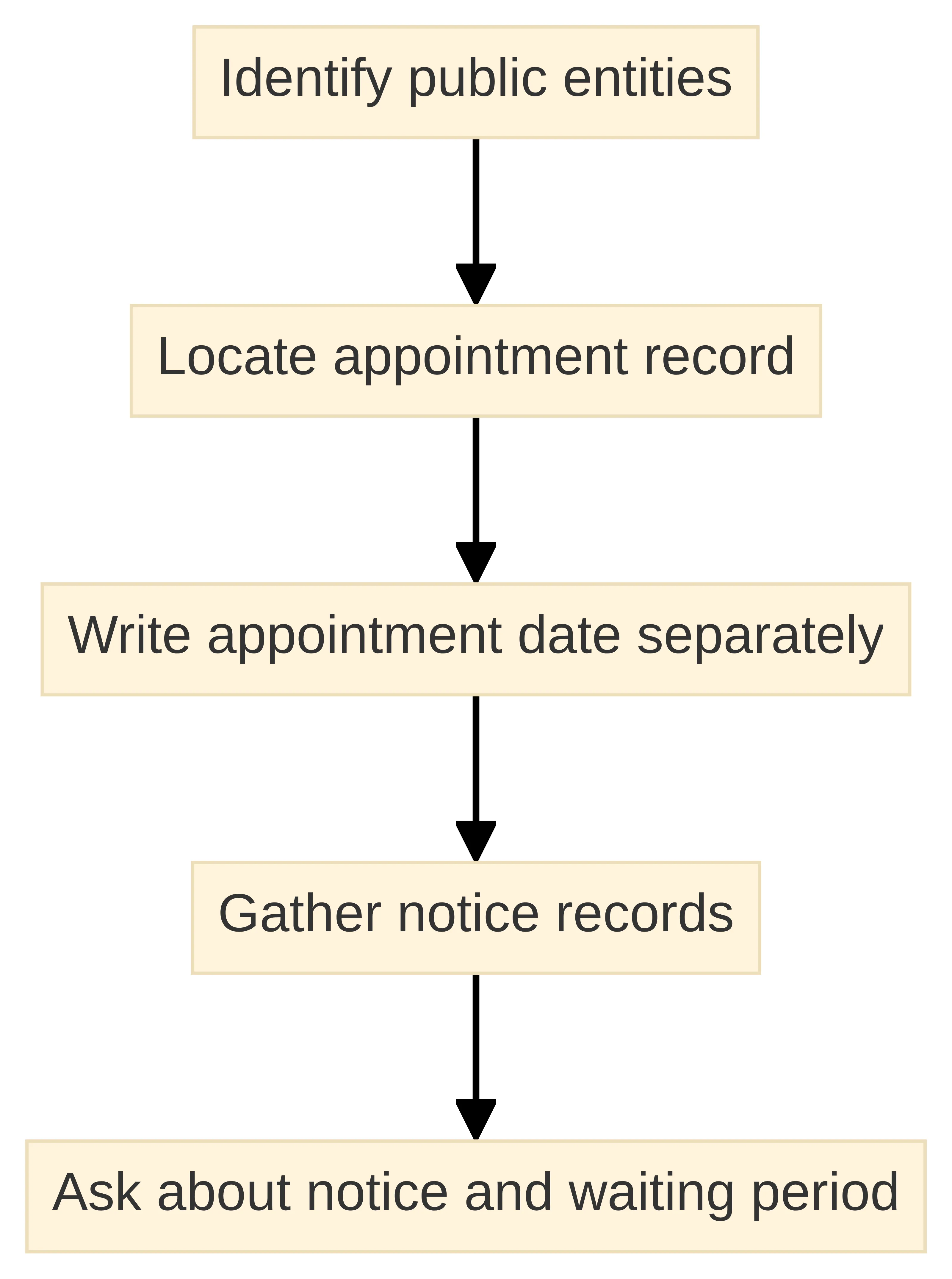
Use this sequence to prepare the issue for legal review:
- Identify every public entity that may be connected with the event.
- Locate the estate appointment record or record that no appointment has occurred.
- Write the appointment date separately from the death date.
- Gather any notice, receipt, delivery record, response, or public-entity correspondence.
- Ask whether the notice requirement applies, whether service was proper, and what waiting period or filing route follows.
The sequence does not authorize you to prepare or serve a notice on your own. A mistake about the defendant, the estate representative, the service method, or the date can affect the legal analysis. Give the lawyer the records and ask for a prompt review of the public-entity route.
A New York court decision retrieved on October 28, 2026, applied the rule tying a municipal wrongful-death notice period to appointment of an estate representative in the circumstances before that court. That decision illustrates why the appointment record matters; it does not decide the timing of every claim. Treat the court’s application as a reason to provide the exact estate facts, not as a substitute for case-specific review.
Flag a related criminal case before assuming the deadline
A criminal case involving the same event can affect the civil timing rules. New York Estates, Powers and Trusts Law § 5-4.1 provides that, when a criminal action has been commenced against the same defendant concerning the event, the decedent’s personal representative has at least one year after the criminal action ends to maintain the wrongful-death action, subject to the statute’s conditions.
That rule does not mean every criminal investigation changes the civil deadline. The statutory language concerns a criminal action, the same defendant, the event from which the wrongful-death claim arises, and other conditions that must be examined. A police investigation, arrest, news report, or family belief that charges may be filed is not enough for you to calculate the civil period yourself.
Tell the lawyer if any of the following has occurred:
- A prosecutor filed criminal charges.
- A court case began against a person or entity connected with the death.
- You have a docket number, indictment, complaint, arraignment date, or disposition record.
- The criminal case ended, was dismissed, or remains pending.
- The defendant in the criminal case may not be the same person or entity you believe is responsible for the civil claim.
Add the criminal-case information to the timing page rather than placing it in a separate family file. Record the defendant’s name as it appears in the court record, the date the action began, the current status if known, and the date it ended if it has ended. Keep copies of papers rather than relying on memory.
Then ask a direct question: does the criminal action satisfy the statutory conditions that affect the wrongful-death timing rules, and what date should control the civil analysis? Ask that question even if the ordinary two-year period appears to have plenty of time remaining. Ask it urgently if the ordinary period may have passed or is close.
The practical boundary is not to choose between the ordinary period and the criminal-case rule yourself. Give the lawyer both timelines and let the applicable statutory conditions be evaluated together with the estate and defendant information.
Build a consultation packet from the facts already available
A consultation packet should make the accident, medical, insurance, estate, and family facts easy to locate. You do not need to create a polished case file. Gather what you already have, label it by subject, and mark missing records instead of delaying contact until every document arrives.
Use five folders or digital sections:
Accident and event facts
- Date, time, and location of the event.
- A short description in your own words.
- Names and contact information for witnesses, if available.
- Photographs, video, incident reports, police materials, or messages.
- Names of businesses, property owners, public bodies, drivers, employers, or other people connected with the event.
Medical and death records
- Hospital, emergency, physician, or treatment information.
- Medical bills and insurance explanations of benefits, if available.
- The death certificate or other record showing the date of death.
- Information about the treatment timeline and the circumstances leading to death.
- A list of records that exist but have not yet been obtained.
Use descriptions rather than conclusions. Write what you saw, what you were told, and which record supports each date. Keep uncertainty visible.
Complete the packet with three more sections.
Insurance and financial information
- Health, auto, homeowners, commercial, life, or other insurance information connected with the event.
- Claim numbers, adjuster names, letters, payment records, and recorded-statement requests.
- Available information about medical expenses, household support, employment, or other financial records that may help explain the family’s questions.
Estate information
- The will, probate or administration papers, and the name of the estate representative, if known.
- The appointment order and its date.
- Contact information for the estate professional, if one is involved.
- Any notice of claim, delivery proof, public-entity response, or Court of Claims communication.
- Any criminal-case papers involving the same event.
Family information
- Names and contact information for close relatives and people involved in estate administration.
- A list of who has records, photographs, messages, or firsthand information.
- Questions about the decedent’s household, work, support, or relationships that the family wants explained.
The appointment date and death date should appear on the first page because they can lead to different timing questions. If a public entity may be involved, put that fact beside the location and defendant information. These organizing choices help the lawyer see the route without turning your packet into an argument about liability.
Keep the packet factual and private. Do not delete messages that seem unfavorable, edit photographs, or rewrite someone else’s account to make it sound more certain. Preserve original files where possible and label copies with the date you received them.
A one-page front sheet can make the first conversation more efficient. Include the decedent’s name, date of death, event date and location, possible defendants, estate representative and appointment date, public-entity connection, criminal-case status, and the three questions you most need answered. Add a note beside every unknown item. Unknown information is still useful when it is clearly identified.
Send only the materials requested through the contact process. Keep your own complete copy, including the original timing page and a record of when you sent each item. The goal is not to prove the claim before the consultation. The goal is to make the available facts and the missing facts visible.
Turn missing information into questions for the lawyer
A consultation becomes more useful when every unresolved fact becomes a direct question. Write the questions before the conversation so grief, time pressure, or unfamiliar legal terms do not determine what you remember to ask.
Start with the filing role:
- Who generally may maintain this wrongful-death action under the New York statute?
- Does the current estate representative have the authority needed for this matter?
- If no representative has been appointed, what estate issue needs attention first?
- Which family or estate information should be collected before any filing decision?
Then ask about the defendant and timing:
- Is the potential defendant private, municipal, another public corporation, or New York State?
- Does a notice of claim apply to the proposed defendant?
- If it applies, what event starts the notice period, and does the estate appointment date control?
- Has any notice already been served, and was the service directed to the correct entity?
- Does the ordinary two-year period apply, or does another rule or exception require analysis?
- Does a criminal action involving the same defendant and event affect the civil timing question?
Use a second group of questions to understand the review process:
- Which records should be obtained first?
- Which facts remain material even if a record is missing?
- What should the estate representative, family members, or witnesses avoid doing while the matter is reviewed?
- What deadline should be treated as the next control date?
- What additional facts would change the defendant or filing route?
- What will the lawyer need from you before deciding whether the office can take the matter?
Ask for clear explanations of fee, expense, and retainer terms before agreeing to representation. A consultation can explain the financial arrangement that would apply to your matter; it does not require you to decide every question during the first conversation.
Keep the questions tied to your facts. For example, do not ask only whether wrongful-death cases have a two-year period. Ask which date the lawyer would use for your situation, whether a public-entity notice issue exists, and whether any criminal action changes the analysis. A specific question produces a more useful answer than a general label.
If a document is missing, say so directly. If family members disagree about the event, preserve both accounts and identify the disagreement. If you do not know whether a public body, insurer, or criminal defendant is connected to the matter, list the uncertainty rather than filling it with an assumption.
The lawyer’s review should address the questions that control your next decision: who may act for the estate, which defendant route may apply, what timing rules must be protected, and what information is still needed. You can leave the conversation with a list of next steps even when the legal analysis cannot be completed immediately.
Take notes during the meeting. Record the dates the lawyer identifies, the documents requested, the person responsible for each follow-up item, and any instruction about preserving records or avoiding contact with a potential defendant. That list turns a difficult conversation into a set of actions you can track.
Use the firm’s stated access options for the next conversation
The decision to contact a wrongful death lawyer does not require you to decide that a claim is valid. Contact becomes more practical when you have a date of death, a description of the event, the potential defendant, the estate representative information, and a short list of timing questions. If a public entity or related criminal case may be involved, treat that uncertainty as a reason to seek prompt review rather than waiting for the packet to be complete.
The Law Offices of Evan W. Kohn offers free consultations and operates 24/7. We can arrange home or hospital visits for clients who cannot travel. We do not charge if we do not win the case. These access and fee points do not determine eligibility, representation, or recovery.
Only a qualified New York lawyer who reviews the particular facts can decide whether a potential claim fits the legal requirements and which deadlines or procedures apply. Gather what you have, identify what remains unknown, and bring the timing questions forward without trying to answer them from a general rule.
If you are ready to place the available facts before The Law Offices of Evan W. Kohn, use the prepared front sheet and identify any public-entity, estate-appointment, or criminal-case issue at the start. A focused summary gives the next conversation a clear place to begin.
Questions to clarify before requesting a wrongful-death consultation
What is a wrongful death claim in New York?
A wrongful death claim in New York is generally an action maintained by the duly appointed personal representative of a deceased person, when the decedent is survived by distributees, against a person who would have been liable to the decedent if death had not occurred.
What is the deadline for filing a wrongful death claim in New York?
The general deadline for filing a wrongful death claim in New York is two years after the decedent’s death. However, if a criminal action has been commenced against the same defendant, the personal representative may have at least one year after the criminal action ends to maintain the wrongful death action.
What information should I gather before contacting a wrongful death lawyer?
Before contacting a wrongful death lawyer, gather information about the accident, medical records, insurance details, estate documents, and family information. This includes the date of the accident, the date of death, and any relevant communications with potential defendants.
What consultation options does The Law Offices of Evan W. Kohn offer?
The Law Offices of Evan W. Kohn offers free consultations, operates 24/7, and can arrange home or hospital visits for clients who cannot travel. They do not charge if they do not win the case.
How can a criminal case affect the timing of a wrongful death claim?
If a criminal case has been initiated against the same defendant related to the wrongful death, the personal representative may have additional time to file the wrongful death claim, specifically at least one year after the criminal action concludes.
Hurt like this?
We handle Wrongful Death cases in the Bronx.
Evan W. Kohn, Esq. — more than 35 years of Bronx personal-injury practice. Reading about it only goes so far; a free consultation tells you what actually applies to your case.