
Car Accidents
Should You Consult a New York Tort Lawyer? A Bronx Route-Mapping Decision Guide

Start by comparing the possible New York routes
A potential injury or wrongful-death matter can be compared through its likely New York legal route rather than through the event label alone. This guide uses five route questions: whether the facts point toward ordinary negligence, a vehicle and no-fault issue, medical malpractice, wrongful death, or a public-entity procedure; who may be connected to the event; what injury or loss followed; what records distinguish the route; and which timing issue requires prompt review.
The route comparison is not a decision that you have a valid claim. It is a way to identify the first legal question to raise with a tort lawyer when responsibility, coverage, procedure, or timing is unclear.
A personal-injury lawyer may investigate the basis of a potential claim and help address timely filing, but the applicable deadline depends on the facts and the type of claim. That distinction matters in the Bronx and throughout New York City because a car crash, a construction injury, a fall on property, a medical-malpractice concern, and a death caused by alleged negligence can follow different routes.
Use the article as a preparation guide, not as a decision that you have a valid claim. If the event involved a vehicle, a workplace, a public agency, a medical provider, or a family death, place that fact near the top of your notes. Then bring the unresolved route to a qualified attorney rather than trying to settle the legal question from a general deadline or example.
Use five route questions instead of an event label
A tort lawyer can use the same basic facts to compare different New York routes. The first review is not a promise of an outcome; it is a way to identify which route-specific facts require investigation.
Compare these five questions:
- Ordinary negligence: What act or omission, property condition, or worksite fact is connected to the injury, and who may have controlled it?
- Vehicle and no-fault: Which people or organizations were connected to the vehicle, what did insurers say, and could the serious-injury framework apply?
- Medical malpractice: What act or omission is at issue, what treatment dates matter, and is there a continuous-treatment question?
- Wrongful death: What is the date of death, who is authorized to act for the estate, and who may be responsible?
- Public entity: Does a city, municipality, State entity, or other public defendant appear, creating a notice or Court of Claims question?
The NYC Bar says a personal-injury lawyer can help address timely filing. That role is especially relevant when the event fits more than one route or when the available records do not yet show which route controls. This comparison can also show what to ask first. When a vehicle is involved, keep the driver, owner, employer, insurer, and vehicle records together. When treatment is central, separate the date of the questioned act or omission from later appointments and note whether continuous treatment is part of the question. When a death or public body is involved, keep the death date, estate-appointment information, defendant identity, and notices together. These groupings do not select a legal theory or predict an outcome. They keep facts that may affect different routes from being blended together and make missing information visible. An unknown insurer, missing report, uncertain date, or unidentified defendant can be listed as an open question for the consultation rather than filled with an assumption.
Your account should include facts that feel unfavorable as well as facts that support your position. A lawyer cannot assess an unresolved route from a one-sided summary that leaves out a warning, a gap in treatment, a conflicting statement, or your own possible contribution to the event. You also do not need to decide the legal meaning of every fact before the meeting.
The same approach applies when a family member died. A wrongful-death discussion may require a separate look at the date of death, the person authorized to act for the estate, the identity of the potentially responsible party, and whether a public entity or criminal proceeding is involved. Treat those facts as separate questions. Do not assume that the deadline for an ordinary injury claim controls a death-related matter.
Place the event in a route category without deciding the claim
Classify the event by the route-specific question it raises, without treating the category as a diagnosis:
- Ordinary negligence or premises: a slip, trip, fall, construction condition, or other alleged act or omission; for a construction accident, note any workers’ compensation or insurance-paperwork question.
- Vehicle and no-fault: a truck or commercial-van event; separate insurance benefits from responsibility and the serious-injury question.
- Pedestrian collision: a crosswalk event or hit-and-run; identify the driver, vehicle, property, witnesses, and available reports.
- Medical malpractice: a concern involving treatment, a birth injury, or a brain injury; establish the treatment chronology and the act or omission being questioned.
- Wrongful death: a death allegedly connected to another person’s act or omission; identify the date of death, estate representative, and possible defendant.
An event may fit more than one route. The category does not establish fault, coverage, damages, or a filing deadline; it identifies which comparison questions to raise.
Bronx and New York City circumstances can make the route less obvious. A crash may involve a private driver, a commercial vehicle, a rideshare platform, a taxi, or a city-related vehicle. A construction injury may raise both workplace and third-party questions. A pedestrian event may involve a crosswalk, a property condition, or an unidentified driver. Those are factual distinctions, not conclusions about responsibility.
Bring the event to a consultation when you cannot identify the responsible party, when more than one person or organization may be involved, or when an insurer has asked you to give a statement or accept an amount. The appropriate action is to present the facts and communications for legal review, not to choose a legal theory from the event label alone.
Map each possible defendant to the route it may trigger
Map each possible defendant to the route it may trigger, without deciding that the person or organization is legally liable.
- A driver, vehicle owner, employer, rideshare, taxi, or transit operator may place the event in the vehicle and no-fault comparison.
- An employer, contractor, property owner, landlord, or business may raise an ordinary-negligence or construction route.
- A medical provider or facility may make treatment chronology and medical-malpractice questions central.
- An estate representative and the person or organization connected to a death may require the wrongful-death comparison.
- A city, municipality, public agency, school district, public authority, or New York State entity may create a public-entity route.
- An unidentified driver may require a separate review of the available vehicle and insurance information.
For each name, record the connection shown by a license plate, company logo, worksite sign, accident report, medical record, property address, insurance letter, or public-entity reference. That evidence helps compare routes; it does not establish liability. Keep the item that led you to identify a party beside the party’s name, and note whether the information comes from your observation, another person’s statement, or a document. An accident report may identify a vehicle without resolving responsibility. An insurer letter may show the insurer’s position without resolving the legal route. A medical record may show treatment without answering whether an act or omission was negligent. This separation prevents a document’s description or an insurer’s position from being treated as the conclusion. It also gives the lawyer a clear list of which facts need confirmation, additional records, or witness follow-up.
New York Courts guidance says money-damages suits against New York State belong in the Court of Claims and require a Notice of Claim first under Court of Claims Act §10. The same guidance says a Notice of Claim generally must precede a municipal personal-injury, wrongful-death, or property-damage action based on alleged municipal negligence or wrongful conduct.
That distinction changes your next step. If a city, county, town, school district, public authority, State agency, or other government connection appears anywhere in the facts, identify it at the beginning of the consultation and treat the matter as time-sensitive. Do not wait to decide whether the public entity was actually at fault before raising the connection.
Test the vehicle route separately from insurance and fault
The vehicle and no-fault route requires a comparison between insurance activity and responsibility for the event. Its communications do not by themselves answer who caused the event or what losses may be legally recoverable.
New York Insurance Law §5104 addresses covered motor-vehicle negligence actions. It generally limits recovery for non-economic loss unless the claimant suffered a serious injury and addresses basic economic loss as stated in the statute. Application depends on the facts and covered-person status. Therefore, compare the insurance communications, the parties, the serious-injury question, and the claimed losses rather than treating one insurer statement as the answer.
Record each insurer’s name, claim number, letter, email, recorded-statement request, offer, denial, explanation, and stated response date. Identify the communication and its date instead of treating the insurer’s position as a final legal conclusion. Also note whether the communication concerns benefits, responsibility, a recorded statement, an offer, a denial, or a requested response. Keep the original wording and any attachment with its date. A payment or benefit may show that an insurance process is underway, while an offer or denial shows the insurer’s position; neither item alone resolves the serious-injury question, the parties’ responsibility, or the losses that may be discussed. If communications from different insurers conflict, list the conflict instead of choosing one account. The attorney can then compare the policy and claim information with the event records and explain which question requires attention first.
A serious-injury question is not the same as a question about whether you were hurt. Section 5104 uses a statutory framework for certain covered motor-vehicle actions, so the consultation should address whether that framework applies and what facts are relevant to it. You should not decide that your injury is legally insufficient because an insurer used that phrase, and you should not assume that medical treatment alone resolves the issue.
Separate your notes into two columns: insurance activity and event responsibility. Under insurance activity, record payments, requests, denials, and offers. Under responsibility, record what each person or organization did, what the scene showed, and what witnesses or records may exist. Bring both columns to the attorney.
Disclose possible fault instead of ruling yourself out
Your possible contribution to an event does not automatically answer whether legal review is pointless. New York CPLR §1411 generally provides that culpable conduct attributed to a claimant or decedent does not bar recovery in personal-injury, property-damage, or wrongful-death actions; damages are reduced in proportion to that conduct, subject to the statute’s stated exception for certain Article 51 motor-vehicle actions.
The wording matters. The rule does not promise recovery, establish the percentage applicable to your facts, or remove the need to examine the evidence. It means that your own account of what you did, saw, or failed to do may be part of the legal analysis rather than a reason to stay silent.
Write down any fact that may be used to question your conduct: a turn, speed, warning, distraction, protective equipment issue, workplace instruction, prior condition, or disagreement about what happened. Include your uncertainty. A complete account allows the attorney to discuss how comparative fault may affect the route and whether the motor-vehicle exception requires a different analysis.
The direct action is simple: give the full account at the consultation. Do not edit out an unfavorable fact in the hope that it will disappear from the case.
Treat a government defendant as a different timing route
The public-entity route has its own timing comparison. For specified public-entity claims, New York Courts guidance lists a 90-day notice period for certain negligence-based personal-injury or property-damage claims and two years from death for specified wrongful-death claims. The exact rule depends on the defendant and claim.
The same guidance says a Notice of Claim must generally precede a municipal personal-injury, wrongful-death, or property-damage action based on alleged negligence or wrongful conduct by the municipality or its officers, agents, or employees. For money-damages suits against New York State, the guidance places the case in the Court of Claims and requires a Notice of Claim first under Court of Claims Act §10.
These are not universal deadlines. They identify a public-entity route in which the first procedural question may arise before the ordinary injury timeline.
For the public-entity comparison, keep four facts together: the government body named in the records; the event date; the death date and executor or administrator appointment date if applicable; and every notice, claim form, agency letter, incident report, and response. Include the government connection in the first account to the attorney.
A public-entity reference is enough to raise the procedural and timing questions. It does not require you to prove that the entity caused the injury before seeking review.
Compare the timing trigger for each route
Timing is one of the clearest ways the routes differ. The NYC Bar lists three years from the accident for several New York personal-injury categories, including car accidents, slip-and-falls, and other negligence claims. The same source states that a medical-malpractice action generally must be started within two years and six months of the relevant act or omission, or the last treatment in qualifying continuous-treatment cases, with exceptions.
A vehicle, medical-malpractice, wrongful-death, or public-entity matter may involve a different rule or an exception. The date should therefore be compared with the route, defendant, and claim facts rather than calculated from a general example.
| Route to compare | First route question | Timing point in the cited New York guidance |
|---|---|---|
| Ordinary negligence, including several car-accident and slip-and-fall categories | What act or omission, condition, defendant, injury, and records are connected? | The NYC Bar lists three years from the accident for several categories; exceptions and claim-specific rules may apply. |
| Vehicle and no-fault | Which covered people, insurers, losses, and serious-injury facts are involved? | Section 5104 may affect non-economic and basic economic loss; the application depends on the facts and covered-person status. |
| Medical malpractice | What act or omission and treatment dates are relevant? | The NYC Bar states two years and six months from the relevant act or omission, or the last treatment in qualifying continuous-treatment cases, with exceptions. |
| Wrongful death | What is the date of death, who may act for the estate, and who may be responsible? | A New York wrongful-death practice page states two years from death and describes a limited criminal-action-related extension; confirm the rule with current official authority. |
| Public entity | Is the defendant a municipality, State entity, or other specified public body? | New York Courts guidance lists a 90-day notice period for certain negligence-based public-entity claims, while wrongful-death timing is addressed separately. |
The table compares questions, not results. It does not establish that a period applies or that more time remains.
Place the dates beside the route they may affect: event and treatment dates for an injury route; last treatment for a continuous-treatment question; death and estate-appointment dates for wrongful death; notice dates for a public-entity route; and dates stated in insurer or agency communications. Mark an unknown date as “unknown” rather than guessing. Use one line for each possible trigger and a second note for the record that establishes or questions it. For example, an event date can be compared with the incident report, treatment dates with medical records, and a notice or estate-appointment date with the document that states it. If two records give different dates, preserve both and identify the conflict. Do not treat the date printed on an insurer letter as the date of the event unless the records say so. The purpose of the timeline is to show which dates are known, which are reported by someone else, and which still require legal review.
An incomplete timeline is itself a fact to raise promptly because the route comparison cannot be completed from an assumed date.
Treat wrongful death as a separate procedural route
A wrongful-death matter requires its own timing and authority questions rather than a simple extension of an injury claim. One New York wrongful-death practice page states that the general limitations period is two years from the date of death and describes a limited extension connected to a qualifying criminal action against the same defendant. The page also advises confirming the rule with current official authority and the defendant-specific facts.
Public-entity wrongful-death claims can follow a different route. The difference is material: the identity of the defendant and the estate timeline may affect the first action you need to discuss.
For a family death, prepare these facts before the meeting:
- the date and location of the death;
- the event, treatment, or conduct that may be connected to the death;
- the name and role of each possible defendant;
- whether an executor or administrator has been appointed and on what date;
- whether a public entity, public facility, or government employee is involved; and
- whether a criminal case, investigation, notice, or insurer communication exists.
Do not wait for the family to answer every question before seeking legal review. The missing facts belong on the consultation list, especially when the death or estate appointment date is already known.
Bring a route comparison sheet to the consultation
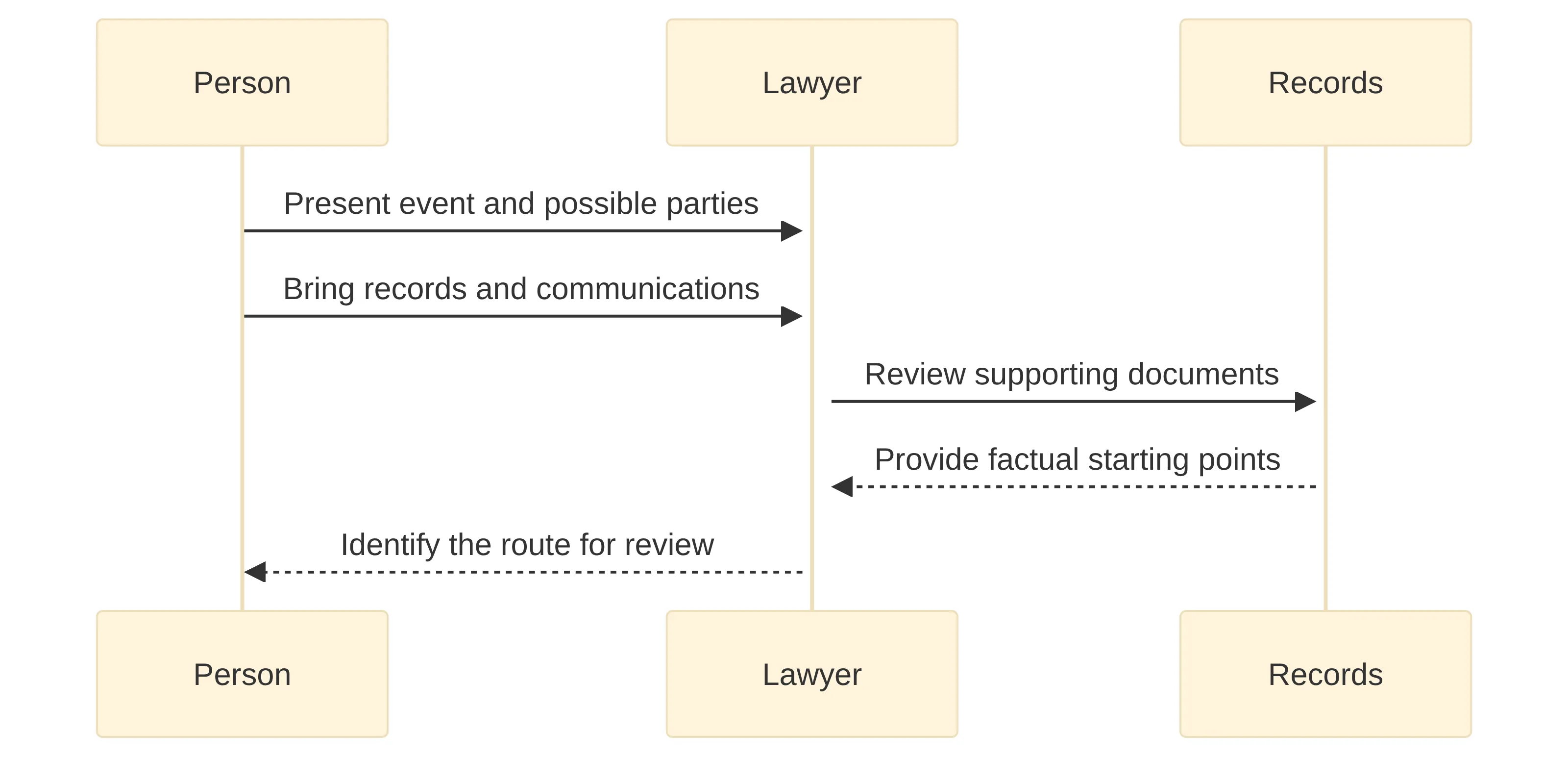
Before meeting with an attorney, gather basic information about the injury, how it occurred, and the medical treatment received. Make that information useful for route comparison by placing it under five headings:
- Route signals: vehicle, worksite, property, medical, death, public-entity, or other facts that may change the legal path.
- People and organizations: drivers, employers, contractors, property owners, medical providers, public bodies, insurers, witnesses, and estate representatives.
- Injury or loss: symptoms, diagnoses received, treatment, work interruption, property damage, death, or estate information if applicable.
- Route records: photographs, reports, medical records, worksite paperwork, insurance communications, notices, claim forms, and messages.
- Timing: event, treatment, last-treatment, notice, death, estate-appointment, and communication dates.
This route comparison sheet is a factual aid, not a proof package or legal conclusion.
Gather the records you already have without delaying the conversation until the folder is perfect. Useful categories may include medical bills and records, photographs, videos, accident or incident reports, wage information, insurance correspondence, claim forms, contracts or worksite paperwork, property notices, and contact information for witnesses. Keep original messages and record the date of important calls in your notes.
Separate facts from assumptions. Write “the driver said…” or “the adjuster wrote…” when the statement comes from someone else. Mark a date as unknown when you cannot establish it. This format helps the attorney distinguish what you personally observed from what another person or document reports.
If a record is missing, note who may have it and what event, treatment, communication, or date it may clarify. Put that gap beside the route it may affect. Examples include a report held by an agency, a treatment record held by a provider, an insurance communication, or a worksite document. This gives the attorney a concrete follow-up question without treating the missing record as proof of anything.
Bring questions that match the unresolved route. You might ask:
- Which parties and insurance policies need further review?
- Does a public-entity connection create a notice issue?
- Which deadline questions are urgent, and what date starts the analysis?
- How does possible fault on my part affect the discussion?
- Does the New York motor-vehicle serious-injury framework appear relevant?
- What records or facts are still needed before the next decision?
- What would happen after this initial conversation?
The goal is not to force an immediate legal conclusion. The goal is to leave with a clearer list of facts, procedures, and dates that require action or further investigation.
Use the meeting to resolve the open legal route
The consultation should help you sort the unresolved route rather than simply repeat the event description. The NYC Bar says a personal-injury lawyer can investigate the basis of a potential claim and help address timely filing. Before the meeting, prepare to discuss the injury, how it occurred, and the treatment received, then use the meeting to ask questions.
Use the conversation to separate:
- facts that are already documented;
- facts that need records, witnesses, or additional investigation;
- deadlines that require prompt attention;
- insurance or government procedures that may control the next step; and
- questions about whether the matter fits the firm’s practice.
Ask the attorney to explain what remains uncertain in ordinary language. If the answer depends on a record you do not have, write down the record and why it matters. A useful order is to begin with the event and injury, identify the people or organizations connected to it, then discuss records, insurance or government procedure, and dates. That order keeps the legal questions tied to the facts instead of turning the meeting into a general discussion of deadlines. It also helps identify whether the next step is obtaining a record, preserving a communication, clarifying a date, or seeking a more detailed review. If several routes remain possible, ask which facts distinguish them and what information would change the analysis. Record the answer in the same route comparison sheet so later communications can be matched to the question they address.
Do not measure the value of the meeting by whether you receive a prediction about compensation. A responsible first discussion may leave factual questions open, especially when responsibility, medical history, coverage, comparative fault, or timing has not been fully examined. The useful result is a defined next step and a clear understanding of what information must be gathered.
You can also ask how communications, documents, and deadlines should be handled while the review continues. If the attorney cannot assess an issue without more information, treat that as a boundary to respect rather than an invitation to guess. Your action is to follow the specific next step explained for your facts or seek another qualified legal opinion if you need one.
Request a Bronx-area consultation with the prepared facts
At The Law Offices of Evan W. Kohn, we offer legal services for car accidents in the Bronx. We also handle truck accident cases involving commercial vans, pedestrian cases involving crosswalk accidents and hit-and-run crashes, and workers’ compensation and insurance paperwork for construction accident cases.
The Law Offices of Evan W. Kohn offers free consultations and operates 24/7. Our office is located at 2000 White Plains Road in the Bronx, and we can arrange home or hospital visits for clients who cannot travel. Bring the factual snapshot, records, communications, party list, and timing questions so the discussion can focus on the route your circumstances require.
A qualified attorney must decide individual suitability after reviewing your specific facts. If your matter involves a public entity, a death, a medical provider, a vehicle, a workplace, or an unresolved deadline, identify that issue at the outset.
Questions to clarify before requesting a tort-lawyer consultation
What should I prepare before consulting a tort lawyer?
Gather basic information about the injury, how it occurred, and any medical treatment received. Create a one- or two-page snapshot that includes details about the event, involved parties, injuries, communications with insurers, and any relevant timing information.
What types of cases can a tort lawyer assist with?
A tort lawyer can assist with various cases, including car accidents, truck accidents, pedestrian accidents, construction injuries, medical malpractice, and wrongful death claims.
What should I do if my injury involves a public entity?
If your injury involves a public entity, it’s important to identify this during your consultation, as it may affect the filing process and deadlines, including the need for a Notice of Claim.
How can I contact The Law Offices of Evan W. Kohn for a consultation?
You can contact The Law Offices of Evan W. Kohn to request a free consultation. They offer 24/7 availability and can arrange home or hospital visits for clients who cannot travel.
Hurt like this?
We handle Car Accidents cases in the Bronx.
Evan W. Kohn, Esq. — more than 35 years of Bronx personal-injury practice. Reading about it only goes so far; a free consultation tells you what actually applies to your case.