
Car Accidents
Car Accident on the LIE: What to Do After a Crash in New York
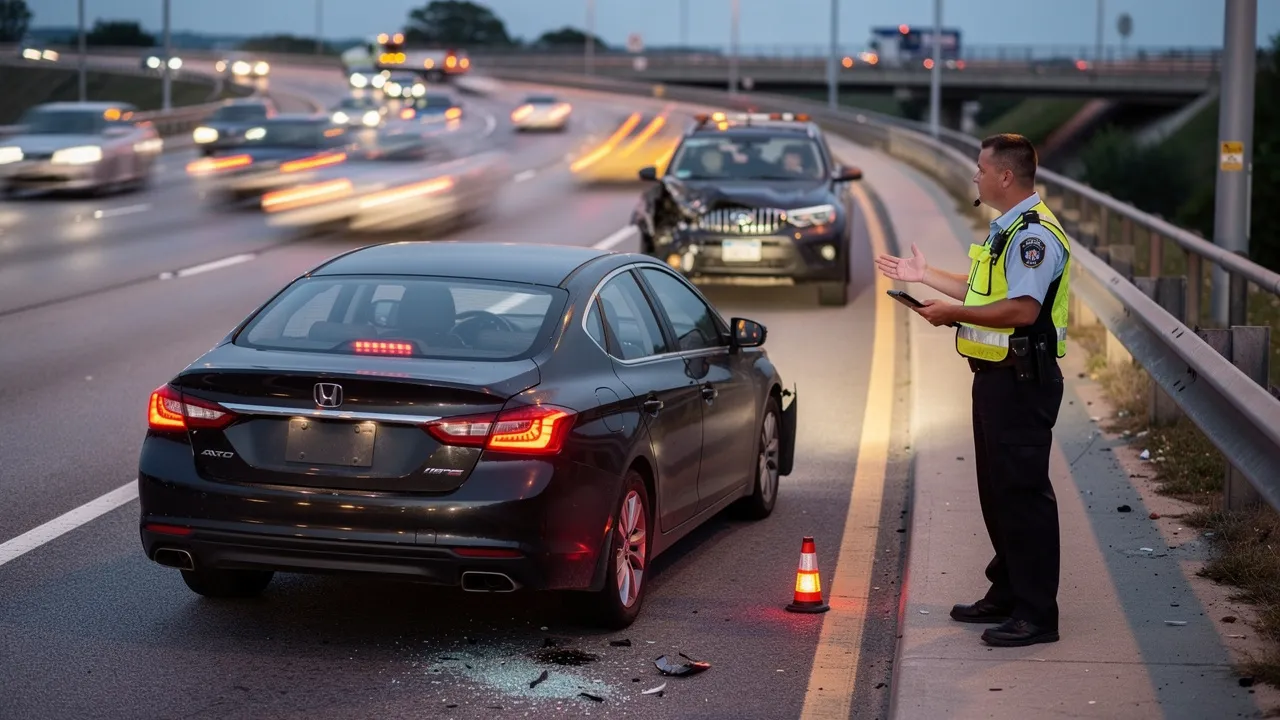
What should you do first after a crash on the LIE?
After a crash on the LIE, you may be trying to help an injured family member in the Bronx while traffic moves around damaged cars. Use a safety-first sequence: check for injuries, call for help, and move away from immediate danger when you can do so safely.
The first response after a LIE crash should stay short and practical:
- Check yourself and other people for injuries.
- Call 911 after a reportable crash or whenever emergency help is needed.
- Move out of immediate danger when you can do so safely.
- Begin documenting the crash only after safety and necessary medical attention are addressed.
Calling 911 after a reportable crash brings emergency professionals to manage scene safety and document the incident.
Crash-scene evidence comes after human safety. Do not stay in a dangerous traffic lane to take photographs, inspect damage, or collect details. Move only when the move itself is safe, then wait for emergency responders when the vehicles cannot be moved safely.
Necessary medical attention takes priority over preserving evidence. Tell emergency personnel about injuries and hazards when they arrive, and let the scene-safety response proceed before you focus on insurance or paperwork.
How should you make the crash scene safer?
The LIE crash scene becomes safer when you protect people from traffic and other hazards without delaying emergency care. If possible, move your vehicle off the road.
Scene-safety steps include:
- Turn on your hazard lights.
- Use flares, reflectors, or reflective triangles if they are available.
- Protect yourself and others from oncoming traffic.
- Watch for leaking fuel before placing yourself near a vehicle or roadway.
- Wait for emergency responders if the vehicles cannot be moved safely after a serious crash.
Use these measures only when you can do so without creating another danger.
An injured person should not be moved unless fire or another life-threatening danger makes movement necessary. If movement is necessary, keep the person’s back and neck as straight as possible. Move the person only to escape that immediate danger.
Downed wires require a separate boundary. Do not approach wires near the vehicle. If wires touch the vehicle or lie near it, remain inside until help arrives.
Emergency care and scene control should come before questions about fault or damage. Do not move an injured person, cross into moving traffic, or inspect a hazardous vehicle merely to collect information.

What information must you exchange after a New York crash?
New York crash duties require you to stop regardless of the level of damage. Leaving a scene involving property damage is a traffic violation, while leaving a scene involving injury or death is a criminal violation.
The required exchange after a property-damage crash includes information that identifies the drivers, vehicles, and insurance coverage:
- Your name and address.
- Your driver license number.
- Your vehicle registration information.
- Your insurance information, including the policy number and effective date.
- Your insurance identification card if another driver or police officer requests it.
Give the information to the other drivers and police at the scene.
Also record the other vehicle’s license plate number and vehicle description. If someone else owns the vehicle, obtain the owner’s details from the registration.
A parked vehicle, other property, or domestic animal creates another responsibility. Try to find the owner or notify the police.
What should you record from the LIE crash scene?
Scene documentation should begin from a safe location, not from a traffic lane. Photograph the overall scene, closer details, and the vehicles’ positions before they move if you can do so safely. Never delay a necessary safety move just to preserve a photograph.
A useful photograph and note checklist includes:
- The overall roadway and nearby lanes.
- Vehicle damage and the position of each vehicle.
- Signs, signals, lane markings, and visible road conditions.
- Construction zones, temporary traffic-pattern changes, or road hazards that may have played a role.
- The time of day and lighting conditions when visibility is part of the concern.
- Weather conditions such as rain, snow, fog, or glare when they affect visibility or traction.
Take only the details you can preserve without placing yourself or anyone else in danger.
Nearby businesses or residences may have cameras that recorded part of the collision. Note their locations promptly so a potential video source can be identified later. If a witness volunteers contact information, preserve it with your crash notes.
Your own crash notes should separate what you saw from what someone else told you. Record the sequence in plain language, keep the photographs and messages together, and note the names of people or agencies who gave you information. A police report is one piece of evidence, not a final civil determination of fault. If the police report contains a factual error, identify the exact entry and the proof that conflicts with it. A qualified attorney can review that specific discrepancy alongside the report’s source and other available evidence.
Your injury notes should describe what you noticed and what happened at the scene without guessing about the legal cause. Preserve communications about symptoms, treatment, vehicle damage, and the crash so the account of the event stays organized.
Which New York crash reports should you complete?
New York crash reporting has two separate parts: promptly notifying your insurance company and local police, then completing any required report to the Department of Motor Vehicles. Telling your insurer about the crash does not finish the DMV reporting obligation.
The New York DMV report must be filed within 10 days of the crash. New York’s Report of Motor Vehicle Crash is Form MV-104. The form is available from motor vehicle offices, most insurance agents, and the DMV website, and it can be submitted online.
Failing to file the required report can be a misdemeanor and can lead to suspension or revocation of a driver license or vehicle registration. Treat the DMV filing as a separate task after you notify an insurer or speak with police.
Your reporting checklist should have three entries: insurer notice, local police notice, and the DMV filing when the crash qualifies. Save the completed form and confirmation with your other crash records.

How should you handle insurance calls after the crash?
Insurance communication should begin with prompt notice of the accident, but a request for a recorded statement deserves separate attention. A recorded statement is rarely required for New York City crash victims, while your own policy may require cooperation. An insurance request from the other driver’s insurer is different from a cooperation request under your own policy. Most people are not legally required to provide a recorded statement to the other driver’s insurer, while your own policy may require cooperation.
An insurance adjuster’s call calls for a careful sequence:
- Give the basic facts needed to report the collision.
- Ask whether the call is being recorded and which insurer is requesting it.
- Describe what you know accurately instead of guessing about speed, distance, fault, or the extent of an injury.
- Pause before agreeing to a recorded statement when injuries are serious, fault is disputed, or the other insurer is closely scrutinizing your account.
- Review any cooperation obligation under your own policy before refusing or delaying a required step.
Giving a recorded statement too soon can weaken a claim. A pause is not a substitute for complying with your own policy; it is a reason to understand the request before answering questions that could affect your account.
Your insurance file should contain the claim number, adjuster’s contact details, messages, letters, and any request for a recorded statement. Keep the file separate from your personal notes so you can identify what the insurer asked and when it asked. Record each call’s date. Request written confirmation of what the insurer wants and ask for a copy of the recording before participating. Keep the written confirmation and any recording with the claim number and call dates.
How might fault and available proof affect the next conversation?
New York fault generally asks whether someone failed to use reasonable care and whether that failure contributed to the crash. An insurer may investigate speeding, following too closely, failing to yield, unsafe lane changes, or distracted driving.
A police report is evidence, not a final civil determination of fault. Video, credible witnesses, or physical evidence may support a different conclusion. Keep that distinction in mind when an insurer treats the report as the entire explanation of the collision. The significance of a police report depends on the information it contains, the source of that information, and other available proof. Review the report for factual errors and discuss material discrepancies with a qualified attorney.
Historical New York State data recorded failure to yield as a contributing factor in 23,462 fatal and personal-injury crashes in 2003, 21,987 in 2004, and 20,714 in 2005. The same data recorded unsafe speed as a contributing factor in 15,319 fatal and personal-injury crashes in 2003, 14,615 in 2004, and 14,244 in 2005.
Historical crash patterns do not decide who caused your collision. Use the available proof to keep the conversation tied to your event: the roadway, vehicle positions, witnesses, video, physical damage, and the statements recorded at the scene.

Which post-crash path fits your situation?
Three post-crash paths can address different needs: emergency or medical help, handling routine reporting tasks yourself, and qualified legal review. These paths can overlap; legal review should never replace emergency care or a necessary safety move.
| Post-crash path | When it fits | Direct action | Boundary |
|---|---|---|---|
| Emergency or medical help | Someone is injured, the scene is dangerous, or vehicles cannot be moved safely | Call 911, move away from danger when possible, and follow emergency instructions | Do not delay necessary medical attention to document the scene |
| Self-handled reporting and insurance | The scene is controlled and you are completing ordinary notice and DMV tasks | Promptly report the accident to your insurer and local police, and file Form MV-104 when required | An insurer call does not complete the DMV duty |
| Qualified legal review | Serious injury, uninsured circumstances, or medical expenses and other economic losses exceeding $50,000 in no-fault benefits may make contacting an attorney appropriate | Preserve your records and request an evaluation of the unresolved questions | Routine steps do not answer individualized liability, coverage, deadline, or claim-value questions |
Choose the path that matches the unresolved problem, not the path that feels easiest in the moment. If danger or injury is present, call for emergency help first. If the scene is controlled but reporting or insurance questions remain, complete the required steps and seek qualified review when the issue falls outside routine handling.
A practical path check asks three questions: Is anyone still in danger? Are reporting or insurance tasks unfinished? Does the injury, coverage, or fault issue require individual review? Answer the first question before the second, and the second before treating legal review as the next task.
When should you seek qualified professional evaluation?
A qualified New York attorney evaluation may be appropriate when the injury, coverage, or reporting issue is not routine. Consider seeking review when:
- Medical expenses and other economic losses exceed New York no-fault benefits of $50,000.
- You suffer a serious injury as defined by the Insurance Law.
- An injury results in death.
- The injured person or the person at fault lacks insurance meeting New York’s minimum provisions.
- The crash involves a hit-and-run or an uninsured driver.
That administrative issue is separate from deciding whether an injured person has a civil claim, so keep the DMV correspondence with the rest of the crash records.
Before seeking professional review, keep the crash notes, photographs, police information, DMV filing, medical records, insurer messages, and any recorded-statement request together. A qualified attorney can then focus on the questions that remain unresolved instead of relying on a short description of the collision.
Prompt review is especially useful when an injury is serious, fault is disputed, coverage is uncertain, or another driver cannot be identified or insured. Report a hit-and-run or uninsured-driver crash to police quickly, then preserve the reporting record.
How can you request a consultation about the crash?
Before you contact a qualified New York attorney, gather your crash notes, photographs, police information, medical records, DMV filing, and insurer messages. The Law Offices of Evan W. Kohn offers free consultations and operates 24/7. We can arrange home or hospital visits for clients who cannot travel.
This article is general information, not legal advice. A qualified New York professional must evaluate your individual injuries, insurance coverage, reporting duties, deadlines, and possible claim.
What practical questions should you ask after a LIE crash?
What should you do after a car accident on the LIE if the vehicles cannot be moved safely?
Call 911, protect yourself from traffic, and wait for emergency responders to secure the scene. Do not move an injured person unless fire or another life-threatening danger requires it. If downed wires touch or lie near a vehicle, remain inside and do not approach them until help arrives.
When must a New York crash be reported to the DMV?
A crash must be reported when it causes a fatality or personal injury, or more than $1,000 in damage to one person’s property. File Form MV-104 within 10 days of the crash. Reporting the collision to an insurer does not replace the DMV filing.
Do you have to give the other insurer a recorded statement?
A recorded statement is rarely required for New York City crash victims, but your own insurance policy may require cooperation. Ask whether the call is recorded, answer known facts accurately, and consider pausing before a recorded statement when injuries are serious, fault is disputed, or the other insurer is closely scrutinizing your account.
Does a police report decide who caused a New York crash?
No. A police report is evidence, not a final civil determination of fault. Insurers and attorneys may also consider video, credible witnesses, vehicle damage, roadway conditions, and other physical evidence, which can support a different account of the collision.
When might a New York car accident require individual legal review?
Consider individual review when a serious injury, disputed fault, uninsured or hit-and-run driver, death, or uncertain coverage is involved. Review may also be appropriate when medical expenses and other economic losses exceed New York no-fault benefits of $50,000.
Hurt like this?
We handle Car Accidents cases in the Bronx.
Evan W. Kohn, Esq. — more than 35 years of Bronx personal-injury practice. Reading about it only goes so far; a free consultation tells you what actually applies to your case.