
Car Accidents
Injury Lawyer Near Me in the Bronx: How to Decide Whether to Request a Consultation

Run a four-question local-fit screen before you call
“Injury lawyer near me” is a local-fit question, not just a distance search. Use this four-question local-fit screen to compare whether an office is practical to contact:
-
Does the stated service area fit the relevant location? The Law Offices of Evan W. Kohn serves clients in all five boroughs, Westchester, Putnam, Rockland, and Nassau counties, and New Jersey. Compare that stated area with where the accident occurred or where you need help.
-
Does the stated practice coverage fit the accident category? The Law Offices of Evan W. Kohn offers legal services for auto accidents and handles personal-injury cases involving construction accidents, slip-and-fall incidents, and truck accidents.
-
Do the stated communication and access arrangements fit your needs? The Law Offices of Evan W. Kohn has a multilingual team and can arrange home or hospital visits for clients who cannot travel.
-
Are the consultation arrangements workable? The Law Offices of Evan W. Kohn offers free, no-obligation consultations, operates 24/7, and lists 2000 White Plains Road in the Bronx.
Keep the answers in a short local-fit record. If a point remains unclear, ask about it when requesting the consultation.
Match the office to the accident category
The accident category is the first substantive fit question. A nearby location does not by itself show that an office handles the event you need to discuss. Start with a plain description of what happened, then compare that description with the office’s stated practice areas.
The Law Offices of Evan W. Kohn handles personal-injury cases involving auto accidents, construction accidents, slip-and-fall incidents, and truck accidents. The Law Offices of Evan W. Kohn also offers legal services for auto accidents in the Bronx and helps individuals injured by commercial trucks.
For a car accident, the firm’s stated categories include rear-end crashes, intersection and left-turn crashes, hit-and-run accidents, drunk- and distracted-driver incidents, uninsured-driver crashes, and matters involving injured passengers. These categories can help you describe the event accurately. They do not establish who was responsible, whether a claim exists, or what legal route applies.
A useful description separates the event from the legal question. You might write “rear-end collision,” “fall near an entrance,” “construction-site injury,” or “commercial-truck collision.” If the event involved a taxi, bus, rideshare vehicle, bicycle, motorcycle, pedestrian, workplace, or property, include that detail without forcing it into a more familiar label. If several categories overlap, name each one.
The fit question is whether the office can understand the subject of the proposed conversation from the facts you can provide. A match is a reason to ask for a consultation, not an answer about the merits of the matter. Keep uncertain details marked as uncertain. A short, accurate description gives the first conversation a clearer starting point than a legal label chosen from a search result.
The same approach works when the injury description is still limited. Note the event first, then add the treatment or symptoms you know about without diagnosing yourself. If the event and injury do not fit neatly into one category, preserve that uncertainty and ask which facts should be discussed. The purpose of this screen is to identify a relevant conversation, not to resolve the legal questions before contact.
Add access details to your contact brief
Add an access note to the contact brief rather than treating a map result as the decision. Record where the accident happened, where you are now, whether travel to the Bronx would be workable, and any language, accessibility, medical, or communication need to mention at first contact. These details help you explain how you can participate; they do not determine the merits of a matter.
The Law Offices of Evan W. Kohn serves clients in all five boroughs, Westchester, Putnam, Rockland, and Nassau counties, and New Jersey, offers free, no-obligation consultations, operates 24/7, and can arrange home or hospital visits for clients who cannot travel.
Identify any language, accessibility, medical, or communication need when you make contact rather than assuming a listing answers it. Keep the access note beside your event description and the records you have. If geography or participation details are unclear, make that uncertainty part of the first contact.
This gives you a concrete way to decide whether to request a consultation without ranking offices or treating distance as a legal conclusion.
Turn unknowns into a focused contact brief
A local-fit contact brief keeps the four-question decision visible when you make contact. It is shorter than a case file and is not meant to prove a position. Its purpose is to show what is known, what is uncertain, and what you need to ask before deciding whether to continue the conversation.
Use four short entries:
- Reach and participation. Note where the accident occurred, where you are now, whether travel is difficult, and any communication need to mention.
- Event category. Give the ordinary description of the accident, such as a car collision, fall, construction injury, or truck collision. Add the date and location if known.
- Reason for contact. State the injury or practical effect you know about without diagnosing it or assigning responsibility.
- Unresolved question. Record the one issue that makes you seek a consultation, such as an insurance communication, a timing concern, or uncertainty about which facts matter.
The New York State Bar Association guidance recommends writing down the names and contact details of people involved, having papers relating to the matter available, and giving the lawyer the complete story, including facts that may not help your position. Keep those details available if you have them, but do not postpone contact while trying to assemble a finished file.
A compact note also prevents the local-fit screen from becoming a vague impression. It lets you say where the matter arose, what kind of event occurred, how the injury affected you, and what you cannot answer. If a record is missing, label the gap and identify where you think it may be held. During the consultation, the gap itself can become a focused question rather than a reason to guess.
The screen is complete enough for an initial decision when you can explain the location, event category, participation need, and reason for contact. Additional records can then support the conversation without changing the basic question of whether the office is a practical place to begin.
Use a factual event description to test the match
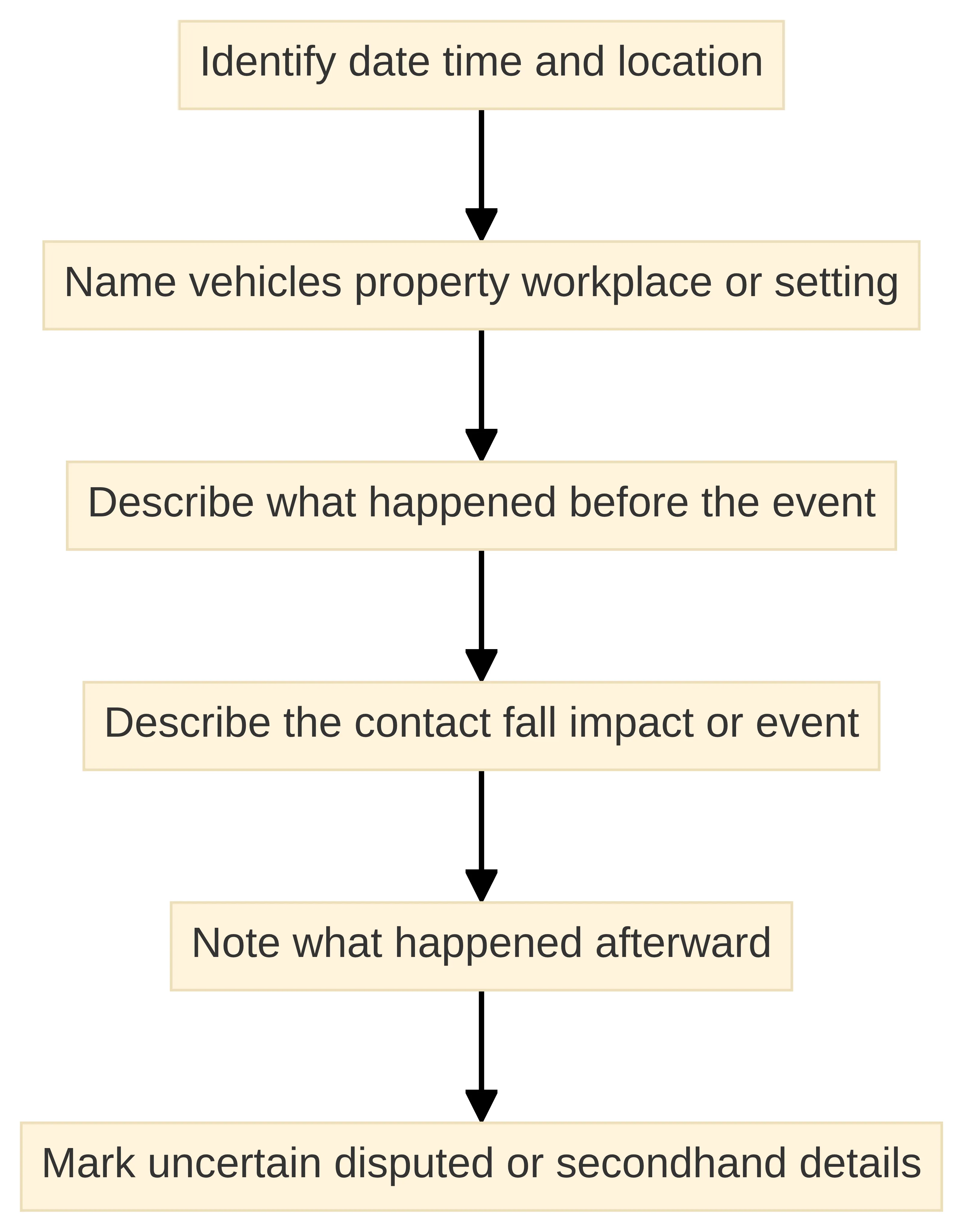
A factual event description helps test the accident-fit question without turning the first contact into an argument about blame. Begin with the date, approximate time, location, people involved, and setting. Then give a short sequence of what you remember before, during, and after the event.
For example, identify the vehicle, property, workplace, or other setting involved; describe the contact, fall, impact, or other event; and note whom you spoke with afterward. Include names and contact details for people involved when you have them. If a detail came from someone else, label it that way. If two records differ, preserve the difference instead of silently choosing one.
The New York State Bar Association advises preparing the names, addresses, and telephone numbers of people involved and telling the lawyer the complete story, including facts that may not help your position. That guidance supports a clear starting account. It does not require you to decide that another person was negligent or that a particular fact proves responsibility.
Use the sequence to make the category understandable. A rear-end collision, a fall near a particular entrance, a construction-site event, and a commercial-truck collision may call for different factual questions. If the event involves several vehicles, a workplace, a property owner, or another road user, name each connection rather than selecting the nearest label.
Separate what you personally saw from what you were told, and mark uncertain details. The result is a factual description that lets you ask whether the office’s practice fit is relevant, while leaving responsibility and other unresolved issues for the consultation.
Separate medical and work context before deciding what to ask
Medical care and work context can change which questions belong in the local-fit conversation. Keep them separate from the event description. Record where and when you received care, what treatment information you have, whether the injury occurred while working, and what practical effect you want to discuss. These notes describe the circumstances; they do not diagnose an injury or select a legal route.
For a New York work-related injury, the Workers’ Compensation Board says that, except in emergencies, the treating health-care provider must be authorized by the Board. The Board also says an injured worker should tell health-care providers that the injury happened at work and provide the employer’s name. Those instructions are relevant to identifying a work-related question, but they do not resolve what other issues may apply to a particular matter.
The Workers’ Compensation Board says that, under the stated conditions, medical bills, medically necessary prescribed drugs and equipment, and certain treatment-related travel expenses for a work-related injury are paid or reimbursed through the employer or workers’ compensation insurer. The Board oversees New York’s workers’ compensation system, while insurance carriers and claim administrators pay claims. Keep receipts or related papers when available and identify any point you want clarified.
If the injury was not work-related, keep the work entry limited to actual effects such as missed shifts or changed duties. If it was work-related, identify the employer, when the injury was reported, and the providers or treatment involved. A separate medical and work description helps determine which facts belong in the consultation without treating a record as a conclusion about responsibility.
Urgent medical needs come first. Use the information already available to explain the context of the injury, then bring the unresolved treatment or work question to the consultation. The local-fit decision remains about whether the office is an appropriate place to start the conversation, not about deciding the matter in advance.
Read the insurance trail for questions that need review
Insurance communications are a reason to sharpen the question you want to ask, not a reason to assume that every notice has the same meaning. Put the exact letter, email, claim notice, message, form, or other communication that prompted concern where you can refer to it. Note the sender, date, subject, claim number, and any response date shown on the document when those details are available.
Keep the original wording and mark anything you do not understand instead of summarizing it into a conclusion.
A short communication record can contain the date, sender or recipient, subject, and question raised. Keep copies of what you sent and received when possible. If a message includes a deadline, demand, release, statement, or document you are asked to sign, place that item at the top of the questions for the consultation. The New York State Bar Association guidance advises consulting a lawyer before signing documents or taking legal action and making sure you understand what you are signing.
This use of the insurance trail supports the local-fit decision in two ways. It shows the subject that needs to be discussed, and it may reveal whether the timing or communication issue requires prompt contact. It does not establish liability, determine coverage, or tell you what response is appropriate without considering the circumstances.
When you make contact, describe the communication that raised the concern and keep the document available. That gives the conversation a specific starting point while preserving the distinction between identifying a question and answering it.
Use timing uncertainty to decide how promptly to contact an office
Timing is the final part of the local-fit decision because an unresolved date may affect how promptly you should make contact. Record the accident date, treatment dates, insurance communications, and any response date printed on a notice or form. Keep the original wording of a document that gives you a date to consider.
The New York Courts timetable lists three years from the date of the accident for a slip-and-fall claim under CPLR 214(5). That entry is not a general countdown for every injury matter. The claim type, facts, parties, and applicable law can change the timing question, so do not use that slip-and-fall entry as a rule for a car crash, truck collision, construction injury, work-related injury, or another event.
A simple timing note has three parts: the known date, the event or communication connected with it, and the question the date raises. For example, identify whether the date relates to the accident, treatment, employer notice, an insurance message, or a requested response. If you do not know which date matters, record each one rather than selecting one from a general explanation.
A date that seems distant can still call for prompt contact, and a date that seems urgent may not answer the whole question. The New York State Bar Association advises consulting a lawyer before taking legal action and understanding the consequences of documents you sign. Use that guidance as a reason to raise timing and document questions promptly.
The local-fit screen therefore ends with a practical choice: if the office’s stated reach and accident fit align and timing is a concern, request the consultation and identify the date at the outset. If an access or practice-area question remains unknown, make that the first point to clarify.
Do not collapse every date into a single deadline field. Give each date a label and a source so unlike events are not treated as interchangeable. An accident date places the event in sequence. A treatment date identifies when care was recorded. An employer-notice date identifies a work-related communication. An insurer-response date identifies a communication and any response date shown on it. These labels organize the question; they do not tell you which date controls.
Create a two-part timing note: on the left, write the date, source, and whether it is known, approximate, or missing; on the right, write what you want the lawyer to review. If a letter requests a response, keep its exact wording beside the date. If a medical record establishes treatment but not employer notice, keep those entries separate. If records conflict, list both and identify where each came from instead of choosing one silently.
The New York Courts timetable’s three-year slip-and-fall entry illustrates why the source and claim type matter. It can frame a question about that kind of claim, but it cannot be converted into a general rule for an auto accident, truck collision, construction injury, work-related injury, or another event. For those matters, use the relevant event, work, treatment, and insurance records to formulate questions rather than importing the slip-and-fall entry.
The practical question for the consultation becomes: which dates in these records may affect the matter, and what should be reviewed about each one? This method does not calculate a deadline. It makes uncertainty visible and gives the consultation a usable timeline, while leaving the applicable rule to case-specific review.
Turn the meeting into questions about the unresolved issues
A consultation becomes more useful when you bring questions tied to the facts and records you already organized. The New York State Bar Association advises asking the lawyer to explain the strengths and weaknesses of the matter, the steps involved, and an estimated timeline, then keeping the lawyer informed about new developments. The consultation-preparation guidance also describes discussing next steps if you decide to move forward.
Write questions in four groups:
- Fit: Does the accident type and location belong in the office’s area of work? Which facts should be clarified first?
- Records: Which papers are missing? What should you preserve? Does any record conflict with your account?
- Timing and communications: Which dates need review? What should you understand before responding to an insurer or signing a document?
- Process: What steps would follow an initial review, what information would be needed next, and what timeline can reasonably be estimated from the facts available?
Ask the lawyer to distinguish what is known from what is still uncertain. For example, you can ask whether a record supports a particular part of the sequence, whether an insurance communication raises a question, or whether a missing document should be located before the next decision. You do not need to present a finished theory of the case.
Give the complete account, including facts that may appear unfavorable. The New York State Bar Association guidance says the lawyer should be made aware of all relevant facts so the matter can be assessed, and it advises keeping the lawyer informed about new developments. If your symptoms, work status, address, contact information, insurance communications, or available records change, note the change and communicate it through the agreed channel.
A lawyer can discuss the strengths and weaknesses of the matter and explain possible steps, but the conversation still depends on the facts you provide and the law applicable to those facts. Leave the meeting knowing which questions were answered, which records or dates remain open, and what action was actually agreed upon.
Before the meeting ends, repeat the practical next step in your own words. Ask which record or date needs attention first, who will provide it, and how you should communicate a new development. If you decide not to proceed, keep the organized brief so you can explain the matter consistently if you seek another consultation.
Request an accessible next step toward legal review
Your next step is ready when your six-part brief identifies the accident type, the people and sequence, the medical and work information, the insurance trail, and the questions that still require review. That preparation lets you decide whether a local consultation fits your circumstances without treating general information as a legal conclusion.
At The Law Offices of Evan W. Kohn, we offer free, no-obligation consultations and can arrange home or hospital visits for clients who cannot travel. We serve clients in the Bronx, all five boroughs, Westchester, Putnam, Rockland, and Nassau counties, and New Jersey. We handle personal-injury matters involving auto accidents, construction accidents, slip-and-fall incidents, and truck accidents.
Before you reach out, keep your contact information and prepared records together. If travel is difficult, explain that at the beginning so the access question can be addressed directly.
What should I ask during an injury-law consultation?
What types of injury situations may justify seeking a legal consultation?
Injury situations that may warrant a legal consultation include auto accidents, slip and fall incidents, construction injuries, and any other accidents where negligence may be involved. It’s important to discuss the specifics of your situation with a lawyer to determine if legal action is appropriate.
What documents should I gather before my consultation with an injury lawyer?
Before your consultation, gather relevant documents such as accident reports, medical treatment records, and any correspondence with insurance companies. These documents can help the lawyer assess your case more effectively.
What should I expect during my consultation with an injury lawyer?
During the consultation, you can expect to discuss the details of your accident, the injuries sustained, and any medical treatment received.
How can I request a free consultation with The Law Offices of Evan W. Kohn?
You can request a free consultation by contacting The Law Offices of Evan W. Kohn directly. They offer consultations with no obligation and can arrange home or hospital visits for clients who cannot travel.
What geographic areas does The Law Offices of Evan W. Kohn serve?
The Law Offices of Evan W. Kohn serves clients in the Bronx, all five boroughs of New York City, as well as Westchester, Putnam, Rockland, Nassau counties, and New Jersey.
What should I do if I cannot travel to the law office for my consultation?
If you cannot travel to the law office, inform them when you contact them. They can arrange home or hospital visits to accommodate your needs.
Hurt like this?
We handle Car Accidents cases in the Bronx.
Evan W. Kohn, Esq. — more than 35 years of Bronx personal-injury practice. Reading about it only goes so far; a free consultation tells you what actually applies to your case.