
Medical Malpractice
When a New York Medical Mistake May Warrant Legal Review

Prioritize Public-Entity, Records, and Timing Questions
For a suspected New York medical problem—such as a possible misdiagnosis, delayed diagnosis, surgical error, medication mistake, or birth injury—the first useful screen can be narrower than deciding whether malpractice occurred. Check whether a public entity or municipal facility may be involved, and determine whether the medical records needed to reconstruct the care have been requested. Those questions do not establish negligence. They identify timing and records-access issues to raise promptly in a case-specific review.
New York medical-malpractice claims generally require proof of a departure from accepted medical practice and proof that the departure proximately caused the injury. A poor outcome or medical error does not automatically establish either point. The care must be evaluated in context, and the alleged departure must be connected to the harm. Records and a clear account can organize the facts, but they do not by themselves decide those legal questions.
Start with the public-entity check
Write down the exact provider, hospital, clinic, department, and other entity names appearing in the records. Do not assume that every facility follows the same timing analysis. If the records suggest that a public entity or municipal facility may be involved, mark that status as possible or unclear and put it near the top of the consultation questions. The identity of the defendant can affect which claim-specific rules need review.
For claims subject to New York’s municipal notice-of-claim rule, court guidance states that notice generally must be served within 90 days after the claim arises. Whether that rule applies depends on the defendant and the claim; the 90-day period is not a universal deadline for every medical-malpractice matter. The practical point is to raise the public-entity question promptly rather than assuming that the ordinary medical-malpractice timing analysis is the only one that matters.
New York generally provides a two-year-and-six-month limitations period for medical-malpractice actions, measured from the act or omission—or, in applicable continuous-treatment situations, the last treatment—subject to exceptions. The statute includes provisions for some foreign-object and cancer-diagnosis claims. These rules are date-sensitive and claim-specific. Record the relevant dates and ask for individualized review instead of treating a general period as a calculation for your case.
Check access to the medical records
A written records request can address a different problem from the public-entity question: whether the information needed to understand the care is available. New York guidance says a request should be made in writing to the physician or health-care facility. It should identify the qualified person making the request and the provider, describe the records sought, and be signed. A provider may require notarization.
Qualified persons identified in New York guidance include the patient, certain authorized guardians or parents, estate representatives for a deceased patient, and an attorney with a signed power of attorney authorizing the request. If someone else is making the request, preserve the information that explains that person’s authority. Do not assume that a general request or an unsigned message contains everything the provider needs.
If access is denied, preserve the denial and any information supplied with it. New York guidance says the requester may appeal without charge, and the provider must give a form explaining the appeals process. A denial or pending appeal belongs on the same timing-and-access list as a missing record; it should not be treated as ordinary delay without noting what happened.
Keep a date-and-entity page
A concise date-and-entity page can keep the two issues connected. List the suspected act or omission, each relevant treatment date, the date of any later diagnosis or worsening condition, and the last treatment for the same illness, injury, or condition if care continued. Beside each date, note whether it appears in a medical record, bill, message, or personal account. Mark uncertain dates as uncertain rather than filling gaps with assumptions.
Next to the dates, list the entity connected to each part of the care and its status: private, possibly public, or unclear. Add the status of each record— in hand, requested, denied, or not yet requested. This page is not a liability assessment. It is a way to show which facts are available, which records may still be needed, and whether a defendant-status or notice question should be addressed immediately.
Medical records can help show the condition before the suspected mistake, the care received, and what happened afterward. Keep related medical bills, wage records, receipts, treatment records, and other documents showing the financial and personal effects of the injury. These materials can help organize what changed and when, while the question of whether the care departed from accepted practice and caused the harm remains for case-specific evaluation.
Put the timing and access questions first
A consultation about a suspected medical mistake can begin with a focused list:
- Which provider or facility treated the patient, and does any record suggest a public entity or municipal facility?
- Could New York’s municipal notice-of-claim rule be relevant to this defendant and claim?
- Which dates may matter under the general limitations rule or a statutory exception?
- Which records are in hand, which have been requested, and whether any denial or appeal information has been preserved?
- What facts describe the care, the suspected departure, the injury, and the change in condition afterward?
This order keeps the public-provider and records-access questions from being buried inside a general account of the outcome. It also avoids treating an incomplete record as proof that malpractice occurred. The purpose of the initial review is to identify the rules and facts that require closer attention, including whether the available records and account support further evaluation of care, causation, and harm.
The Law Offices of Evan W. Kohn offers free consultations and operates 24/7. A consultation request can begin with the provider or facility names, the date-and-entity page, the records-request status, any denial or appeal information, and the basic account of what changed after the care.
Separate a Bad Outcome From a Possible Care Problem
A bad medical outcome is not automatically malpractice. New York law requires the care to be evaluated against the applicable standard of acceptable medical care, and the alleged negligence must be connected to the harm. That distinction matters because treatment can produce a serious result even when the provider followed an accepted approach, while a possible care problem may require detailed review before its significance is clear.
Medical concerns that may justify gathering records and seeking legal review include:
- A possible misdiagnosis or delayed diagnosis.
- A surgical error or concern about the care surrounding a procedure.
- A medication mistake, such as a concern about the medication provided or the way it was administered.
- A birth injury or complication that raises questions about the care provided before, during, or after delivery.
- A condition that worsened after treatment in a way you believe may be connected to the care.
These categories describe questions, not conclusions. A delayed diagnosis does not by itself prove that an earlier diagnosis was required or that the delay caused the later condition. A surgical complication does not by itself show that the procedure departed from accepted practice. A medication problem still requires review of the prescription, administration, surrounding information, and resulting harm. The same caution applies to birth injuries and other serious outcomes.
Write the concern in factual terms. Instead of stating that a provider was negligent, note that a diagnosis was made on a particular date, that another provider later identified a condition, or that symptoms changed after a procedure or medication. This approach preserves what you know while leaving the legal assessment to a review of the care, the applicable standard, causation, and harm. It also gives you a clearer account to take into a consultation.
Use Four Questions to Screen the Facts
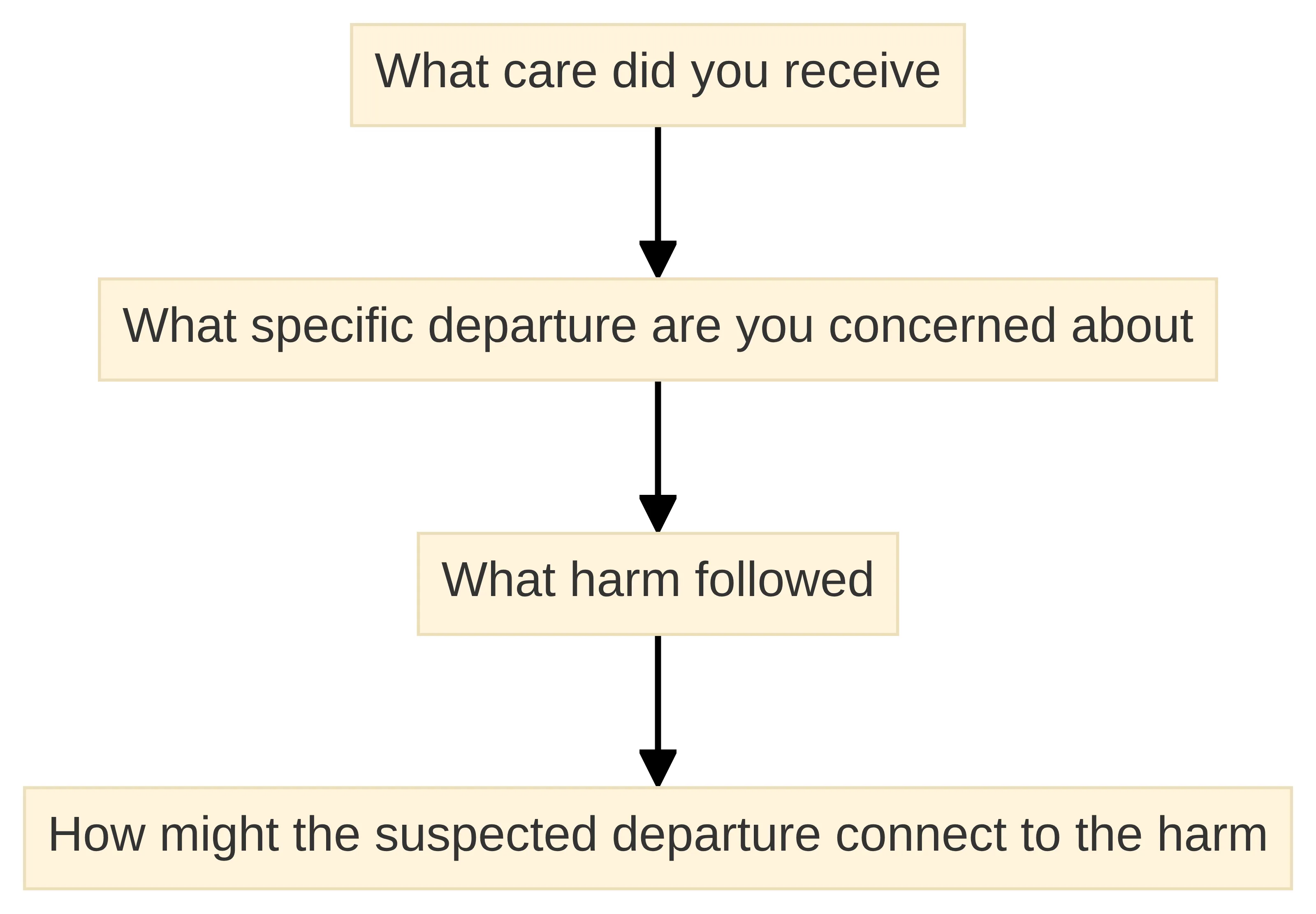
Four questions can organize a suspected medical-malpractice concern before you contact a lawyer. The questions do not determine whether you have a claim. They separate the medical care, suspected departure, connection to harm, and consequences that need review.
-
What care did you receive? Identify the provider, facility, department, procedure, medication, test, diagnosis, or treatment involved. Note your condition before the care and the symptoms, diagnosis, or treatment that followed. Medical records can help show your condition before the suspected mistake, the care provided, and what happened afterward.
-
What specific departure are you concerned about? Describe the act, omission, delay, communication problem, medication issue, or other event that seems out of place. State what you expected to happen only if that expectation comes from a specific conversation or record. Do not treat an unfavorable result as proof that the care departed from accepted medical practice.
-
What harm followed? Identify the injury, worsening condition, additional treatment, continuing symptoms, or other consequence you experienced. Add dates where you can. Keep the description separate from estimates about compensation. The first review needs a factual account of what happened to you, not a predicted case value.
-
How might the suspected departure connect to the harm? Explain the sequence as you understand it: the care, the suspected problem, and the injury or worsening condition. A mistake alone does not establish causation. The evidence generally must connect the alleged departure from accepted practice to the injury for which you seek relief.
These four questions also show where your account is incomplete. A missing date, unknown provider, or unavailable record does not automatically end the inquiry. List the gap and identify who may have the information. Your pre-consultation account should make the facts traceable and preserve the questions that remain open.
The questions are a way to organize information, not a scorecard. One answer may be detailed while another is only an approximate recollection. That difference should remain visible in the account. A date taken from a discharge record can be labeled separately from a date remembered by a family member, and a later diagnosis can be recorded without assuming that it explains the earlier symptoms.
It is also useful to note what would change the account. If a missing operative record, medication record, imaging result, or provider note could clarify the suspected departure or the later harm, identify that document and the provider or facility associated with it. If the available records contain different dates or descriptions, preserve both rather than choosing the version that appears to support the concern. A consultation can then focus on the disagreement, the missing material, and the connection between the care and the injury.
Treat Causation as the Question the Records Cannot Answer Alone
Causation asks whether the suspected departure from accepted medical practice caused the injury or worsening condition. Medical records can show the sequence of care, but the sequence alone does not establish that the suspected mistake caused the result. A condition may have more than one possible cause, and the legal question requires a connection between the alleged departure and the harm.
Write the causation portion of your account in three stages:
- Before care: Describe the condition, symptoms, diagnosis, test results, or limitations that existed before the event you question.
- Care and suspected problem: Identify what the provider did or did not do, when it happened, and what record or conversation supports your understanding.
- After care: Describe the new injury, worsening condition, additional treatment, changed diagnosis, or other consequence, with dates and providers where available.
This structure does not prove the connection. It makes the proposed connection visible for review. A qualified medical expert usually evaluates whether care departed from accepted practice and whether that departure caused the injury. New York case law also illustrates that detailed, specific, factual expert evidence may matter when the question is whether alleged negligence proximately caused injury or death.
Do not remove facts that seem to weaken your concern. Include earlier symptoms, other treatment, later diagnoses, pre-existing conditions if you know about them, and periods when the condition improved or stayed the same. A complete sequence gives the legal and medical reviewers a way to examine competing explanations. Your role before the consultation is to preserve the account accurately, not to choose the explanation that produces the strongest conclusion.
Build a Before-and-After Care Timeline
A before-and-after care timeline shows how your condition changed in relation to the medical care you are questioning. Medical records can document your condition before the suspected mistake, the treatment you received, and what happened afterward. Your own timeline helps you locate those records and identify gaps.
Create the timeline in date order. For each event, record:
- The date and approximate time, if known.
- The provider, facility, department, or practice involved.
- Your symptoms, diagnosis, test, procedure, medication, or treatment.
- What you were told and what instructions you received.
- What changed afterward, including new symptoms, worsening symptoms, additional treatment, or a new diagnosis.
- The name of the next provider or facility and the reason for the visit.
- The record, bill, message, discharge paper, or other document that may support the entry.
Use exact dates when a record supplies them. Mark an entry as approximate when you are relying on memory. Do not silently replace an uncertain date with a guess. A timeline can show that you need to request a record, ask a family member what they remember, or explain an uncertainty during the consultation.
Separate what you personally observed from what another provider later told you. For example, list the symptom you experienced on one line and the later diagnosis on another. This keeps the sequence clear without treating a later statement as proof of why the earlier event occurred.
A short timeline is useful even when the underlying care lasted months. Start with the condition before the suspected problem, continue through the care that concerns you, and end with the treatment and effects that followed. Keep the longer records available, but bring a concise version that allows the first conversation to focus on the unresolved facts.
Prepare a Factual Consultation Brief
A factual consultation brief gives you a compact way to explain the care, suspected mistake, resulting harm, and available records. Medical records can show the treatment timeline, while bills, wage records, receipts, treatment records, and other documents can show the financial and personal effects of the injury.
Keep the brief to a few organized pages and include:
- Your name and contact information, plus the name of the family member whose care is at issue if you are contacting a lawyer for someone else.
- The providers, hospitals, clinics, pharmacies, and other facilities involved.
- A short description of the condition before the suspected mistake.
- The date range of the care and the event that concerns you.
- The specific act, omission, diagnosis, delay, procedure, medication, or communication issue you want reviewed.
- The injury, worsening condition, additional care, or other consequence that followed.
- The names and dates of later providers who treated or evaluated the condition.
- A list of records you already have and records you still need to request.
- Medical bills, receipts, wage information, treatment records, and other documents that show how the injury affected your life.
- A list of questions about timing, the responsible provider or entity, records, fees, and the next stage of review.
Use neutral descriptions. Write that you believe a diagnosis was delayed, a medication may have been incorrect, or a procedure produced a concerning result. Avoid presenting those statements as established negligence. Include facts that are inconvenient or incomplete, and label your own memory as approximate when necessary.
Bring the original records or organized copies if available, but keep a copy of everything you provide. Do not discard messages, discharge papers, bills, or appointment records because they appear repetitive. A document that seems routine may help establish a date, provider, instruction, or change in your condition.
Request New York Medical Records in Writing
A New York medical-records request should be made in writing to the physician or health-care facility. The request should identify the qualified person making it, identify the provider, describe the information sought, and be signed. A provider may require the signature to be notarized.
A written request is easier to track than an informal conversation. Include:
- Your full name and identifying information used by the provider.
- The provider, practice, hospital, or facility that holds the records.
- The date range and types of information you want, such as office notes, test results, imaging, medication records, operative materials, discharge records, or billing records.
- The name and address of any third party to whom the records should be sent, if you are directing delivery elsewhere.
- Your signature and the date of the request.
New York guidance identifies the patient and certain authorized guardians, parents, estate representatives, and attorneys with a signed power of attorney as qualified persons who may request records. If you are requesting records for a minor, deceased family member, or another person, identify the authority that permits you to make the request. An attorney requesting records for a qualified person needs a signed power of attorney authorizing the request.
Keep a copy of the request and note when you sent it. Record any response, missing category, or stated reason for delay. If access to your medical records is denied, New York guidance says you may appeal without charge, and the provider must give you a form explaining the appeals process.
Requesting records does not establish that malpractice occurred. It gives you a more complete account of the care and may help identify the dates, providers, and events that require legal review. If you do not yet have every record, prepare the consultation brief with the materials you do have and list what remains outstanding.
Use a simple tracking entry for every provider or facility named in the care history. Record the entity’s name, the date of the written request, the date range and categories requested, the person or entity authorized to receive the records, and the response. If one response supplies only part of the requested material, identify the missing category instead of treating the response as complete. For example, a file may still require a test result, operative material, medication record, discharge record, or billing record that was not included in the first production. The point of the tracker is not to predict what the missing document will show; it is to make the gap visible.
Keep the request and the response together with the timeline. A request date can help explain why a record was unavailable when the consultation brief was prepared, while a response can identify a different provider, facility, or date that belongs in the history. If the provider asks for a notarized signature or other clarification, record that request and ask what must be supplied before access can be considered. If you are acting for another person, keep the authorization or other authority information with the request so the lawyer can see why you sought the records.
When a request is denied, do not silently replace the missing information with your recollection. Preserve the denial, use the supplied appeal form if appropriate, and note whether the appeal remains pending. Bring both the denial and the appeal status to the consultation. This gives the reviewer a way to distinguish an unresolved access problem from evidence that does not exist and to decide whether the record issue affects the care, causation, consequences, or timing analysis.
Preserve Proof of the Injury’s Consequences
Documentation of the injury’s consequences shows what changed after the medical care and how the condition affected your finances and daily life. Medical bills, wage records, receipts, treatment records, and other documents can help establish the financial and personal effects of an alleged medical injury.
Create separate folders or digital groups for:
- Bills from the original provider, later providers, hospitals, pharmacies, testing facilities, and rehabilitation services.
- Insurance statements, payment records, balances, and receipts for amounts you paid.
- Wage records, employer communications, or other documents showing time away from work or changes in earnings.
- Treatment records that describe continuing symptoms, additional care, restrictions, or changes in your condition.
- Receipts and records for travel, equipment, prescription costs, or other out-of-pocket expenses connected to treatment.
- A dated personal account of limitations, recurring symptoms, care needs, and changes in ordinary activities.
Keep the documents in date order and retain the originals or unaltered copies. Do not calculate a settlement amount from the total of your bills. The records document consequences for review; they do not by themselves establish a departure from accepted practice or prove that the departure caused the injury.
If a consequence is difficult to document, describe it clearly in the brief and identify who may have supporting information. A missed work period may appear in payroll records, while a change in daily activities may be recorded in treatment notes or explained by a family member. Mark estimates as estimates. Clear labeling helps keep documented amounts, personal observations, and unresolved questions separate.
Put Timing Questions on the First Call
Timing questions belong at the beginning of a medical-malpractice review because New York deadlines depend on the type of claim, the conduct involved, the treatment history, and statutory exceptions. Do not wait until your records are complete before raising the dates with a lawyer.
New York generally provides a two-year-and-six-month limitations period for a medical-malpractice action, measured from the act or omission—or, in applicable continuous-treatment situations, the last treatment for the same illness, injury, or condition—subject to exceptions. The statute includes provisions for some claims involving a foreign object and alleged negligent failure to diagnose cancer or a malignant tumor.
That general description is not a calculation for your situation. Start a date list that includes:
- The date of the suspected act, omission, diagnosis, procedure, medication, or failure to act.
- The date of the last treatment for the same illness, injury, or condition, if treatment continued.
- The date you first learned of a later diagnosis, foreign object, worsening condition, or other event relevant to the concern.
- Each appointment, procedure, discharge, referral, and follow-up visit connected to the same condition.
- Any date when a public entity, municipal facility, or other organization became part of the care history.
Take this list to the first legal conversation and ask which date and rule applies to the claim being considered. A date that appears to be the starting point may not control after the provider, treatment pattern, claim type, and statutory exception are examined. Prompt review gives the specific facts and applicable timing rules a chance to be evaluated before a deadline question becomes urgent.
Check Whether a Public Defendant Changes the Timing Analysis
A public provider or facility can create a separate notice-of-claim question in addition to the ordinary medical-malpractice limitations analysis. The identity of the defendant matters, so include every hospital, clinic, agency, and organization named in your records when you prepare the timeline.
For claims subject to New York’s municipal notice-of-claim rule, the courts’ guidance states that notice generally must be served within 90 days after the claim arises. Whether that rule applies depends on the defendant and the claim. The cited municipal guidance does not establish that a 90-day deadline applies to every medical-malpractice matter.
Use the first consultation to ask directly:
- Is any provider, facility, or organization a public entity?
- Does the proposed claim require a notice of claim?
- If so, when did the claim arise for that purpose?
- What must the notice contain, and who must receive it?
- Does another deadline apply alongside the notice requirement?
The court guidance describes a notice as a written, sworn document that identifies the claimant and attorney if applicable, explains the nature of the claim, states when and where it arose, describes how it arose, and identifies the injuries or damages claimed to the extent practicable. Those details show why a public-entity question should be raised early rather than treated as a routine records issue.
Do not assume that a public hospital, public employee, or government connection produces the same route in every case. Put the organization’s exact legal name, address, and role in the consultation brief and ask how that status affects timing.
Know What the Initial Review Cannot Establish
An initial review cannot decide whether malpractice occurred from the outcome alone. A bad result or medical error does not automatically show a departure from accepted medical practice, and the evidence must also connect the alleged departure to the injury. The first conversation identifies the facts that require deeper review; it does not replace that review.
Your records may not answer every question. Detailed, specific, factual expert evidence may matter when causation is disputed.
The initial review also should not be treated as a prediction of compensation. Bills, wage records, receipts, and treatment records document financial and personal effects, but they do not independently establish liability or determine what a claim may be worth. Keep those subjects separate:
- Care: What treatment, diagnosis, procedure, medication, or omission occurred?
- Standard: What departure from accepted medical practice is being considered?
- Causation: What evidence may connect that departure to the injury or worsening condition?
- Consequences: What medical, financial, and personal effects can be documented?
- Timing: Which limitation or notice rules may apply to the specific defendant and claim?
A careful first review can identify missing records, unclear dates, competing explanations, and questions for expert evaluation.
Use the Consultation to Resolve the Open Questions
A consultation is most useful when your prepared facts lead to specific unanswered questions. Bring the timeline and factual brief, then use the meeting to identify what must be established about the care, possible departure, causation, consequences, and timing.
Questions to put on your list include:
- Which part of the care requires medical review first?
- What records are missing from the timeline, and which provider or facility may hold them?
- Does the concern involve a diagnosis, delay, procedure, medication, birth injury, or another category that needs a different factual review?
- What facts would help distinguish an accepted medical risk from a possible departure from accepted practice?
- What information is needed to evaluate whether the suspected departure caused the injury or worsening condition?
- Does the timeline show any earlier symptoms, later treatment, or other event that may affect causation?
- Which bills, wage records, receipts, and treatment records should be added to the file?
- Which limitations period applies, and does continuous treatment or a statutory exception matter?
- Is a public entity involved, and could a notice-of-claim requirement apply?
- What additional records, authorizations, or expert review would be needed before a decision can be made?
- What fee arrangement and case expenses would apply if the matter proceeds?
A consultation may also clarify what cannot be determined from the materials you brought. That is a useful result. You can leave with a list of missing records, dates that need confirmation, and the factual issues that require professional evaluation instead of relying on a conclusion based only on the outcome.
Confirm Medical-Malpractice Scope, Fees, and Expenses
The Law Offices of Evan W. Kohn offers free consultations and operates 24/7. A free initial conversation gives you a way to present the prepared facts and ask whether the matter can be reviewed within the office’s medical-malpractice scope.
Use that conversation to ask focused questions rather than assuming that every injury, provider, or medical outcome follows the same legal route. Ask what information the office needs, whether additional records are required, and what questions remain unresolved about the care, causation, defendant, and timing.
The Law Offices of Evan W. Kohn offers free consultations and contingency-based representation. Ask whether that arrangement applies to your medical-malpractice matter and confirm the specific fee terms.
- Which case expenses might arise?
- How would expenses be handled if the matter does not proceed?
- What work would occur before any decision to move forward?
- What documents would explain the arrangement?
The consultation being free does not itself answer those questions. The supplied business information describes the representation as contingency-based, but it does not specify a percentage, expense treatment, or whether the arrangement applies to this particular medical-malpractice matter. Confirm those terms directly before deciding whether to proceed. Keep the consultation brief factual and separate from any decision about representation. Your prepared timeline can help the conversation stay focused on the suspected medical mistake, resulting harm, available records, and dates that may affect review.
Request an Accessible Consultation With Your Prepared Facts
A suspected medical mistake is ready for an initial legal review when you can describe the care, the specific concern, the harm that followed, the available records, and the dates that may control the analysis. You do not need to decide that malpractice occurred before seeking that review. A qualified New York professional must evaluate whether your specific facts support a claim and which deadlines or notice rules apply.
Prepare your timeline, records request, consequence documents, and question list before the conversation. If travel is difficult, we can arrange home or hospital visits for clients who cannot travel. Bring a concise account of the care, suspected mistake, resulting harm, timing, and records you have gathered.
Frequently Asked Questions About a Medical-Malpractice Consultation
What are common examples of medical malpractice that may warrant legal review?
Common examples include misdiagnosis or delayed diagnosis, surgical errors, medication mistakes, birth injuries, and conditions that worsen after treatment. Each situation requires careful evaluation to determine if negligence occurred.
What basic information should I gather before contacting a medical malpractice lawyer?
You should collect details about the medical care received, the specific problem you believe occurred, the harm that followed, and relevant dates. Organizing medical records, bills, and any other documentation will also be helpful.
How does New York's statute of limitations affect medical malpractice claims?
In New York, the general statute of limitations for medical malpractice claims is two years and six months from the act or omission, or from the last treatment for the same condition, subject to certain exceptions.
What is the process for requesting medical records in New York?
To request medical records, submit a written request to the healthcare provider or facility, identifying yourself as a qualified person, specifying the records needed, and signing the request. Notarization may be required.
What should I do if my request for medical records is denied?
If access to your medical records is denied, you can appeal the decision without charge. The provider must provide a form explaining the appeals process.
What types of documentation can help establish the consequences of a medical injury?
Documentation such as medical bills, wage records, treatment records, and personal accounts of how the injury has affected your life can help establish the financial and personal impacts of the injury.
What questions should I ask during my initial consultation with a medical malpractice lawyer?
During the consultation, ask about the specific facts that need review, what records may be missing, the applicable statute of limitations, and the fee arrangement for representation.
Hurt like this?
We handle Medical Malpractice cases in the Bronx.
Evan W. Kohn, Esq. — more than 35 years of Bronx personal-injury practice. Reading about it only goes so far; a free consultation tells you what actually applies to your case.