
Medical Malpractice
When a New York Medical Outcome May Warrant Legal Review

Start with timing and unresolved-fact questions
Start by separating the decision from the diagnosis: ask whether any timing concern needs prompt attention and which factual questions an attorney should examine. It should begin with facts and open issues, not with a conclusion that malpractice occurred.
An unexpected or harmful medical outcome alone does not establish malpractice. A clinical error and a malpractice claim are not necessarily the same thing. That distinction matters after a misdiagnosis, delayed diagnosis, surgical concern, medication mistake, birth injury, or another result that left you or a family member worse than expected.
A short preparation note can show whether a case-specific discussion would be useful. Write down:
- What outcome caused concern.
- Which questions remain unanswered.
- Where and when the care occurred, including whether it was in the Bronx, another New York City borough, elsewhere in New York, or New Jersey.
- Which records, bills, messages, and names you already have.
You do not need to decide fault before taking this step. You need a clear starting point.
The decision at this stage is not whether you can prove a case. The decision is whether the combination of a concerning outcome, incomplete answers, and available information justifies asking an attorney to examine the facts. A consultation can be appropriate even when your account contains uncertainty or the records are still incomplete.
Describe the concern without assigning fault
A medical concern is easier to review when you describe the event without labeling the provider’s conduct. Possible starting points include a diagnosis that came later than expected, a condition that was not identified, a procedure that raised new concerns, a medication issue, or an injury connected with childbirth. These categories can make legal review worth considering, but none of them by itself answers whether malpractice occurred.
A factual concern statement separates what you observed from what you suspect. Use language such as:
- Record the first visit date, the symptoms or condition discussed, and the instructions you received.
- Note when a test was ordered, when it was performed, and when you learned the result.
- Describe what changed after a procedure, medication, or delivery without stating why the change occurred.
- Mark any date, record, or decision that you cannot yet confirm.
This format keeps the account useful even where your memory is incomplete. It also gives the attorney a way to distinguish a documented event from an interpretation that still needs investigation.
A concern involving more than one facility or provider deserves a separate line for each location. Note the hospital, clinic, office, pharmacy, or other care setting as you remember it, along with the people involved and the dates connected to each event. If care crossed from New York into New Jersey, mark that transition rather than assuming every part of the matter follows the same rules. Keep the description neutral: “I want to understand whether the care and the injury are legally connected” is more useful at this stage than “the provider caused the injury.”
A family member’s account can add useful context when the patient was a child, sedated, hospitalized, or otherwise unable to record events personally. Identify who observed each event and separate that person’s memory from the medical record. If you are preparing information for someone else, note your relationship and any authority that may affect access to records.
Write the care timeline while details are available
A care timeline gives your initial discussion an ordered account of symptoms, appointments, tests, treatment, communications, and changes in condition. Create it before trying to explain why the outcome happened. The timeline is a working document, not a finished legal theory.
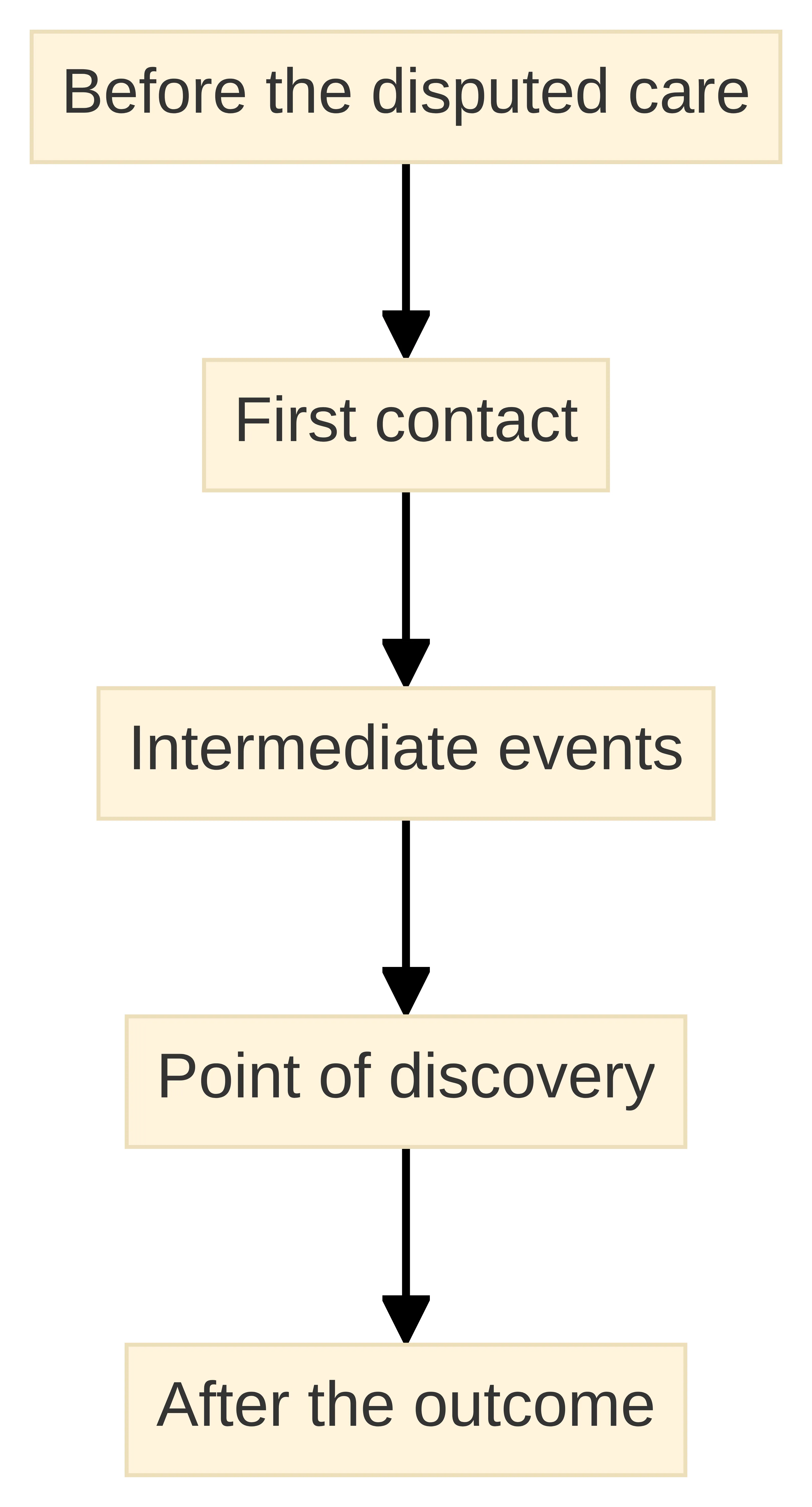
A practical timeline can follow this sequence:
- Before the disputed care: Record the symptoms, diagnosis, treatment, or pregnancy-related circumstances that existed before the concern arose. Include your own account of your condition without trying to prove what caused it.
- First contact: Note the date, location, reason for the visit, symptoms described, tests ordered, medications discussed, and instructions you received.
- Intermediate events: Add follow-up visits, referrals, test results, calls, portal messages, prescriptions, procedures, and any change in symptoms.
- Point of discovery: Record when you first learned of the diagnosis, complication, medication issue, or possible delay. If you do not know the exact date, mark the best estimate and identify how you remember it.
- After the outcome: List later treatment, additional opinions, hospital visits, work interruptions, expenses, and continuing effects.
Use separate entries when two events happened on the same day. A short entry with a reliable date is more useful than a long entry that blends several visits together.
A timeline should show the difference between a record and a recollection. Label each entry as “documented,” “my memory,” or “needs confirmation.” Add the name of the document, portal message, bill, or person connected with the entry. If two records conflict, preserve both dates and mark the conflict instead of selecting the version that seems more favorable. The disagreement itself can become a focused question for the consultation.
The timeline should also identify transitions between providers and facilities. Record when responsibility appeared to move from a primary-care office to a specialist, hospital, pharmacy, or later treating provider. Add the reason for the transition if you know it, and mark the reason as unknown when you do not. This helps keep separate events from being blended into one account.
Gather the materials that show what happened
A consultation file should bring together the materials that show the care, the outcome, and the practical effects. Gather what you can; an incomplete file is still usable. Start with these groups:
- Medical records: Visit notes, test orders, test results, imaging reports, operative or procedure records, discharge papers, medication lists, referral records, and follow-up notes.
- Financial records: Medical bills, payment notices, insurance correspondence, receipts, pharmacy costs, travel expenses, and documents showing time away from work.
- Communications: Patient-portal messages, emails, letters, text messages, voicemail details, appointment confirmations, and written instructions.
- Personal account: Your timeline, symptom notes, names of people who observed changes, and a list of questions you cannot answer from the documents.
- Later-care materials: Records from another provider, emergency visits, corrective treatment, rehabilitation, or additional testing.
Sort the materials by date if you can. Keep the original files in their original form and work from copies when adding notes.
Each item should have a reason for being in the file. A test result may show what was recorded at a particular time. A bill may show a charge or payment. A message may establish what question was raised and when someone responded. A later medical record may explain what another provider observed after the disputed care. Do not assume that a document proves the interpretation you currently hold; identify what the document actually says.
A simple index can keep the file usable:
| Date or range | Item | Source or location | What it may clarify |
|---|---|---|---|
| Date or range | Visit note | Patient portal or facility | Symptoms, examination, instructions |
| Date or range | Test or imaging report | Facility records | Result and reporting date |
| Date or range | Bill or insurer letter | Paper or digital file | Cost, payment, or coverage question |
| Date or range | Message or call note | Portal, email, or personal record | Question raised and response |
Use “unknown” when you do not know the date or location. That is more useful than leaving an item unexplained.
A consultation file can use separate folders for medical records, communications, financial documents, and your timeline. Give each file a short descriptive name that includes the date when known. Keep a list of missing items beside the index rather than treating the missing material as if it does not exist. The list shows which questions still depend on another record.
If the file is too large to assemble at once, begin with the documents that anchor the sequence: records for the first concerning visit, the test or procedure at issue, the point when the outcome was recognized, and the later care that followed. Add the communications that explain what was asked or reported at each point, then add bills and work-related materials. This order is not a conclusion about the case; it is a way to make the core sequence reviewable while the remaining materials are still being collected.
Preserve the full record, including uncertainty
Preserving the full record means keeping favorable, unfavorable, incomplete, and conflicting information together. Save portal messages and attachments, download records when available, keep paper documents, and retain copies of correspondence with facilities, providers, insurers, and pharmacies. Do not rewrite an original note to make the sequence clearer; add a separate explanation instead.
A preserved uncertainty is a useful question, not a failure in your preparation. Mark statements such as “I remember discussing this, but I do not have the note,” “The result date and notification date differ,” or “I do not know whether the referral was completed.” These distinctions help separate what is established from what still needs review.
An unexpected result can be serious without establishing malpractice on its own. Keep your preparation focused on what happened, what the records show, what injury followed, and what remains unknown. Avoid deleting material or changing your account simply because it does not fit your initial suspicion.
A separate correction log can preserve changes to your working account without altering the original record. If you remember an additional detail, write the date you added it and explain whether it came from memory, a document, or another person’s account. If your recollection changes, keep the earlier version and identify the reason for the update.
Use New York access rules as a records checkpoint
New York law provides a process for a qualified person to request patient information in writing, but statutory exceptions and limitations can apply. New York Public Health Law § 18 addresses access to patient information and includes limitations involving potential substantial and identifiable harm, personal notes and observations, and other specified exceptions.
A written request can help you identify what you asked for, when you asked, and what the provider supplied. Keep a copy of the request, the delivery record, any response, and a list of records that appear to be missing. If a facility offers inspection rather than copies, record that option and note what you were able to review. The statute’s exceptions mean that access is not an automatic answer to every records question.
Use the access process as a checkpoint rather than as a reason to postpone legal contact until every file arrives. A consultation can address which records appear central, which gaps need follow-up, and how to describe a response or denial. If you are requesting records for another person, note your relationship and authority to make the request; do not assume that another person’s records are available to you on the same terms as your own.
A records-request log should include the provider or facility, the date of the request, the information requested, the delivery method, and the response. Add the date of any partial production and describe what appears to be missing. This log keeps a records issue separate from the underlying question about the care.
Compare the response with the request line by line. Mark each item as received, partially received, not received, or unclear, and keep the provider’s wording with the log. If you cannot tell whether a missing item is covered by an exception or was simply omitted, record that uncertainty as a question for counsel rather than treating the absence as proof of what the record contains. This preserves the difference between a records-access issue and a conclusion about the care.
Raise timing questions before the file is complete
Medical-malpractice filing periods are legally prescribed and vary by state. A general online time estimate may not account for the facts, people, facilities, locations, or legal route involved in your situation.
A timing note should identify:
- The dates of the care, procedure, diagnosis, or alleged delay.
- When you first noticed the injury or learned of the concern.
- When another provider discussed a possible error or different explanation, if that occurred.
- The names and locations of the providers and facilities involved.
- Whether any care or provider was connected with New Jersey or another state.
- Any notice, claim, insurer, facility, or legal correspondence you have received.
Use exact dates where you have them and label estimates. Keep the original envelope, email header, or delivery confirmation for time-sensitive communications.
Timing questions belong near the beginning of your contact note, not at the end of your records project. Ask what dates need immediate attention, which jurisdiction’s rules may be relevant, and whether waiting for additional records changes the practical next step. Do not treat the absence of a finished file as permission to wait without asking about timing.
A New York location does not by itself resolve every timing question when care, providers, facilities, or later treatment crossed into New Jersey or another state. List every relevant location and date before the consultation. Filing periods vary by state, so the location history belongs in the first group of facts you provide.
Understand why the lawyer must investigate beyond the outcome
In general, obtaining compensation for medical negligence requires proving that substandard medical care resulted in an injury. That premise explains why a poor or unexpected outcome is a starting point for questions, not a final answer. The review must connect the care, the alleged departure from appropriate care, and the injury through the facts and records of your matter.
An attorney may need to examine several separate issues:
- What condition or risk existed before the disputed event.
- What the provider knew or recorded at each relevant point.
- What testing, treatment, warning, referral, or follow-up appears in the records.
- What changed after the care and how that change was documented.
- Whether another explanation for the outcome appears in the medical history.
- Which records or professional opinions are needed to evaluate the unresolved connection between care and injury.
These are investigation questions, not conclusions for you to reach from a symptom, bill, or single report.
New York generally requires a medical-malpractice complaint to include an attorney-executed certificate of merit under CPLR § 3012-a. The certificate-of-merit rule addresses attorney review and consultation with a qualified physician, with a stated exception involving a time limitation that would bar the action before consultation can be obtained. This procedural requirement is another reason to raise timing and record questions during the initial legal discussion rather than treating preparation as an indefinite project.
A possible case can involve several questions that should remain separate: what care was provided, what standard or decision is being questioned, what injury followed, and what evidence connects the two. Your preparation is stronger when each question has its own timeline entry or document rather than one broad statement that the care caused the outcome.
One useful review order is to ask: (1) what happened and when, (2) what the provider knew or recorded then, (3) what condition or injury appeared afterward, and (4) what evidence still connects or separates those events. This order helps prevent the later outcome from becoming the explanation for every earlier decision. It also shows why a consultation may remain worthwhile when the file contains a serious outcome but not yet a clear explanation.
Turn the prepared record into focused questions
A focused consultation question connects a document or timeline entry to a decision you need to understand. Organize your questions into four groups:
- Fit: Does the concern fall within the type of medical-malpractice review the attorney handles?
- Record: Which missing notes, results, communications, or billing materials matter most?
- Timing: Which dates should be evaluated first, and does a New York or New Jersey connection affect the analysis?
- Next step: What additional facts, records, or professional review would be needed before deciding how to proceed?
Bring the questions in writing so an incomplete answer can become a follow-up item rather than being forgotten.
Questions can be direct without asking the attorney to promise an outcome. For example:
- “What part of my timeline needs clarification?”
- “Which records should I request first?”
- “What does the conflicting date or note change about the review?”
- “What facts would support or weaken the possible connection between the care and the injury?”
- “Which timing questions require prompt attention?”
- “What would you need to learn before deciding whether there is a reasonable basis to proceed?”
These questions keep the discussion tied to your file instead of to a general description of malpractice.
State connection is a question to raise when care, providers, facilities, or later treatment cross borders. Filing periods vary by state, so do not assume that a New York location answers every timing issue. Give the attorney the full location history and ask which rules need to be considered.
A one-page opening brief can put the main issues in order:
- The patient and the care locations.
- The event or outcome that caused concern.
- The key dates and any date conflicts.
- The records already gathered and the records still missing.
- The injury or practical effect being reported.
- The three questions that need the clearest answer first.
Attach the detailed index separately. The opening page should orient the conversation, not replace the underlying records.
Before the discussion, mark each question as either a document question, a medical-history question, or a timing question. A document question points to a missing or conflicting item; a medical-history question identifies facts about the condition before or after care; a timing question identifies a date or location that may need prompt review. This sorting helps the attorney see which answers may come from the file and which may require further investigation, without asking the opening page to decide fault.
Take the next step toward a case-specific review
A prepared file does not need to prove malpractice before you ask for legal review. It needs to show the sequence of care, the outcome that concerns you, the records you have, the gaps you found, and the timing questions that cannot wait. A qualified attorney must decide whether your facts support a claim and what legal steps may be available. The Law Offices of Evan W. Kohn has over 35 years of experience helping clients navigate the complexities of healthcare law.
Bring the timeline, records index, communications, bills, and unanswered questions so the discussion can focus on your circumstances. Requesting a consultation does not require you to reach a conclusion about fault before the conversation begins.
Questions to ask before requesting a medical-malpractice consultation
What should I gather before a medical malpractice consultation?
Before a consultation, collect relevant medical records, bills, communications, and a timeline of events. This includes visit notes, test results, and any correspondence related to your care.
How can I determine if my medical outcome warrants legal review?
A medical outcome may warrant legal review if it involves an unexpected or harmful result, such as a misdiagnosis or surgical error. However, an adverse outcome alone does not establish malpractice.
What are the key elements of a medical malpractice claim in New York?
In New York, a medical malpractice claim generally requires proving that substandard medical care resulted in injury.
What should I do if I suspect a medical error has occurred?
If you suspect a medical error, document your concerns, gather relevant records, and consider scheduling a consultation with a medical malpractice attorney to discuss your situation.
Hurt like this?
We handle Medical Malpractice cases in the Bronx.
Evan W. Kohn, Esq. — more than 35 years of Bronx personal-injury practice. Reading about it only goes so far; a free consultation tells you what actually applies to your case.