
Workers' Compensation
Should You Contact an Injury Lawyer Near You After a New York Workplace Injury? A Practical Decision Guide

Begin with the question a consultation can answer
A New York workplace-injury consultation can help you identify which legal process may apply, what facts still need review, and what timing questions require prompt attention. That is a more useful starting point than trying to decide on your own whether you have a valid claim or what your case might be worth.
Your work injury may involve an employer-based workers’ compensation process. It may also involve facts pointing to a possible claim against a responsible party other than your employer. Those routes can involve different questions, records, and procedures. A consultation gives you a place to separate them instead of treating every workplace injury as a single issue.
Contacting an injury lawyer may be worth considering if any of the following describes your situation:
- You were injured while working in New York, including after a fall from a scaffold or ladder, an equipment incident, or an accident at a construction site.
- You do not know whether the injury was reported correctly to your employer, the workers’ compensation carrier, or the New York Workers’ Compensation Board.
- Someone other than your employer may have controlled the property, supplied equipment, managed the worksite, or contributed to the condition that caused the injury.
- An insurer, employer, contractor, property owner, or government-connected entity has asked you to provide information before you understand the process.
- Your injury has left you unsure what records to keep, what deadlines may apply, or how workers’ compensation differs from a personal-injury claim.
- You cannot travel easily and need to know whether an accessible consultation option is available.
These circumstances do not establish that you can recover damages or that another party is legally responsible. They identify unresolved questions that may justify legal review. The first conversation should help organize those questions around what happened, who was involved, which route may apply, and what must be done next.
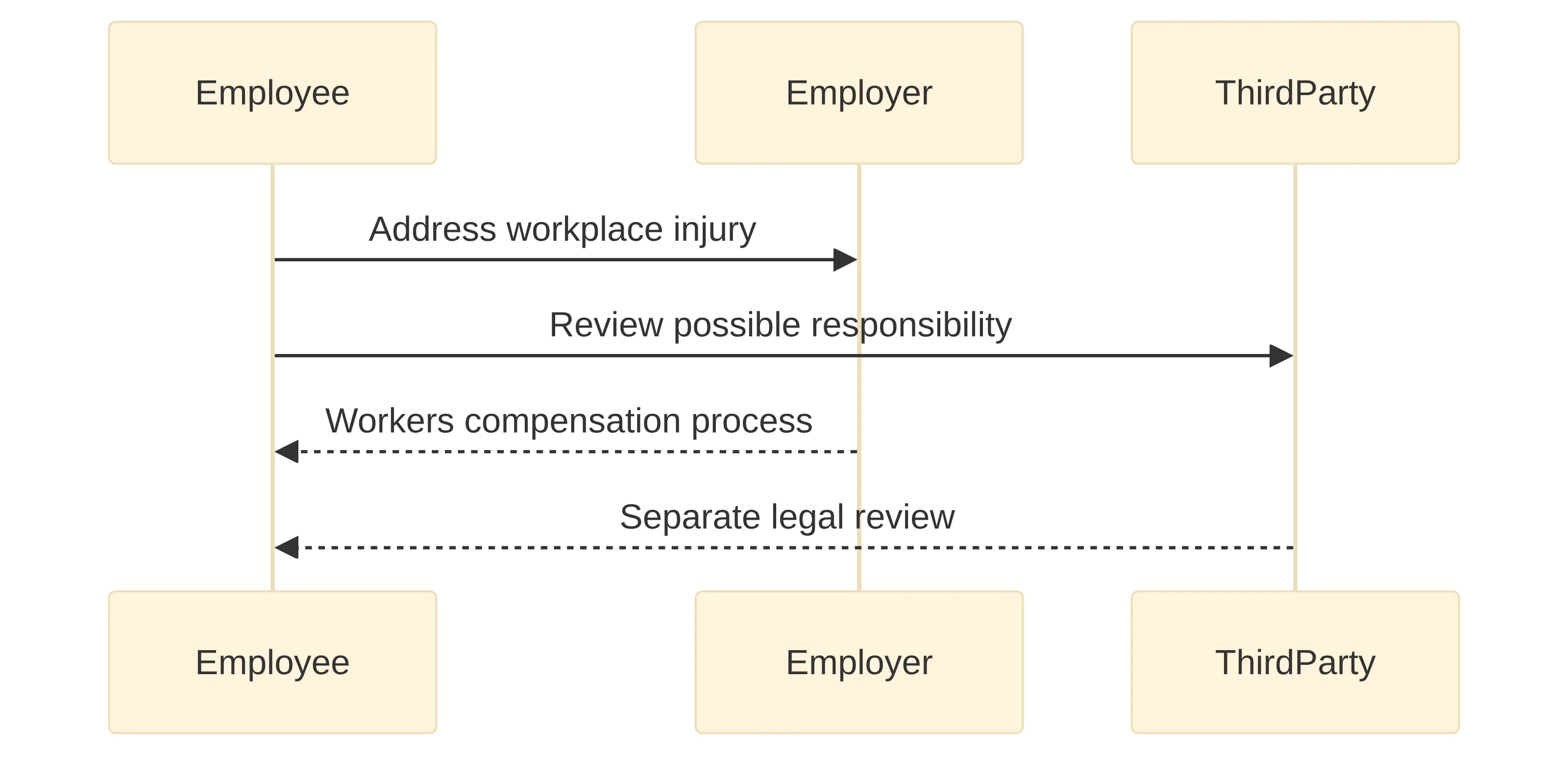
Treat the injury as two possible legal routes
A New York workplace injury may require separate review of workers’ compensation and a possible third-party personal-injury claim. Workers’ compensation generally provides the exclusive remedy against an employer, while New York law permits certain claims against parties other than the employer. The distinction matters because the identity of the potentially responsible party can change the legal questions you need answered.
The employer route starts with the workplace injury and the workers’ compensation process. It focuses on reporting, the employee claim, medical information, and the benefits or procedures that may be available under that system. You should not assume that an employer’s workers’ compensation coverage answers every question about the accident.
The third-party route asks whether a non-employer contributed to the injury. A non-employer connection to the injury may require a different review from the claim involving your employer.
A possible third-party claim does not replace the need to address workers’ compensation. The two routes can involve different parties and procedures, and you need a fact-specific review before deciding whether either route is available. Keep the names and roles of everyone connected to the worksite, equipment, property, and accident rather than assuming that the business issuing your paycheck is the only relevant entity.
The potential relief can also differ. That statement describes a possible difference between legal routes; it does not predict whether your facts support such a claim or what result you might obtain.
Use the two-route question as an organizing tool:
- Identify the employer and the workers’ compensation information you have.
- List every non-employer business or person connected to the location, equipment, project, or unsafe condition.
- Separate what you know from what you suspect about each participant’s role.
- Bring both lists to a consultation instead of choosing a legal theory before the facts are reviewed.
The practical boundary is simple: start the employer-based process that may apply, while asking whether another responsible party requires separate legal review.
Overview
A New York workplace-injury decision has four connected parts: identify the event, protect the timing questions, preserve the available record, and use a consultation to compare the possible routes. You can work through them in that order even when the accident details are incomplete.
The route map below shows what to examine:
- The event: Record when and where the injury happened, what task you were performing, what changed, and who was present.
Late reporting can carry consequences described by that guidance. - The employee claim: If you are pursuing New York workers’ compensation, the Workers’ Compensation Board guidance says to file Employee Claim Form C-3 as soon as possible and states that the form must be filed within two years of the accident.
Applicability must be confirmed promptly. - The other-party question: Workers’ compensation generally concerns the employer relationship, while a possible third-party claim may involve a property owner, general contractor, equipment manufacturer, or another non-employer party.
- The consultation file: Gather the accident account, medical and work records, communications, names, photographs, and open questions without presenting your summary as a final legal conclusion.
The order is practical rather than rigid. A potential government connection or a rapidly disappearing record can move timing review to the front. A serious injury can make it harder to gather documents yourself, so ask for help and keep the initial account as accurate as you can.
A consultation does not require a polished case file. It requires enough information to show what happened, what has already been reported, what remains uncertain, and which parties may need to be considered.
Record who, where, and how the injury occurred
Your accident account should identify who was involved, where the injury occurred, and how the event unfolded. A short, dated account is often easier to discuss than a long narrative written from memory weeks later.
Start with the basic setting:
- The date and approximate time of the incident.
- The Bronx, another New York City borough, Westchester, Putnam, Rockland, Nassau, New Jersey, or another location where the work occurred.
- The address, project name, worksite entrance, floor, room, roadway, or other location detail you can identify.
- Your employer, job title or task, supervisor, staffing agency, general contractor, subcontractor, property owner, and other businesses you remember.
- The names and contact information of coworkers, witnesses, safety personnel, medical responders, or others who arrived after the incident.
Then describe the sequence. Explain what you were doing immediately before the injury, what object or condition was involved, where your body was positioned, what happened next, and what you noticed afterward. If the event involved a scaffold, ladder, machine, vehicle, construction opening, falling object, or surface condition, use ordinary descriptive language rather than trying to assign a legal label.
Separate direct observations from information you received later. For example, you may have seen a ladder move but only later heard who supplied it. You may know that a supervisor directed the task but not which company controlled the site. Both facts can matter, but they should remain separate so the consultation can identify what needs confirmation.
Include facts that may feel unfavorable, uncertain, or incomplete. You do not need to make the event sound stronger than it was. You also do not need to decide whether another party was negligent. A useful account tells the complete sequence, including what you do not remember and what you learned from someone else.
A workplace accident snapshot can use this order:
- Location and work assignment.
- People and businesses present or connected to the task.
- Condition, equipment, instruction, or event immediately before the injury.
- Physical event and immediate symptoms.
- Reports, witnesses, photographs, and treatment that followed.
- Questions that remain unanswered.
That structure helps you explain the event without turning a preliminary account into a conclusion about responsibility. Before the consultation, convert the account into a simple chronology with one line for each stage: work assignment, event, report, first treatment, later communications, and time away from work or changed duties. For each line, mark whether it is based on what you saw, what someone told you, or a document. This helps identify conflicts without asking you to resolve them. It also gives the lawyer a way to compare the accident account with reports, medical records, messages, and work records. If a date is unknown, leave it marked as unknown and note the best available range; do not fill a gap with an assumption. The chronology is a tool for review, not a statement that every entry has already been legally established.
Put workplace reporting on the immediate verification list
For injuries other than minor injuries, New York reporting guidance states that the injury must be reported to the Board and insurance carrier on or before the 18th day after the workplace injury or illness occurred, or within 10 days after the employer learns of it, whichever period is greater.
The same New York guidance says that failure to file on time is a misdemeanor punishable by a fine and that the Board may impose a penalty of up to $2,500. Those are serious statements about the reporting process, so do not treat an informal conversation with a supervisor as proof that every required report was made.
Write down what happened with reporting:
- When you told your supervisor, employer, site manager, or another representative.
- The method you used, such as an in-person report, text message, email, telephone call, incident form, or workplace system.
- The exact words you remember using to describe the injury.
- Who received the report and who else may have witnessed it.
- Whether you received a claim number, incident number, insurance contact, form, or written response.
- Whether the employer directed you to a doctor or facility and what information accompanied that direction.
Keep copies of written communications and note the date of each conversation. If you remember only an approximate date, label it as approximate. Do not create a precise date merely because a form asks for one.
The reporting guidance concerns New York workplace injuries and does not determine how every fact in your matter should be handled. The distinction between a minor injury as described in the source and another injury may affect the analysis, and the status of your employer, worksite, and report may require review. Bring the available record to a lawyer rather than assuming that a missed, late, or informal report ends the matter or that a report automatically protects every possible claim.
If the injury happened in New York but you worked through a temporary agency, subcontractor, staffing company, or multiple employers, list each entity. The reporting question may involve more than the person who supervised you on the day of the accident. Promptly identify what was reported, to whom, and when. To keep the timing review usable, make a separate date sheet rather than scattering dates through the narrative. Record the incident date, when the employer learned of it, when you made a report, any date shown on a carrier or Board document, and whether Form C-3 has been filed. Add a separate line for any public-entity or Notice of Claim question. Label each date as exact, approximate, or taken from a document. This format makes it easier to see which date is missing and which rule needs confirmation. It also preserves the difference between a workplace report, an employee claim, and a possible notice requirement; those should not be treated as interchangeable filings.
File the employee claim while checking every timing issue
Your New York workers’ compensation claim requires its own timing review, separate from the workplace report. The New York Workers’ Compensation Board guidance says that if you are pursuing workers’ compensation, you should file Employee Claim Form C-3 as soon as possible, and it states that Form C-3 must be filed within two years of the accident.
The two-year statement is not a substitute for checking the facts of your situation. The type of injury, the date of the accident, whether the condition developed over time, and what has already been filed may all affect the discussion. Treat the deadline in the guidance as a reason to act promptly, not as permission to wait.
Gather the information that will make the employee-claim question easier to review:
- Your full name, address, telephone number, and preferred language for communications.
- Employer names, worksite addresses, job duties, and dates of employment.
- The date, place, and description of the injury or work-related condition.
- Names of supervisors and witnesses.
- The date and manner of your report to the employer.
- Medical provider names, appointment dates, diagnoses or symptoms as recorded in your documents, and work restrictions.
- Any workers’ compensation carrier information, claim number, forms, letters, or payment notices.
Do not guess at medical facts or copy a description that does not match your records. Use the words you know and identify questions for later review. If a form has already been submitted, keep a complete copy and note how and when it was sent.
Workers’ compensation paperwork does not by itself answer whether a non-employer claim may exist. Keep investigating the people and businesses connected to the worksite while you address the employee claim.
A lawyer can review how the employee claim fits with the rest of the accident record. Until then, keep the filing question active, preserve your copies, and do not treat an incomplete answer from an employer or insurer as a final determination of your options.
Check whether a governmental connection changes the process
A government connection can create a separate notice question for your New York injury. A public building, municipal worksite, public authority, city or county property, transit location, or government-employed party may require a different review from an ordinary private-employer accident. You need to identify the connection early rather than assume that the ordinary workers’ compensation timeline answers every claim.
The guidance says that seeking permission for a late Notice of Claim requires a special proceeding in Supreme Court accompanied by a proposed Notice of Claim.
Those periods are not a universal deadline for every workplace injury. They matter if the facts involve a government body or another situation in which a Notice of Claim is required. The correct entity, claim type, incident date, and procedure must be checked promptly. Do not infer that a public location alone resolves the question, and do not infer that the absence of a government label means no special notice issue exists.
Put these facts in your consultation file:
- The name of the agency, authority, municipality, public school, public hospital, or other government-connected entity you know.
- The exact location and who owned, operated, managed, or controlled it if you know.
- Any incident report, notice, claim form, correspondence, or reference number.
- The date you reported the injury and the date any government representative learned about it.
- Names of contractors, subcontractors, property managers, or private companies working at the location.
If a potential government connection exists, place that issue near the front of your questions. Prompt legal review is the sensible boundary when the identity of a public entity or the applicable notice procedure is uncertain.
Preserve the record without trying to prove the case yourself
Your accident record should be preserved in its original form while you avoid turning evidence collection into an attempt to prove the entire case yourself. New York evidence rules generally require the offering party to authenticate or identify non-testimonial evidence by showing that it is what the party claims it is, unless the evidence is self-authenticating. That makes basic context and reliable copies useful to keep.
Preserve what you already have:
- Photographs and videos of the location, equipment, surface, scaffold, ladder, vehicle, protective gear, or visible injury.
- Text messages, emails, worksite messages, safety instructions, schedules, and communications about the event.
- Incident reports, employer forms, medical records, discharge papers, prescriptions, restrictions, and appointment information.
- Pay records, work schedules, time records, and communications about missed work or changed duties.
- Names and contact information for witnesses, supervisors, contractors, property representatives, and medical responders.
- Letters or forms from an insurer, employer, workers’ compensation carrier, government entity, or other involved organization.
Keep the original file when possible. Do not crop away the date, sender, location information, or surrounding message thread if that information helps show what the item is. Save copies in more than one secure place, and label your own notes with the date you created them. If you received a photograph or document from someone else, record who sent it and when.
A preservation step is not a conclusion about admissibility. The New York evidence guide addresses authentication or identification generally, while the treatment of a particular photograph, recording, message, or document depends on the facts and the proceeding. Do not post the material publicly merely to create a record, and do not alter the scene or ask someone else to change an account.
Your account can also preserve uncertainty. Write that a condition appeared present if that is what you observed; do not state who created it unless you know. Write that a supervisor gave an instruction if you heard it directly; identify a secondhand account as secondhand. A careful record gives a lawyer more to examine than an overconfident summary.
If an employer, insurer, contractor, or another party asks you to sign a statement or provide a recorded account, keep the request and note what was requested. You can bring it to a consultation with the rest of your file. This approach protects the accuracy of the information without requiring you to argue the legal meaning of every item.
Assemble a consultation file that shows the open questions
Your consultation file should show what happened, what has been done, and what remains unresolved. A complete file is not required before you ask for legal help. A clear file simply lets you spend the conversation on the questions that matter most.
Organize the file into short sections:
1. Accident summary
Write a one-page account of the date, location, task, equipment or condition, people present, physical event, immediate symptoms, and treatment. Add a separate list of facts you learned from someone else. Include the names of every employer, contractor, property owner, equipment supplier, or other business you can identify.
2. Reporting and claim documents
Add the employer report, incident report, claim number, carrier information, correspondence, and any record showing when you notified someone. If you are pursuing New York workers’ compensation, include the information needed to discuss Employee Claim Form C-3.
3. Medical records and restrictions
Gather provider names, dates of visits, discharge instructions, work restrictions, prescriptions, referrals, and bills you possess. You do not need to interpret the diagnosis. Identify gaps, such as a visit you remember but cannot yet document.
4. Work and financial information
Keep pay records, schedules, attendance information, communications about missed work, and records of changed duties. Mark what you have and what an employer or insurer may hold.
5. Evidence and witnesses
Add photographs, videos, messages, safety material, names, phone numbers, and your notes about when each item was created or received. Separate your own observations from statements made by others.
6. Timing and government questions
List the date of the accident, report date, medical visits, claim submissions, insurer communications, and any possible public-entity connection. Bring the exact dates for prompt review.
End the file with a question list rather than a conclusion. Ask which parties need review, whether the workers’ compensation process and a third-party claim raise separate issues, what records should be requested, and what timing concern deserves immediate action.
A short index on the first page can identify each document and its date. That small step makes it easier to locate the report, photograph, message, medical record, or letter being discussed.
Use the consultation to compare the two possible routes
A consultation should compare the workers’ compensation route with any possible third-party route using the same accident facts. The comparison below is a discussion framework, not a decision about your rights or case value.
| Question | Workers’ compensation route | Possible third-party route |
|---|---|---|
| Who is the relationship centered on? | Your employer and the workplace injury process. Workers’ compensation generally provides the exclusive remedy against an employer. | |
| What should you identify first? | The employer, carrier, report, medical records, and employee-claim information. | Every non-employer connected to the equipment, property, worksite, project, or condition. |
| What timing issue is identified in New York guidance? | Workplace reporting periods and the Employee Claim Form C-3 timing. The Board guidance states that C-3 must be filed within two years of the accident if you are pursuing New York workers’ compensation. | Whether a separate notice or filing requirement applies to the potential defendant and facts. A government connection may raise a Notice of Claim question. |
| What type of difference may matter? | The process addresses the employee-employer injury relationship. | |
| What can you ask at the consultation? | Whether reporting and claim documents are complete and what the next procedural step is. | Whether the facts support examining another responsible party and what evidence is needed to evaluate that possibility. |
The table does not mean that every injured worker has two claims. It shows why you should not stop the analysis after identifying workers’ compensation.
Bring questions that force the routes to remain separate:
- Does the employer-based process require any immediate correction or filing?
- Which companies controlled, supplied, owned, maintained, or managed the location or equipment?
- Does a contract, work order, incident report, or photograph identify another responsible party?
- Could a public entity or public property create a Notice of Claim question?
- Which records belong to the employer, carrier, contractor, property owner, or government entity?
- What should you do while the route analysis remains unresolved?
The purpose is not to choose the route that sounds more favorable. The purpose is to prevent a potentially relevant route from disappearing while the first process is being addressed. You should leave knowing which process or processes require attention, which person or entity must be identified, which document or fact is still missing, and which timing question should be verified first. If the answer depends on a contract, worksite relationship, equipment record, medical document, or government connection, write that dependency down rather than reducing it to a yes-or-no conclusion. This is especially important when the same event involves an employer, staffing company, contractor, property owner, or equipment supplier: the names may overlap in the story, but their roles should remain separately identified. A useful consultation therefore produces a prioritized question list and a record-preservation plan, even when the available facts are not yet enough to determine whether a third-party claim exists. That outcome keeps the next step tied to verified facts and documented timing rather than proximity to the office or confidence in an initial account.
Judge a nearby lawyer by fit, not distance alone
A nearby injury lawyer should be judged by whether the practice can review your type of matter, location, timing questions, and access needs—not by mileage alone. A nearby office may still be the wrong fit if it cannot address the distinction between a workplace process and a possible claim involving another responsible party.
The Law Offices of Evan W. Kohn offers free consultations for workplace injury cases. We have over 35 years of experience helping injured workers from all backgrounds. We serve clients in all five boroughs, Westchester, Putnam, Rockland, and Nassau counties, and New Jersey. – Can the lawyer separate the workers’ compensation questions from a possible third-party claim?
- Can you provide the accident record, medical information, reporting history, and names of other businesses for review?
- How should you send photographs, forms, messages, and employer or insurer communications?
- What timing concern should be addressed first based on the dates you provide?
- What happens if the matter involves a public property, public entity, contractor, or equipment supplier?
- What access arrangements are available if your injury makes travel difficult?
Distance still has a practical role. A nearby office may make an in-person meeting easier, but geography does not establish suitability, jurisdiction, representation, or a lawyer-client relationship. Your location and the location of the accident should be discussed together with the type of work, employer, potential third parties, and procedural questions.
The useful test is whether the conversation gives you a clearer map of the unresolved issues. A lawyer does not need to promise an outcome to explain what facts, documents, and timing questions require further attention.
Key Highlights
A New York workplace-injury decision can be organized around these points:
- Start with unresolved questions. A consultation can help separate the employer-based workers’ compensation process from a possible claim involving another responsible party without deciding your rights or case value in advance.
- Keep the two routes distinct. Workers’ compensation generally provides the exclusive remedy against an employer, while certain claims against non-employer parties may be available under New York law. New York evidence rules generally require authentication or identification of non-testimonial evidence unless it is self-authenticating.
- Bring an organized file, not a finished argument. Dates, names, records, communications, and open questions are enough to begin a focused review.
The central decision is not whether proximity alone proves that a lawyer is suitable. The decision is whether the unresolved workplace, third-party, timing, evidence, and access questions should be reviewed promptly and fact specifically.
Request an accessible first conversation
The Law Offices of Evan W. Kohn can arrange home or hospital visits for clients who cannot travel, and we serve injured workers in the Bronx, all five boroughs, Westchester, Putnam, Rockland, and Nassau counties, and New Jersey. If a potential government connection or another responsible party is involved, put that fact near the front. A qualified professional must determine how the specific facts affect your legal options, deadlines, and next steps.
Request a free consultation
What should you bring to a workplace-injury consultation?
How can I determine if I have a third-party claim after a workplace injury?
To determine if you have a third-party claim, consider whether someone other than your employer contributed to the injury, such as an equipment manufacturer or property owner. A consultation with a lawyer can help clarify this distinction.
What information should I gather before consulting an injury lawyer?
Before consulting an injury lawyer, gather details about the accident, including the date, location, involved parties, medical records, any reports made, and communications with your employer or insurance company.
Can I receive compensation for pain and suffering in a third-party claim?
Yes, a third-party personal injury claim may allow you to seek damages for pain and suffering, which are not typically covered by workers’ compensation.
What should I do if I cannot travel to meet with a lawyer?
If you cannot travel, inquire whether the law firm can arrange home or hospital visits for consultations.
How does the consultation process work with an injury lawyer?
During the consultation, the lawyer will review the details of your case, discuss potential legal routes, and help you understand your options regarding workers’ compensation and any possible third-party claims.
Hurt like this?
We handle Workers' Compensation cases in the Bronx.
Evan W. Kohn, Esq. — more than 35 years of Bronx personal-injury practice. Reading about it only goes so far; a free consultation tells you what actually applies to your case.