
Car Accidents
When to Contact a New York Motor Vehicle Accident Lawyer and How to Prepare

A New York no-fault date-and-insurer check comes first
Start by writing down the accident date and the no-fault insurer connected to the claim. In New York, a no-fault notice generally must be reported within 30 calendar days, although a documented clear and reasonable justification may affect a late filing. A focused review can then address the benefits, medical proof, evidence preservation, or filing-timing questions raised by the specific facts.
Your first questions can be organized the same way whether the collision occurred at a Bronx intersection, on a Manhattan avenue, in Brooklyn, Queens, or Staten Island. The location line may also involve Westchester, Putnam, Rockland, Nassau, or New Jersey if the crash happened during travel across the region. Write down where the accident occurred, what vehicles were involved, whether you were a driver, passenger, or pedestrian, and what has happened since. Those details give the consultation a starting point instead of leaving the next step as a guess.
Use this verification sequence:
- Date: Record the accident date and whether the no-fault notice was reported within 30 calendar days. If it was later, note any documented clear and reasonable justification.
- Role and insurer: Record whether you were a driver, passenger, or pedestrian and identify the vehicle and insurer connected to the claim. The applicable filing route should be checked against those facts.
- Benefits: List medical expenses and lost wages, and note any no-fault forms or benefit communications already received.
- Review points: Mark any question about serious injury, negligence, causation, comparative fault, medical proof, evidence preservation, or filing timing for case-specific review.
This date-and-insurer record gives an initial consultation a defined set of New York issues to examine.
Check the no-fault notice issue before treating the crash as routine
A New York no-fault claim generally must be reported within 30 calendar days after the motor vehicle accident. The notice should identify the injured person and provide reasonably obtainable information about the time, place, and circumstances of the accident. The New York Department of Financial Services states that written notice should be made as soon as reasonably practicable and no later than 30 calendar days, unless written proof supplies a clear and reasonable justification for a late filing.
The 30-day period is a reason to deal with the notice question early, not a reason to assume that every late notice has the same result. If you are still within the period, gather the basic accident details and submit the written notice to the appropriate no-fault insurer as soon as reasonably practicable. If more than 30 days have passed, record why the notice was delayed and seek prompt legal review of the available documentation. A late filing may be affected by a documented clear and reasonable justification, but that issue depends on the facts and proof connected to your delay.
Use this short notice check before the consultation:
- Write the accident date, approximate time, and location.
- Identify yourself and any other injured person.
- Record the vehicles involved and your position in the accident, such as driver, passenger, or pedestrian.
- Locate any policy, claim, or insurer information already in your possession.
- Note when you first notified an insurer and how you sent the notice.
- Preserve letters, emails, messages, and call notes about the notice.
Do not discard an uncertain or incomplete record because you do not yet know the legal significance. Tell the lawyer what is known, what is estimated, and what is missing.
Identify which insurer and benefits may be involved
The appropriate no-fault insurer in a New York crash generally depends on how you were involved. If you occupied a vehicle, the claim is generally filed with the insurer of that vehicle. If you were a pedestrian, the claim is generally filed with the insurer of the vehicle that struck you. That makes the vehicle, your position, and the accident location more than background details; each belongs in the initial fact file.
New York no-fault first-party benefits generally provide up to $50,000 for covered benefits, including necessary health-care expenses, without regard to fault. New York’s no-fault system generally covers necessary medical expenses and lost wages for covered policyholders, passengers, and pedestrians up to that amount, subject to the applicable policy and facts. No-fault benefits therefore address certain immediate economic losses; they do not by themselves answer every question about a separate injury claim or another person’s responsibility.
Before treating an insurer’s identity as obvious, compare the accident facts with the available policy information. A useful record should show the vehicle you occupied, whether another vehicle struck you, whether you were walking, and which insurer has already contacted you. If an adjuster has asked for forms or information, keep the request and your response together. If you do not know which insurer should receive the claim, make that an early consultation question rather than sending the same account without tracking where it went.
Your next step is to create an insurer map with three lines: the vehicle or vehicles involved, the insurer connected to each vehicle, and the claim or policy number you have for each one. Mark every line that remains uncertain. That simple map lets a lawyer focus on the missing connection instead of reconstructing the insurance trail from memory.
Separate immediate benefits from a possible injury claim
New York no-fault benefits and a possible motor-vehicle injury claim address different questions. No-fault generally concerns covered medical expenses and lost wages without regard to who caused the accident. Recovery for non-economic loss after a motor-vehicle crash generally requires a serious injury under the applicable no-fault rules. New York Insurance Law § 5104 provides that liability for non-economic loss is not fixed until a trier of fact determines that a serious injury exists.
A payment question can therefore exist even when fault is disputed, and a fault question can remain even when no-fault treatment benefits are being addressed. Medical bills, wage loss, the nature of the injury, the medical connection to the crash, and the conduct of the other driver may require separate review. A consultation may examine negligence, causation, medical evidence, comparative fault, available insurance or assets, evidence preservation, and filing timing.
Separate your notes into two columns:
- Immediate benefit issues: notice, insurer identity, medical treatment, covered expenses, wage loss, and requests from the no-fault carrier.
- Potential injury-claim issues: what the other driver did, how the collision occurred, the injuries you attribute to the crash, the medical records supporting that connection, and the losses that followed.
The two columns may overlap, but keeping them distinct prevents an insurance form or payment question from becoming your entire account of the accident. It also gives you a clearer way to ask what requires legal review.
Do not decide from the first medical bill or the first insurer call that the matter is either finished or ready for a lawsuit. Keep your records of treatment and related expenses, and put unresolved questions in the consultation file. The purpose of the file is to show what happened and what remains unanswered, not to label your injury before the facts are reviewed.
Flag the 2026 serious-injury change for legal verification
A legal alert published June 5, 2026, reported that New York removed the former 90/180 serious-injury category. That category had concerned a non-permanent impairment that prevented substantially all customary daily activities for at least 90 of the first 180 days after an accident. The alert also described other motor-vehicle tort changes, including a modified comparative-negligence standard, but the law applicable to a particular accident requires verification.
The date of your accident matters when a legal change may affect the analysis. Record the exact accident date, the date symptoms began or changed, the dates of medical visits, and the period during which the injury affected ordinary activities or work. Do not rely on an older online checklist that treats the former 90/180 category as the only way to discuss serious injury. Do not assume that a summary of the June 2026 alert resolves how the law applies to your facts.
Bring the alert-related question to a lawyer in concrete terms: Which serious-injury rules apply to an accident on my date, what records matter under those rules, and what part of the analysis remains uncertain? A lawyer can compare the accident date, medical proof, activity limitations, and other relevant facts with the law that applies. Your task before the meeting is to preserve the timeline and describe the effect of the injury accurately, including changes and periods of uncertainty.
Run a date-and-insurer check before treating the crash as routine
Before deciding whether to wait, run a short date-and-insurer check. Write down the accident date, whether you were a driver, passenger, or pedestrian, and the no-fault insurer identified in the available records. In New York, a no-fault claim generally must be reported within 30 calendar days, although a documented clear and reasonable justification may affect a late filing. For a New York crash, the appropriate no-fault insurer is generally the insurer of the vehicle you occupied; pedestrians generally use the insurer of the vehicle that struck them. Record any missing or conflicting entry for case-specific legal review rather than trying to resolve it from general information.
Look for uncertainty in five places:
- What happened: The vehicle positions, traffic movement, impact, or sequence may be disputed or hard to recall.
- Who saw it: Witness names, statements, photographs, videos, or other accounts may exist but may not yet be organized.
- What caused the injury: The medical timeline may need to be connected to the collision and separated from earlier or later conditions.
- Who may be responsible: More than one vehicle, driver, owner, employer, or insurance policy may appear in the records.
- What timing could change: Notice, evidence preservation, and filing questions may be open even when the accident itself is clear.
Each unresolved point is a question for review, not a conclusion about liability.
Preserve what you already have in its original form and make a separate note when you are relying on memory. Keep photographs, messages, letters, claim documents, medical records, and wage information together without editing the original material. If a witness or insurer supplied information by telephone, record the date, the person’s name if known, and the substance of the conversation. Delays in gathering evidence, preserving witness statements, or filing suit can undermine a position, so put those delays on the list for prompt legal discussion.
If you have no injury and minimal property damage, you may decide that legal representation is unnecessary, depending on the facts. An injury, missed work, medical expense, disputed account, or unanswered insurer request creates a different decision point. If any of those conditions describe your situation, use the unresolved question itself as the reason to prepare for a consultation rather than waiting for every fact to become clear.
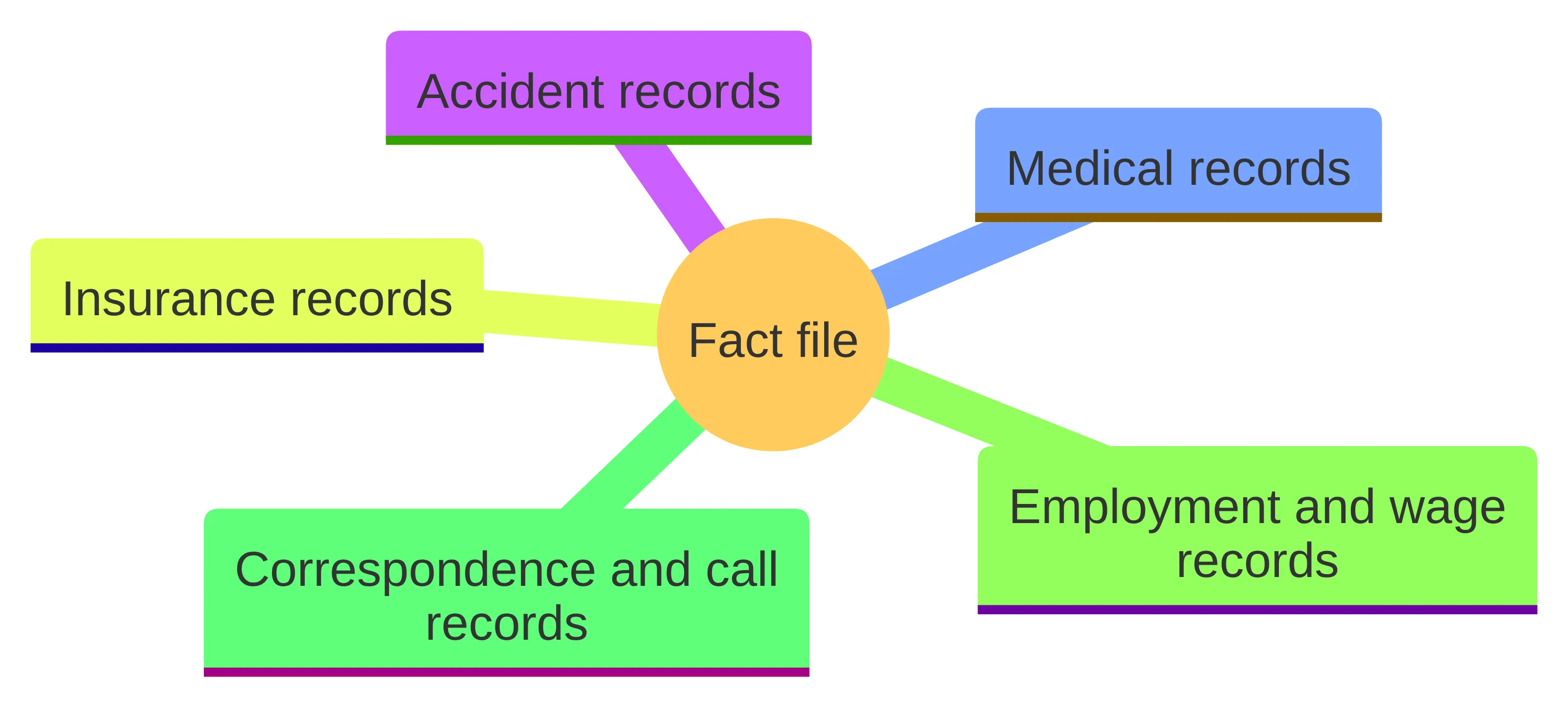
Build a fact file in five record groups
A five-group fact file gives a lawyer a usable account of the crash, its effects, and the communications that followed. Organize the file in a paper folder or electronic folder, keep original documents unchanged, and add a short index showing what each group contains. The goal is not to prove the case on your own. The goal is to make the known facts, missing records, and open questions easy to locate.
1. Accident records
Start with the event itself. Include the date, approximate time, location, direction of travel, your role in the accident, the vehicles involved, and a plain description of what you remember. Add photographs, video, witness information, diagrams, or other material you already possess. If an important detail is uncertain, label it as uncertain instead of filling the gap with a guess. A short chronological account is more useful than a long argument about who was right.
2. Medical records
Collect the treatment information you have, including visit dates, provider names, diagnoses or descriptions given to you, bills, prescriptions, referrals, restrictions, and changes in symptoms. Add a timeline of when you first sought care and what changed afterward. Keep records of earlier conditions or prior treatment if they may help explain the medical history. Medical evidence and causation may be part of the consultation, so present the complete timeline rather than only the records that appear favorable.
3. Insurance records
Gather policy information, insurer names, claim numbers, no-fault forms, notices, requests for information, payment explanations, and correspondence about medical expenses or lost wages. Record the date and method of each notice you sent and each response you received. Put the vehicle you occupied or the vehicle that struck you at the top of the group so the potential insurer connection is visible. The 30-calendar-day no-fault notice issue and the generally applicable benefit limit make this group time-sensitive.
4. Employment and wage records
Record the dates you missed work, the reason given for each absence, and the wage information you can obtain. Keep employer communications, pay information, leave records, and any document that describes work restrictions together. New York no-fault generally covers lost wages for covered policyholders, passengers, and pedestrians within the applicable first-party benefit framework, so the work record belongs beside the insurance record rather than in a separate memory-only note.
5. Correspondence and call records
Save letters, emails, text messages, claim portal notices, and notes from calls with insurers, medical offices, employers, witnesses, or anyone involved in the accident. For a call, write the date, the person or department, the number used if available, and what was requested or promised. A consultation may examine delays, evidence preservation, and filing timing, so the communication trail can show what you knew, when you knew it, and what remained unanswered.
Use the completed file by placing three labels at the front: known, uncertain, and missing. Put each question under the label that fits. If you cannot obtain a document, note who may hold it and when you asked for it. Bring the incomplete file anyway. Missing records are themselves useful subjects for the consultation when they are described plainly.
Write the questions the consultation must answer
A focused question list keeps the consultation centered on the issues that could change your next step. A New York motor-vehicle accident consultation may examine negligence, causation, medical proof, comparative fault, available insurance or assets, evidence preservation, and filing timing. Write questions that ask how those issues relate to your facts rather than questions that demand a prediction before the records are reviewed.
Use questions such as:
- Which no-fault insurer appears responsible based on my role in the accident and the vehicles involved?
- What should I do about the 30-calendar-day notice issue if my notice was late, incomplete, or sent to an uncertain insurer?
- Which medical records help explain the timing and connection between the crash and my injuries?
- What evidence should I preserve or try to obtain about the collision and the people involved?
- Does the accident date raise a question about the serious-injury rules reported in June 2026?
- How should I document medical expenses, lost wages, treatment changes, and work restrictions?
- What facts could affect negligence, causation, or comparative fault?
- Are there insurance or other coverage questions that require further investigation?
- What filing or evidence-preservation timing should I address now?
- Which records or facts do you still need before discussing the next step?
Bring the question list with the five record groups, then mark each answer as resolved, partly resolved, or still open. Ask for the next document or fact needed for every open item. If a lawyer cannot answer a question immediately because a record is missing, write down the record to locate and the reason it matters. That turns the meeting into a sequence of specific follow-up tasks instead of a general conversation about the crash.
Request review without treating contact as a case decision
At The Law Offices of Evan W. Kohn, we offer legal services for auto accidents in the Bronx. We offer free consultations 24 hours a day for car-accident cases. We handle insurance paperwork, file no-fault forms, and negotiate with insurance companies, with the scope of those services depending on an engagement and applicable terms. You can bring the organized fact file whether your main concern is a no-fault notice, an insurer response, medical proof, lost wages, evidence, or responsibility for the collision.
The Law Offices of Evan W. Kohn can arrange home or hospital visits for clients who cannot travel. If your injuries make travel difficult, include that fact when you contact us so the available arrangement can be discussed. You do not need to wait until every record is complete; provide the accident date, location, your role, the main injury or insurance concern, and the records you already have.
Prepare a short contact summary with five lines:
- Accident date and location
- Driver, passenger, or pedestrian status
- Main injury, treatment, or wage-loss issue
- Insurer and notice status
- The question you most need answered
That summary helps the initial conversation begin with the issue that caused you to seek review. Contacting a law office is not a finding that you have a valid claim, a prediction about compensation, or a commitment to proceed. It is a way to place the unresolved facts in front of a legal professional.
Confirm fees and scope before moving forward
At The Law Offices of Evan W. Kohn, we do not charge if we do not win the case. Before moving forward, ask how the fee agreement defines the representation, how case expenses are handled, what work is included, and what circumstances could change the arrangement. Fee agreements and expenses require review before engagement, so keep the written terms with your consultation records.
A useful closing conversation should leave you with a clear list of next steps: the records to provide, the timing issue to address, the insurer or claim information still needed, and the questions that remain open. You can make that review more productive by bringing a dated accident account, the five record groups, and a short list of unresolved questions.
If the crash left a notice, benefit, serious-injury, evidence, or liability question unresolved, use the organized file to move from uncertainty to a focused legal conversation. Keep the account factual, preserve the records, and let the consultation address what the available information can and cannot establish.
What should you ask before requesting a New York motor vehicle accident consultation?
What should I do if I missed the 30-day deadline to file a no-fault claim after my accident?
If you missed the 30-day deadline to file a no-fault claim, document the reasons for the delay and seek legal advice as soon as possible.
How do I determine which insurer to file my no-fault claim with after a motor vehicle accident?
The appropriate no-fault insurer generally depends on your involvement in the accident.
What is the serious injury threshold in New York for pursuing a personal injury claim?
In New York, to pursue a personal injury claim for non-economic losses, you must generally demonstrate that you suffered a serious injury, as defined by the law. Recent reforms have changed the criteria, so it’s important to consult a lawyer for the current standards.
What records should I gather before contacting a lawyer after a motor vehicle accident?
Before contacting a lawyer, gather records related to the accident, including the accident report, medical records, insurance information, employment records showing missed work, and any correspondence with insurers.
Can I get a free consultation from The Law Offices of Evan W. Kohn?
Yes, The Law Offices of Evan W. Kohn offers free consultations 24 hours a day for car accident cases.
What should I expect during my initial consultation with a lawyer after a car accident?
During your initial consultation, expect to discuss the details of the accident, your injuries, any medical treatment received, and the insurance claims process. The lawyer will help identify any unresolved questions and outline the next steps.
Hurt like this?
We handle Car Accidents cases in the Bronx.
Evan W. Kohn, Esq. — more than 35 years of Bronx personal-injury practice. Reading about it only goes so far; a free consultation tells you what actually applies to your case.