
Car Accidents
Car Accident Law Firm Near Me in the Bronx: A Practical Consultation Decision Guide

Decide whether an unresolved car-accident question makes consultation useful
A New York car-accident consultation becomes useful when an unresolved question is affecting what you do next. You may be dealing with an injury that has not settled, an insurer that has not answered clearly, uncertainty about no-fault benefits, concern about the serious-injury requirement, or a deadline that may depend on who was involved. Those questions are different from simply wanting an office close to home.
The practical decision is not whether your claim will succeed. The practical decision is whether a legal review could help you identify the route, documents, and timing issues that your facts raise. A consultation can begin with a short account of the crash and the problems that remain open.
New York’s no-fault system, the serious-injury rule, and different limitation periods can each create a separate question after a crash. New York requires every New York-registered motorist to carry no-fault insurance. The cited NYC Bar guidance says that no-fault insurance pays necessary medical expenses and lost wages for the policyholder, passengers, and pedestrians up to $50,000, regardless of fault. The same guidance says that a person may sue a negligent driver for pain and suffering after serious and permanent injuries.
If any of those subjects is unclear in your situation, put the unresolved question first and use the rest of this guide to prepare for a focused conversation.
Compare local fit, case scope, and access before contacting a Bronx firm
For someone searching for a Bronx-area car accident firm, a useful first comparison is local fit rather than distance alone:
- Stated matter fit: Does the firm’s listed car-accident work match the crash pattern you need to discuss?
- Geographic fit: Does its stated service area include your borough or county?
- Access fit: Can you use the consultation and travel options the firm describes?
- Open issue: Can you name the injury, insurance, treatment, loss, or timing question you want reviewed?
This screen keeps the search concrete: compare the firm’s stated scope and access with the issue you need reviewed, then use the consultation to address what remains uncertain.
We serve clients in all five boroughs, Westchester, Putnam, Rockland, Nassau, and New Jersey. Our office is located at 2000 White Plains Road in the Bronx.
Use the comparison above to identify what to verify before contacting a firm: its stated Bronx location and broader service area, the car-accident matters it lists, and the access it describes. Keep any New York insurance or timing question tied to your own facts; a consultation is where an individualized route can be considered.
Run a three-track New York route-check before choosing a Bronx car-accident consultation
You do not need to decide the legal label before asking for a review; you need to identify what you cannot confidently sort out from the records and communications you already have.
Write down the question in one sentence. Examples include: “Which insurance process should address my medical bills?” “Why has the insurer questioned my treatment or lost wages?” “Does the injury raise a serious-injury issue?” “Could another deadline apply because a public vehicle or agency was involved?” A clear question gives the conversation a starting point without turning your description into a legal conclusion.
To make that first question more useful, sort the uncertainty into four buckets before you contact a firm. This is a communication tool, not a way to decide whether a claim exists.
- Event and responsibility: Identify what you know about the collision, the people and vehicles involved, and whether a public vehicle, roadway, agency, or other government-related party may be connected. If the other driver, owner, or responsible party is unclear, make that uncertainty explicit rather than choosing a label.
- Records and administration: Identify the form, bill, letter, claim number, or insurer communication that is missing, disputed, or difficult to understand. Note what was submitted, when it was sent, and what response followed. This separates a records problem from a conclusion about coverage or fault.
- Timing: List the accident date, dates of treatment, dates of insurance submissions, and any date connected with a possible public-entity notice. Different claim types and responsible parties can call for different timing questions, so mark the date that needs review instead of relying on one general estimate.
- Legal route: State whether the open question concerns no-fault benefits, a possible claim against another driver, the serious-injury requirement, or recovery for non-economic loss. These subjects may arise from the same collision but do not answer one another automatically.
Choose one bucket as the primary reason for contact and list the others as related questions. This keeps the consultation from becoming a broad retelling with no clear starting point. For example, an injured passenger may primarily need help organizing a no-fault form and medical bills, while also needing to ask how the injury information and the other driver’s conduct should be reviewed. If the vehicle or roadway may involve a public entity, add that fact to the timing bucket even if the insurance paperwork is the immediate problem.
For each bucket, attach one concrete item or fact: a police report or collision description for the event, an insurer letter or bill for administration, a dated submission or accident date for timing, and medical or treatment records for an injury-related question. If an item is unavailable, label it missing. Then phrase the question as a request for review: “Which part of this record should I clarify?” or “Which date and responsible party need to be checked?” That wording preserves the difference between what you know, what a document says, and what still requires individualized legal assessment.
This four-bucket check also helps you recognize when a nearby firm is being contacted for a specific reason rather than only because it appears close to home. The location may affect access, but the primary unresolved bucket explains what you need the consultation to address.
A New York crash may justify prompt legal review when one or more of these conditions is present:
- Your injury, symptoms, treatment, or ability to work remains unsettled.
- You need to distinguish no-fault benefits from a possible claim against another driver.
- An insurer has sent forms, requested records, denied payment, or made an offer that you do not understand.
- You need to know whether the serious-injury requirement affects a possible recovery for non-economic loss.
- The other vehicle, roadway, or event may connect the accident to a public entity.
- You are relying on a general three-year period without knowing whether a different claim type or notice rule applies.
These are reasons to organize the facts and seek review, not findings that a particular legal route applies. The cited New York Courts material says that listed negligence or unintentional-tort claims against a public entity generally require a notice of claim within 90 days after accrual. That possibility makes the identity of the responsible party an early question.
Distance still matters when it affects access. A nearby office may be practical if you can travel, while a different arrangement may matter if pain, hospitalization, work, transportation, or family responsibilities make an office visit difficult. Treat access as one factor after you have named the issue requiring review. Then choose a contact option that lets you share the facts without delaying the questions that need attention.
Separate no-fault benefits from a fault-based injury claim
New York no-fault benefits and a fault-based injury claim address different questions. The cited NYC Bar guidance explains that New York has mandatory no-fault insurance and that every New York-registered motorist is required to carry it. The guidance says the policyholder’s, passengers’, and pedestrians’ necessary medical expenses and lost wages are paid up to $50,000 without regard to who caused the accident.
That means the immediate payment question is not identical to the question of who caused the crash. A person may need to understand the no-fault path even while fault remains disputed or unresolved. Gather the communications and forms connected to that path rather than reducing the entire situation to a single question about the other driver.
Additional recovery raises a separate issue. The cited NYC Bar guidance says that additional recovery, such as pain and suffering, must be sought in court.
The two concepts should stay separate in your notes:
- Benefits and expenses: identify the medical expenses, lost wages, forms, bills, and insurer communications connected with no-fault benefits.
- Fault-based recovery: identify the conduct or circumstances you believe require review, the injury information available, and the questions about non-economic loss.
Keeping those tracks separate helps you ask whether an unpaid bill, a disputed payment, an injury limitation, or a possible lawsuit presents the actual problem.
A New York DFS no-fault FAQ states that the regulation described there uses 30 days for written notice, 45 days for medical bills, and 90 days for lost-wage claims. The passage describes a regulation effective April 5, 2002, so those figures should prompt prompt, claim-specific review rather than be treated as an answer to every situation.
Create a separate list showing which forms or bills were submitted, when they were sent, where they were sent, and what response followed. Bring that list to a consultation. It gives the discussion a timeline instead of requiring you to reconstruct the insurance history from memory.
Treat serious-injury requirements as a review question
A New York court decision discusses a 90-of-180-day limitation theory and a significant-limitation theory as serious-injury grounds. The first concerns a medically determined nonpermanent injury that prevented substantially all daily activities for at least 90 days during the 180 days after the accident. The second concerns a significant limitation of use of a body function or system.
Those descriptions do not turn a calendar count or a symptom into an automatic classification. Use them to identify what the consultation must address:
- What medical findings describe the injury?
- What activities changed, and for what period?
- What treatment and restrictions are documented?
- Which records explain limitations of a body function or system?
Bring the questions and the records together. A legal review can then focus on the relationship between the documented injury, the applicable rule, and the claim route.
Verify every deadline against the claim type and responsible party
A New York car-accident deadline depends on the claim being considered and the party involved.
Write the accident date at the top of your notes, then identify what kind of claim or payment issue you are asking about. Separate a lawsuit deadline from an insurance-submission deadline and from a public-entity notice requirement. A general calendar estimate cannot replace that sorting step.
A useful worksheet gives each issue its own line rather than placing every date under one heading. For an insurance question, record what was submitted, the date of submission, and the response. For a possible claim against another driver, record the accident date, the parties you can identify, and the question about the injury or loss that remains unanswered. For a possible public-entity connection, record the public vehicle, roadway, agency, or other government-related detail and mark it for prompt review. If you do not know whether a fact matters, label it “unknown” instead of omitting it.
This format helps prevent three different questions from being confused: whether a benefit form or bill was submitted, whether a notice may be required, and whether a lawsuit may be available. It also gives a lawyer a short list of dates to check against the responsible party and claim type. The worksheet is an organizing tool, not a calculation of the time that applies to your individual situation.
A public-entity connection can create an earlier notice question. For listed negligence or unintentional-tort claims against a public entity, the cited New York Courts material says a notice of claim is generally due within 90 days after accrual. The cited New York Courts instructions describe a written, sworn notice identifying the claimant, claim, circumstances, and damages or injuries when practicable.
Do not wait to solve every factual question before flagging a possible public connection. Record whether a city vehicle, public bus, public roadway, agency, or other government-related party may be involved, and bring that fact to the consultation. The responsible party can affect the route and the timing analysis.
Insurance timing has its own record. The cited DFS FAQ states that the regulation described there uses 30 days for written notice of a no-fault claim, 45 days for medical bills, and 90 days for lost-wage claims. Because the cited passage describes a regulation effective April 5, 2002, use those figures as a subject for current, fact-specific legal review rather than as a universal answer.
Your deadline worksheet should contain four entries:
- The accident date and the date you first learned of each relevant problem.
- The possible defendant, insurer, vehicle owner, or public entity.
- The action that may be required, such as notice, a claim submission, or a lawsuit.
- The document or communication showing what has already been submitted or received.
Bring the worksheet promptly when any date appears close or uncertain. Timing questions become harder to organize after records and communications are scattered.
Prepare a concise accident and loss file before contacting a firm
A concise accident file should let you explain the event in sequence without relying on memory alone. Start with the facts you know and label anything uncertain instead of filling gaps with guesses.
Include:
- The date, approximate time, and location of the collision.
- The direction of travel, lane or intersection information, and a plain description of what happened.
- The vehicles and people involved, including the driver connected with the collision and anyone who was riding with you.
- The names and contact information you have for witnesses, if available.
- Photographs, video, a police report, exchange-of-information material, and any other records you already possess.
- The names of insurers, claim numbers, adjuster communications, forms, and letters.
The file does not need to be polished. It needs to show what happened, what you received afterward, and where the unanswered questions are.
Medical and loss information should be kept in a separate part of the file. The cited NYC Bar guidance identifies necessary medical expenses and lost wages as no-fault subjects, and the cited DFS FAQ addresses the timing of medical-bill and lost-wage submissions.
Organize the material under these labels:
- Emergency care, doctors, facilities, therapy, prescriptions, and follow-up appointments.
- Bills, payment notices, denials, explanations, and no-fault forms.
- Work missed, pay information, employer communications, and the dates connected with the absence.
- Symptoms, restrictions, changes in ordinary activities, and the records that describe them.
- Questions about treatment, payment, or records that you want answered.
Keep copies of what you send and receive. A simple date-and-document list can show how the medical and insurance records developed after the collision.
A one-page summary can sit at the front of the file. Use short headings for the collision, injury, treatment, insurance, work impact, public-entity possibility, and questions. Put the accident date and your contact information where they are easy to find.
Send or bring the documents you can access, but do not delay contact because a record is missing. Mark missing items clearly. The point of preparation is to make the open issues visible, not to create a complete legal file before a conversation begins.
To make the file easier to review, add a short index at the front. Under event, list the collision date, location, vehicles, people, and the description you can support. Under injury and treatment, list the first care, later providers, current restrictions, and records that are still missing. Under insurance and losses, list each insurer or claim number, forms or bills submitted, responses received, and work or wage information. Under timing and questions, list the dates that may need review, any possible public-entity connection, and the questions you want answered.
For each item, use one of three labels: confirmed, reported but not verified, or missing. For example, a police report in your possession can be marked confirmed, while another person’s account of how the collision occurred can be identified as reported. This distinction keeps the summary accurate and shows where the consultation may need additional records. Attach the supporting document or note its location when possible, but do not turn the index into a conclusion about fault, injury classification, or eligibility.
Compare the crash description with the firm’s stated car-accident scope
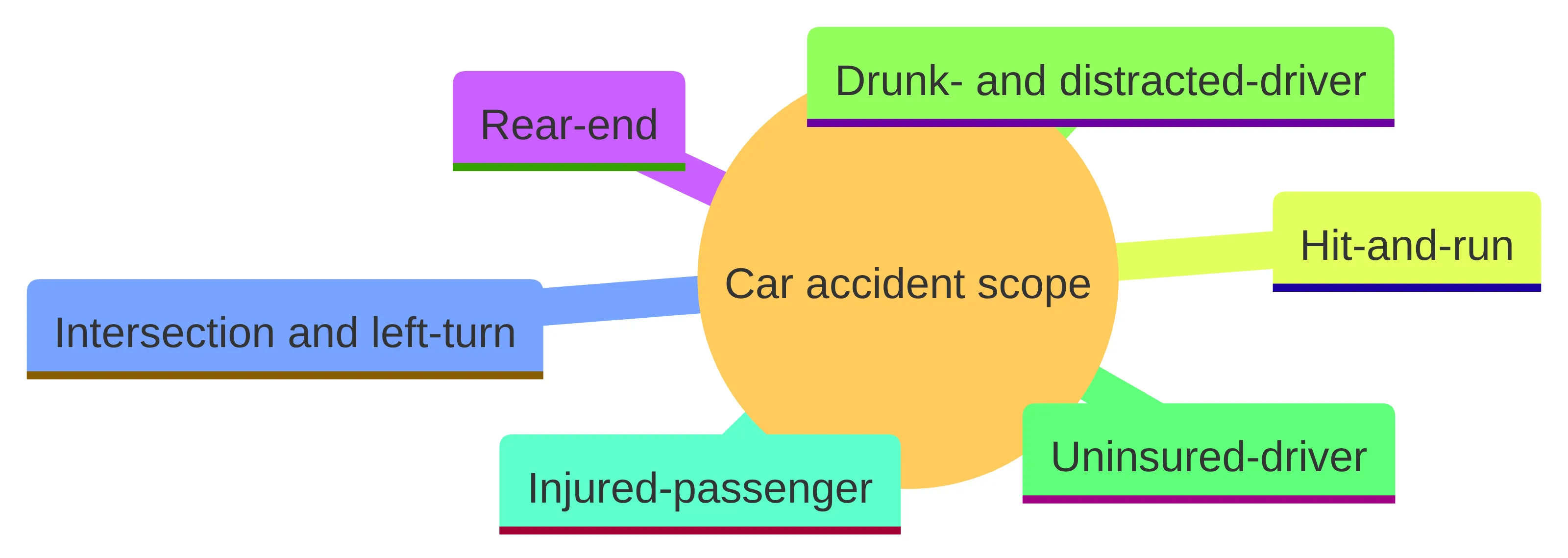
For a scope check, compare the event with the firm’s listed car-accident categories. We handle rear-end, intersection and left-turn, hit-and-run, drunk- and distracted-driver, uninsured-driver, and injured-passenger car-accident cases.
Compare your plain description with those categories without trying to force the facts into a label. Write down the physical event first: where the vehicles were, how contact occurred, who was driving or riding, and what information is known about the other driver. Then note the category that appears closest and the fact that remains uncertain.
For example, an intersection collision may also involve an injured passenger or an uninsured driver. Keep each relevant detail in the summary. A category match is a reason to raise the matter for review, not a decision about liability or the value of a claim.
A useful scope check asks three direct questions:
- Does the firm’s stated car-accident practice include the type of collision or role you are describing?
- Which facts would the firm need to understand the event accurately?
- Which part of the situation remains outside your knowledge, such as the other driver’s insurance, the effect of an injury, or the timing of a possible claim?
Bring the answer to all three questions with the accident file. The purpose is to make the first conversation specific enough to identify the next legal question.
Check location and access across the Bronx region
Access can matter as much as an address. We can arrange home or hospital visits for clients who cannot travel.
If travel is difficult, put that fact in your contact request along with the injury, insurance, or timing issue you want reviewed. If travel is possible, decide whether an office conversation or another available arrangement will make it easier to bring the accident file. Use the option that allows you to communicate the facts clearly and address the time-sensitive questions.
Bring focused questions about insurance, records, and timing
Insurance and public-entity questions should be tied to documents. Ask which submitted forms, medical bills, wage materials, notices, or communications should be placed in chronological order. If a public entity may be involved, ask whether the facts require attention to a written, sworn notice identifying the claimant, claim, circumstances, and damages or injuries when practicable.
The cited DFS FAQ describes 30-day written notice, 45-day medical-bill, and 90-day lost-wage periods under the regulation described there. The cited New York Courts material describes a generally 90-day notice-of-claim period for listed claims against a public entity. Bring the dates and documents so the conversation can address which rule, if any, applies to your facts.
End your list with a practical question: “What should I do next, and what should I avoid doing while the open issues are reviewed?” Add a space for the answer and for any document the firm asks you to locate. A written question list helps you leave with identified tasks instead of a general impression.
You can put the questions in an order that follows the decision the consultation must support. First ask which issue requires the earliest attention: treatment and injury documentation, an insurer’s request or denial, a possible public-entity connection, or a date that may affect the next step. Then ask what facts or records are needed to examine that issue. Next ask whether the no-fault materials, a possible claim against another driver, and any non-economic-loss question should be treated as separate parts of the review. Finally ask which documents you should preserve, obtain, or send and what date should be placed on your calendar for follow-up.
This sequence does not assume that every topic applies. It gives the conversation a way to distinguish an immediate records problem from a broader legal question. It also helps you capture the difference between an answer about what the firm may review and an instruction about a document or communication that still needs to be completed. Leave room beside each question for the answer, the supporting record, and the next person or office you may need to contact.
Ask what administrative help may apply to the individual situation
The Law Offices of Evan W. Kohn handles insurance paperwork, files no-fault forms, and negotiates with insurance companies. Those are stated administrative and insurance-related services that may be relevant when your file contains forms, bills, claim communications, or an unresolved insurer response.
Bring the insurance timeline rather than asking only whether the firm handles “the insurance.” Identify the insurer, the policy or claim number you have, the documents submitted, the dates, and the response. Then ask which administrative tasks may apply to your individual situation and which records are still needed.
Before the conversation, place these items together:
- The insurer’s letters, emails, forms, and claim numbers.
- Medical bills and records connected with the collision.
- Lost-wage information and related communications.
- The accident summary and any public-entity detail.
- Your deadline worksheet and questions about the next action.
This packet gives the discussion a clear starting point while leaving room for the firm to identify missing information.
Ask the firm to separate administrative questions from questions requiring an assessment of the individual claim. Administrative questions may concern where a form or bill was sent, whether an insurer response is in the file, or which no-fault paperwork and communications should be gathered. The firm states that it handles insurance paperwork, files no-fault forms, and negotiates with insurance companies, so those records can be placed in context during the conversation. Whether a particular task applies still depends on the facts and the documents available.
A second group of questions concerns legal review rather than document handling: whether the injury information raises a serious-injury issue, whether the possible responsible party changes the timing analysis, and whether the facts support discussing recovery beyond no-fault benefits. Keep these questions separate from requests to locate a bill or complete a form. That separation makes it easier to understand what has been organized, what remains unknown, and what requires individualized legal assessment rather than a general administrative answer.
Take the prepared facts to a free consultation
A nearby firm is worth contacting when your accident file contains an unresolved injury, insurance, serious-injury, public-entity, or timing question that you cannot sort out alone. Free consultations are available, and home or hospital visits can be arranged for clients who cannot travel.
Bring the accident summary, medical and loss records, insurance timeline, deadline worksheet, and focused questions. Only a qualified legal professional who reviews your individual facts can assess which legal route, deadline, and next action apply to your situation.
Make the first conversation about the facts that remain open: what happened, what treatment followed, what the insurers have done, which dates matter, and what information is still missing. That preparation lets you ask for a useful review without treating a general rule or a nearby address as an answer to your individual circumstances.
What should you bring to a New York car-accident consultation?
What should I do if I have unresolved questions after a car accident in New York?
If you have unresolved questions regarding your injury, insurance claims, or deadlines after a car accident, consider scheduling a consultation with a personal injury lawyer. They can help clarify your situation and guide you on the next steps.
How long do I have to file a lawsuit for a car accident in New York?
In New York, you generally have three years from the date of the accident to file a lawsuit for car accident claims. However, different types of claims may have different deadlines, so it’s important to verify the specific time limits that apply to your situation.
What information should I gather before contacting a personal injury lawyer?
Before contacting a lawyer, gather information about the accident, including the date, location, involved parties, medical treatment received, insurance details, and any communications with insurers. This will help facilitate a more productive consultation.
Where is The Law Offices of Evan W. Kohn located?
The Law Offices of Evan W. Kohn is located at 2000 White Plains Road in the Bronx, New York.
Hurt like this?
We handle Car Accidents cases in the Bronx.
Evan W. Kohn, Esq. — more than 35 years of Bronx personal-injury practice. Reading about it only goes so far; a free consultation tells you what actually applies to your case.