
Pedestrian Accidents
Should Bronx Pedestrians and Cyclists Request a Free Personal Injury Consultation?
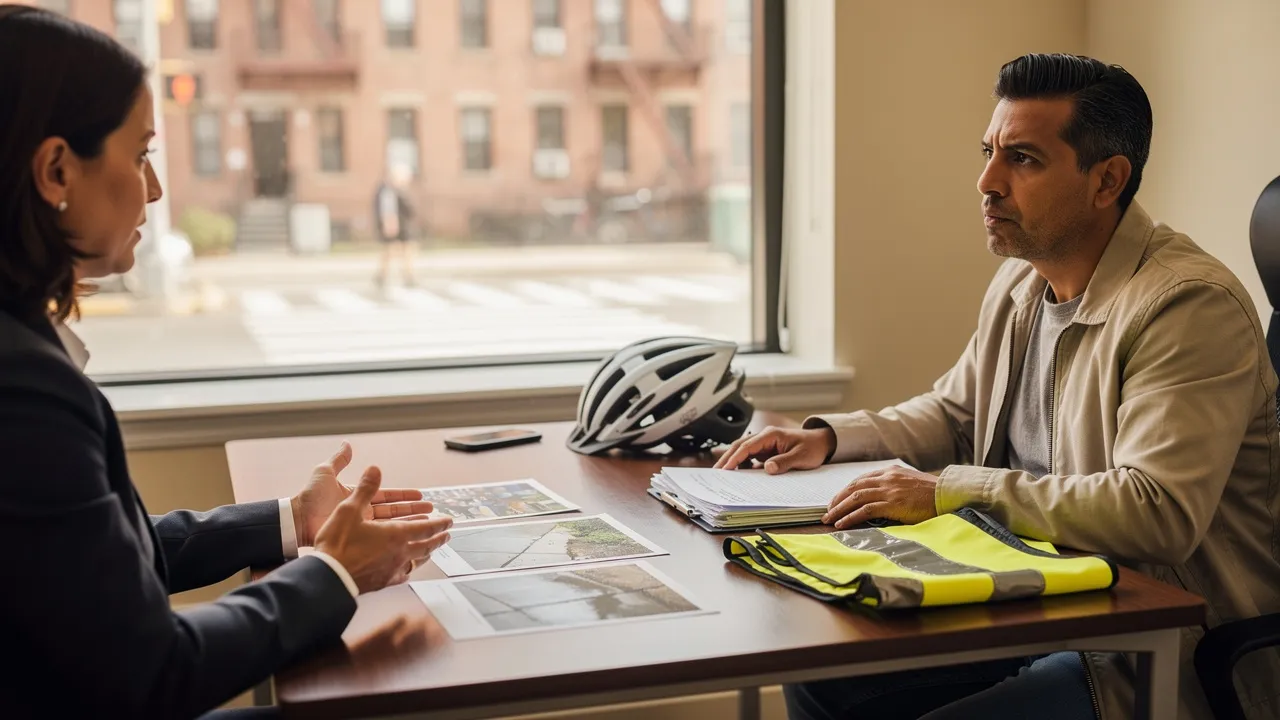
Start with what a free consultation can actually clarify
A free personal injury consultation is an organized conversation about what happened, how you were hurt, what records exist, and which questions need a closer legal review. It is not a guaranteed finding about liability, eligibility, insurance coverage, case value, or outcome. You can use the conversation to put the incident into a clear sequence and identify the facts that still need attention.
For a Bronx pedestrian or cyclist, that sequence may begin with a vehicle turning across a crosswalk, a crash involving a bicycle, e-bike, or scooter, or a fall connected to a sidewalk, roadway, building, or other property. The location and the parties involved can change which questions belong in the conversation. A short account of the event is useful, but a prepared account is more useful when it includes dates, names, records, and unanswered questions.
That makes the first conversation a fact-gathering stage, not a promise that representation will follow. You can describe the event, provide the records you have, and ask what additional information would help clarify the possible legal paths.
The same commentary distinguishes an actual consultation from a response to advertising that merely describes a lawyer’s background, practice areas, and contact information. Providing information in response to that kind of advertising does not by itself create a consultation or prospective-client relationship. Treat the conversation as a chance to understand the next questions and the available choices, rather than as a completed legal assessment.
Build a consultation handoff before requesting legal review
Build a consultation handoff before you request legal review. The purpose is to put the available facts, records, and open questions in one organized set of materials for an initial discussion, rather than trying to reach a legal conclusion on your own.
Start with an incident summary:
- the date, time, and location;
- whether a vehicle, bicycle, e-bike, scooter, sidewalk, roadway, building, store, construction area, or other property was involved;
- any names or contact details you have for drivers, owners, witnesses, property managers, or public agencies; and
- the sequence of events in your own words.
Then make a record list. Include photographs, police reports, witness details or statements, medical records, treatment information, insurance communications, and vehicle information when available. Bring the documents and evidence related to the incident that you already have so the attorney can better understand what happened and discuss potential legal options.
Separate known facts from gaps. Mark what you do not know about the driver or property owner, which insurer has contacted you, whether a public body may be connected to the location, and which records are still being requested. Keep the accident date prominent when a New York motor-vehicle accident or possible public-entity matter is involved because timing requirements may need prompt attention.
Finish the handoff with the items you want addressed: missing facts or records, insurance or public-entity questions, and what the initial discussion would cover. When the materials are ready, request a free consultation if you want that initial discussion.
Put a possible public-entity connection near the front of the consultation handoff. For a sidewalk incident in the Bronx, a fall near a public facility, or an injury connected to a government agency, record the location, ownership clues, and incident date. Do not treat a public location as proof that a government entity is legally responsible; use the detail to identify an issue for review.
For certain personal-injury, property-damage, or wrongful-death claims involving a municipal or public entity, New York requires a Notice of Claim before a lawsuit can begin. A Notice of Claim generally must be served within 90 days after the claim arises, normally the date of the accident or event. These requirements can depend on the entity and facts, so place the date and location in the materials for discussion.
Keep insurance material in a separate part of the consultation handoff. For a New York motor-vehicle accident, file a written no-fault claim as soon as reasonably practicable, but no later than 30 calendar days after the accident unless written proof provides clear and reasonable justification for late filing. When a pedestrian is injured in a New York motor-vehicle accident, the no-fault claim should generally be filed with the insurer of the vehicle that struck the pedestrian.
Place the accident date, vehicle information, and insurer contact together. Note whether a written claim has already been filed and keep related communications with the other records. This timing rule concerns the no-fault claim described by the New York Department of Financial Services; it does not decide liability or the value of any separate injury claim.

Match the incident type to the questions worth raising
A pedestrian, bicycle, e-bike, scooter, or premises incident can lead to different fact questions, even when the injury occurred on the same Bronx or New York City block. Use the following comparison to sort your starting point before you speak with a lawyer.
| Incident type | First question to raise | Records or details to gather | Timing flag |
|---|---|---|---|
| Pedestrian struck by a vehicle | What vehicle, driver, owner, and insurer were involved? | Vehicle description or plate information, police details, photographs, witness contacts, and the location of the crossing or roadway | A New York no-fault claim should generally be filed as soon as reasonably practicable and no later than 30 calendar days, subject to the stated exception for written justification |
| Bicycle, e-bike, or scooter crash involving a vehicle | Was a motor vehicle involved, and what happened immediately before contact? | Bicycle or scooter details, photographs, vehicle information, witness details, treatment records, and communications from insurers | The no-fault question may apply when the event is a New York motor-vehicle accident; identify the involved vehicle and accident date |
| Fall on a sidewalk, roadway, or public property | Who owned, controlled, or maintained the location? | Exact location, photographs of the condition, nearby landmarks, incident reports, witness details, and the date and time | Certain claims against a New York municipal or public entity require a Notice of Claim, generally within 90 days after the claim arises |
| Fall or injury at private property | Which owner, tenant, manager, contractor, or other party may be connected to the location? | Property name and address, photographs, incident report, witness details, and medical records | The applicable route depends on the parties and facts; identify them early rather than assuming a public-entity rule applies |
The table is a sorting tool, not a decision about who is legally responsible. A single incident can fit more than one row, so bring the overlapping facts rather than forcing the event into one category.
A public-entity question deserves its own line in your notes whenever the location, vehicle, facility, or responsible actor may belong to New York State, New York City, another municipality, or a public agency. Write down the public connection and the accident date, then raise both at the consultation.
Prepare the accident facts and supporting records
The accident facts should form the first page of your consultation materials. Write the sequence while the details are available to you, using plain descriptions rather than conclusions about fault.
Include:
- The date, approximate time, and exact location, including the Bronx intersection, sidewalk address, building entrance, roadway, or nearby landmark.
- What you were doing immediately before the incident and what happened in the moments that followed.
- The people, vehicles, bicycles, e-bikes, scooters, businesses, buildings, agencies, or other locations connected to the event.
- The direction of travel, traffic signal, crosswalk, road surface, sidewalk condition, lighting, weather, or other visible circumstances that you remember.
- The names and contact details of witnesses, if you have them.
- Any report number, incident report, police information, notice from a property owner, or communication from an insurer.
You do not need to turn your notes into a legal argument. A dated list of what you know, what you saw, and what you still do not know gives the conversation a workable starting point.
Our investigation process gathers police reports, photos, witness statements, and medical records. Those materials can help organize the event from several viewpoints, but your initial packet can include whatever is already available rather than waiting for a complete file.
Preserve the original photographs and messages when you can, and label copies with the date and location. If a photograph shows a sidewalk defect, vehicle position, damaged bicycle, clothing, or surrounding condition, add a short note explaining what it shows. Do not return to a hazardous location or create a confrontation to obtain more material. Bring the information already in your possession and identify the gaps. Use the same labels across files so a photograph, witness detail, report, and medical record can be tied back to the date or event it concerns. If two accounts differ, preserve both versions and identify the difference; do not silently choose one because it seems easier to explain. That practice helps the consultation focus on what must be clarified, rather than on a polished narrative that hides uncertainty.
Add injuries, treatment, and medical records
Your injury and treatment record should sit beside the accident account, not in a separate story. List the body areas affected, the first place you received care, later appointments, tests, procedures, prescriptions, therapy, work restrictions, and the symptoms you have described to medical professionals. Use the wording in your medical records where possible instead of trying to diagnose yourself.
Set aside the medical records already available to you, including discharge papers, bills, appointment information, test results, prescriptions, therapy records, and communications about treatment. Include the names of medical providers and the dates you saw them. If you have not received every record, list the provider and the date rather than delaying the rest of your packet.
We investigate cases by gathering medical records along with police reports, photos, and witness statements. Your records give the conversation a clearer factual starting point; they do not, by themselves, determine the legal value or outcome of the matter.
Work and daily-life information can help you describe the practical effect of the injury without placing a dollar figure on it. Note the dates you missed work, reduced duties, or needed help with ordinary tasks. Keep wage statements, employer communications, and other related records if you have them, and separate what you personally know from what someone else told you.
Bring questions about records that are missing, inconsistent, or difficult to obtain. A focused question such as “Which treatment records should I request next?” is more useful than trying to decide in advance which diagnosis or amount applies to you.
Bring the insurance information and communications
Use the insurance page to form questions rather than conclusions. You might ask which insurer received a notice, what a letter is requesting, whether a claim number corresponds to the correct incident, or which documents should be kept. Include communications that seem unfavorable or confusing. A complete account of the communications is more useful than a packet that contains only the messages you prefer.
Do not describe an insurer’s position as a final decision about your injury claim. Record the sender, date, subject, and substance of each communication, then ask how it fits with the accident and treatment records. Use a separate line for each communication rather than combining an insurer’s request with your response. Note whether the message concerns treatment, claim administration, or another issue, and identify any date the message mentions. This does not determine what the communication means legally; it gives the lawyer a chronological record to compare with the accident date and treatment timeline. Keeping this log separate from the medical summary also makes it easier to identify which questions concern no-fault filing and which concern a different part of the potential claim. If you are unsure whether a message is important, include it and label the uncertainty instead of summarizing it as an answer.
Raise a possible public-entity connection promptly
Record whether anyone has sent a notice, to whom it was sent, when it was sent, and what proof of service exists.
A sidewalk photograph alone does not identify the correct defendant or establish that a public-entity rule applies. Bring the address, nearby landmarks, incident report, photographs, and any information about ownership or maintenance. Keep the public-entity question visible while leaving the legal classification for fact-specific review.
New York State claims have a specific court pathway. A lawsuit against New York State for money damages may only be filed in the Court of Claims, and a Notice of Claim must first be filed with the State. If the incident involved New York State rather than New York City or another local entity, write “New York State” in your notes and ask about the applicable filing path.
Do not treat every public location as a New York State claim. Identify the agency, property owner, or facility named in your records, then bring that exact information to the consultation.

Use the consultation to separate answers from open questions
Your consultation questions should separate facts that can be described now from legal issues that require review. You can therefore bring unfavorable facts, missing records, prior communications, and uncertainty without trying to present a finished case theory.
Ask questions such as:
- Which facts about the driver, property, or public entity need more documentation?
- Which records should be requested, preserved, or added to the packet?
- Does the insurance information point to a no-fault filing question, and what dates should be discussed?
- Does the location raise a possible Notice of Claim issue?
- What does the lawyer need to know before discussing whether representation is appropriate?
- Which subjects can be answered during the initial discussion, and which require additional records or research?
These questions invite an organized review. They do not ask you to predict responsibility, coverage, value, or outcome before the facts have been examined. Before the conversation ends, ask for a practical recap in four parts: what facts are presently clear, what records or names are still missing, which dates or notice questions need prompt attention, and what decision or follow-up comes next. This recap does not turn the discussion into a prediction. It gives you a way to distinguish an unanswered factual question from a legal question requiring further review. Write down whether the lawyer is asking you to provide records, wait for a response, request another discussion, or review proposed written terms. If the lawyer cannot answer a question from the available information, record it as open rather than filling the gap with an assumption.
The fee arrangement should also remain an open question until the lawyer evaluates the matter. A personal-injury lawyer does not necessarily take every case on a contingency-fee basis; lawyers evaluate the case before agreeing to do so. Under a contingency arrangement described by the New York City Bar, the lawyer is not paid until after there is a recovery, and a lawyer may decline a case if there is not a reasonable chance of recovery or sufficient potential recovery to reimburse the work.
Ask what arrangement is being considered, what event would cause payment, and what written terms would govern if representation is offered. Keep the fee discussion separate from the question of whether the accident facts support legal review. A free initial conversation does not itself promise that a lawyer will accept the matter or use a particular fee arrangement.
Information sent in response to advertising that merely describes a lawyer’s education, experience, practice areas, and contact information does not by itself create a consultation or prospective-client relationship under the cited New York commentary. That distinction gives you a practical reason to describe what you are asking for: an initial discussion about a particular incident, its records, and possible next questions.
State whether you are seeking general information, an initial review of your own incident, or a discussion about possible representation. Clear framing helps keep the conversation focused on the purpose you have in mind.
Confirm access and consultation terms before moving forward
The Law Offices of Evan W. Kohn provides services for pedestrian accidents and workers’ compensation claims. We handle personal-injury cases involving auto accidents, pedestrian hits, slip-and-fall incidents, construction accidents, dog bites, medical malpractice, and workers’ compensation claims. We serve clients in all five boroughs, Westchester, Putnam, Rockland, Nassau, and New Jersey.
That stated service information gives you a practical fit question: does your incident fall within the type of matter you want to discuss? A pedestrian hit in the Bronx, an e-bike collision in another New York City borough, or a premises-related injury can be described in the request with the incident type, location, and date. The service category alone does not decide eligibility, responsibility, coverage, value, or outcome.
Our office is located at 2000 White Plains Road in the Bronx.
Use the access information that fits your circumstances. If travel is difficult, include that fact in the contact details. If the incident occurred outside the Bronx, include the borough, county, or New Jersey location so the discussion starts with a clear geographic context.
Before you submit your information, keep the packet practical:
- Put the incident date, location, and event type at the top.
- Add the short accident timeline and the names of known parties or witnesses.
- List treatment providers, treatment dates, and work-related effects.
- Attach or identify photographs, reports, medical records, insurance communications, and public-property details.
- Write two or three questions that remain unanswered.
- Say whether you can travel or need another arrangement for the conversation.
This format lets you communicate the essential facts without trying to write a legal brief. Keep a copy of what you submit and note when you sent it.

Build an incident record before a free consultation
Before contacting a lawyer, build an incident record—not a prediction about the claim. Write down the date, location, sequence of events, people or vehicles involved, treatment information, and records you already have. Keep photographs, police reports, witness details, medical records, insurer communications, and other documents together so the lawyer can understand what happened and discuss potential legal options. The Law Offices of Evan W. Kohn offers free consultations for electric bicycle accident claims.
A qualified professional decides individual suitability after reviewing the facts and applicable law. The initial conversation can help you understand which information matters next without promising eligibility, coverage, liability, value, or outcome.
If your prepared information points to unresolved questions that deserve legal review, use it to begin the conversation rather than waiting for every record to be complete. Keep the facts accurate, identify the gaps plainly, and preserve the dates connected to insurance or a possible public entity.
Questions to ask before requesting a consultation
What should I prepare for a free personal injury consultation?
Gather documents related to your accident, including the date, location, and details of the incident, medical records, treatment history, insurance information, and any communications with insurers. This preparation helps the attorney understand your situation better.
How does a free consultation help after a pedestrian or cyclist injury?
A free consultation allows you to discuss the specifics of your injury, clarify any unanswered questions about liability or insurance, and understand your legal options without committing to representation.
Can I request a consultation if my injury involves a public entity?
Yes, if your injury involves a public entity, it’s advisable to seek a consultation promptly, as specific rules and deadlines, such as the Notice of Claim, may apply.
Is there a cost for the initial consultation?
The Law Offices of Evan W.
Hurt like this?
We handle Pedestrian Accidents cases in the Bronx.
Evan W. Kohn, Esq. — more than 35 years of Bronx personal-injury practice. Reading about it only goes so far; a free consultation tells you what actually applies to your case.