
Pedestrian Accidents
Should Bronx Pedestrians and Cyclists Contact a Vehicle-Accident Attorney? A Consultation Decision Guide
Start with the consultation decision
A consultation may be useful when your Bronx or New York City crash leaves important questions about fault, insurance, evidence, treatment, or timing. You do not need to decide liability or predict the outcome before you speak with an attorney. The practical decision is whether unresolved facts make legal review worthwhile.
New York accident-claim guidance identifies several situations that may justify prompt legal review: significant injuries, continuing treatment, missed work, a disputed account of what happened, multiple vehicles, an insurer that disputes fault, or a possible government, business, construction, or road-condition issue. A lawyer can review evidence, identify missing records, communicate with insurers, and explain the choices available in your situation.
Your first decision can be simple: do you have a straightforward question that you can answer from your records, or do several unresolved issues affect what you should do next? A short consultation can be worth considering when the second description fits.
You may want legal review if any of these circumstances applies:
- Your injuries are significant, your treatment continues, or you have missed work.
- The driver, insurer, witness, or another participant describes the crash differently from you.
- More than one vehicle, a bus, a truck, a taxi, a rideshare vehicle, or a commercial vehicle may be involved.
- A parked-vehicle door, bike lane, intersection turn, road hazard, or hit-and-run makes the event harder to describe.
- You are unsure which insurer to contact or how your pedestrian or cyclist status affects the claim questions.
- A government vehicle, public roadway, business property, construction area, or defective road condition may be connected to the crash.
A consultation is an opportunity to organize those questions, not a promise that someone will establish liability, determine coverage, or resolve an insurance claim during the first conversation. Your goal is to bring a clear account of what happened and identify the issues that need legal review. That approach works whether you were walking near a Bronx intersection, cycling through Manhattan, riding an e-bike in Queens, or traveling elsewhere in New York City.
Separate immediate documentation from legal evaluation
Immediate documentation and legal evaluation serve different purposes. Documentation records the event and its aftermath while the information is available; legal evaluation asks how those facts may affect your options. For an initial accident consultation, available police reports, medical records, and communications with insurance companies are useful materials to bring. Our office also identifies police reports, photos, witness statements, and medical records as materials used when investigating cases.
Your first written account should stay factual and chronological. Record the date, approximate time, location, direction of travel, weather or lighting conditions you remember, the vehicles or bicycles involved, the point of contact, and what happened immediately afterward. Mark uncertainty plainly. If you do not know a vehicle’s plate number, the driver’s identity, or the exact time, write that you do not know instead of filling the gap with a guess.
Add the practical aftermath:
- Where you received medical attention and what records you have.
- Whether you missed work or changed ordinary activities.
- Which insurers, drivers, property owners, or agencies contacted you.
- What photographs, video, witness details, or messages are available.
- Which records someone else may hold, such as a police report, camera footage, or medical chart.
Documentation does not require you to argue that another person was at fault. A factual account is more useful than a legal conclusion because it gives you and the attorney a common starting point. Keep the immediate record separate from the evaluation: first describe what you saw, heard, did, and received; then list the questions you want answered.
If you have not gathered everything, you can still prepare for a consultation. Label each missing item and explain where it may be found. A partial file with a clear list of open records is more practical than waiting to contact an attorney until every document is assembled.
Triage the accident by travel mode and vehicle involvement
Travel mode and vehicle involvement give you a useful way to sort the consultation file. They do not decide liability or coverage. Bicycle- and e-bike-related incidents can include collisions with cars, trucks, buses, taxis, or limousines; dooring incidents; bike-lane crashes; hit-and-runs; and scooter or e-scooter crashes. Our office handles pedestrian cases involving crosswalk and hit-and-run crashes, so your summary should identify both how you were traveling and what type of vehicle or roadway feature was involved.
Use this comparison to decide what to put at the top of your summary:
| Travel mode or crash pattern | Facts to describe first | Questions to carry into legal review |
|---|---|---|
| Walking or crossing a street | Crosswalk or other location, direction of travel, vehicle movement, impact, witnesses, and any hit-and-run detail | Which driver or vehicle must be identified, what records may show the event, and which insurance questions apply? |
| Cycling on a street or in a bike lane | Direction, lane position, turn or passing movement, vehicle type, contact point, and roadway condition | Does the crash pattern require camera, witness, vehicle, or road-condition information? |
| E-bike, scooter, or e-scooter travel | Type of device, route, vehicle involvement, point of contact, and whether the event was a collision or a fall connected to a roadway condition | Which participants, insurers, and records need to be identified before the claim path is evaluated? |
| Dooring incident | Where the vehicle was parked, which door opened, your direction of travel, and the occupants or witnesses present | What evidence may show the door movement and the surrounding traffic conditions? |
| Hit-and-run | Description of the vehicle and driver, direction of travel, plate information, witnesses, video, and police contact | What steps may help identify the driver or vehicle, and what insurance issue remains if the owner is unknown? |
| Car, bus, truck, taxi, or passenger-injury crash | Vehicle roles, intersection or road position, passengers, impact sequence, and all available reports | Which accounts conflict, which vehicles have relevant insurance, and what records are missing? |
The table is a sorting tool, not a conclusion about your case. Choose the row that describes the event most closely, then add every fact that makes your situation different. If two rows fit, keep both in the file and tell the attorney why the classification is uncertain.
Use the crash pattern to identify open questions
A crash pattern can show which facts deserve attention without telling you who is legally responsible. New York bicycle-accident guidance describes right-hook collisions, left-cross collisions, dooring incidents, rear-end collisions, road-hazard crashes, and sideswipes. It also identifies potential bicycle and e-bike claim scenarios involving buses, trucks, cars, taxis or limousines, bike lanes, hit-and-runs, and scooters or e-scooters.
Turn the pattern into a factual checklist:
- Right turn: Did a vehicle turn across your path, and what did you observe about the vehicle’s direction, lane, and blind-spot area?
- Left turn: Was the vehicle turning across your direction of travel, and were there witnesses, signals, or video?
- Dooring: Was a parked-vehicle door opened into your path, and who may have seen the door or your approach?
- Rear-end collision: Were you struck from behind, and what can the vehicle damage, witnesses, or surrounding video show?
- Sideswipe or passing event: How did the vehicle approach, where were you positioned, and what distance or movement do you remember?
- Road hazard: Did a pothole, debris, uneven pavement, poor signage, or another roadway condition contribute to your crash?
Bicycle-accident guidance states that right-turning drivers must check blind spots and yield to cyclists traveling straight, that left-turning motorists must yield to oncoming cyclists, and that drivers and passengers in parked vehicles should check for cyclists before opening doors. The same source states that road conditions such as potholes, debris, uneven pavement, and poor signage can cause cyclist crashes and that municipalities may be responsible for timely maintenance. Treat each point as a question for review, not as a finding about your own crash.
Your notes should preserve the sequence rather than only naming the pattern. Write where you were, where the vehicle was, what moved first, what you did, what happened at impact, and what happened next. A statement such as the car turned across my path is a starting fact; a statement that the driver violated a particular rule is a legal conclusion for the attorney to evaluate.
Treat the pedestrian or cyclist’s role as an insurance checkpoint
New York Insurance Law § 5102 defines an insurer as the insurance company or self-insurer providing required financial security and includes a vehicle with an unknown and unascertainable owner within its definition of an uninsured motor vehicle. The statutory definition also includes a pedestrian injured through the use or operation of a motor vehicle as a covered person, subject to the statute’s conditions.
Those definitions make insurance identification a checkpoint in your preparation. They do not answer which policy applies to your facts, whether a cyclist falls within a particular statutory route, or what claim you can bring.
Pedestrian and cyclist cases can raise different questions because your role, the device or vehicle involved, and the identity of the owner may differ. For a pedestrian event, record whether a motor vehicle was involved and whether the driver was identified. For a bicycle, e-bike, or scooter event, record the device, the vehicle or roadway condition involved, the owner or operator information, and whether the crash was a hit-and-run. Do not assume that a general reference to pedestrian coverage resolves a cyclist’s insurance issue.
Put these insurance questions in your consultation file:
- Which insurer or self-insurer may need to be identified from the facts you have?
- What should you do if the vehicle or driver is unknown?
- Does the available information show a possible uninsured-vehicle issue?
- What additional facts distinguish the immediate insurance question from a separate injury or liability question?
- Which communications have you already received, and what did you send in response?
Bring the actual letters, emails, claim numbers, and messages when available. If you have not contacted an insurer, record that fact rather than guessing which company should receive a claim.
Insurance coverage, liability, and available claims depend on the particular event, participants, policies, and records. A consultation should focus on identifying those variables. It should not be used to assume that an unknown driver, a bicycle, an e-bike, or a roadway condition automatically produces one result.
Recognize when prompt legal review may be useful
Prompt legal review may be useful when the accident has consequences or factual complications that you cannot sort out from the initial records. New York accident-claim guidance identifies significant injuries, continuing treatment, missed work, a potentially false account from another driver, multiple vehicles, disputed fault, and possible government, business, construction, or defective-road-condition involvement as reasons to consider legal advice.
These signals do not predict the value of a claim. They tell you that a focused review may be more useful than trying to settle every question yourself.
Use the following triage list:
- Injury and treatment: Your injury is significant, treatment continues, or your care has not reached a clear stopping point.
- Work and daily life: You missed work or your ordinary activities changed after the crash.
- Conflicting accounts: The driver, insurer, witness, or another participant gives an account that differs from yours.
- Multiple participants: More than one vehicle, driver, cyclist, pedestrian, passenger, or potentially responsible party is involved.
- Insurance disagreement: An insurer disputes fault or sends communications you do not understand.
- Public or commercial connection: A government vehicle, business, construction area, or roadway condition may be connected to the event.
- Identification problem: The driver or vehicle is unknown, or the event may be a hit-and-run.
If none of these signals applies and your question is narrow, you may still organize your facts and ask for general information. If one or more signals applies, place that fact at the top of your summary so the attorney can address it early. Do not wait to create a perfect legal theory before describing the unresolved issue.
Deadlines can depend on the claim, the responsible party, the insurance route, and the facts surrounding notice or treatment. Ask which timing questions need attention in your situation and provide every date you know: the accident, first treatment, reports, insurer communications, and any notice you received. A general article cannot determine the deadline that controls your matter.
Build a concise consultation file
A concise consultation file should let you explain the event, show what happened afterward, and identify what remains unknown. For an initial accident consultation, available police reports, medical records, and communications with insurers are useful documents to bring. Our office describes gathering police reports, photos, witness statements, and medical records when investigating cases. Organize those materials by subject instead of sending an unsorted collection.
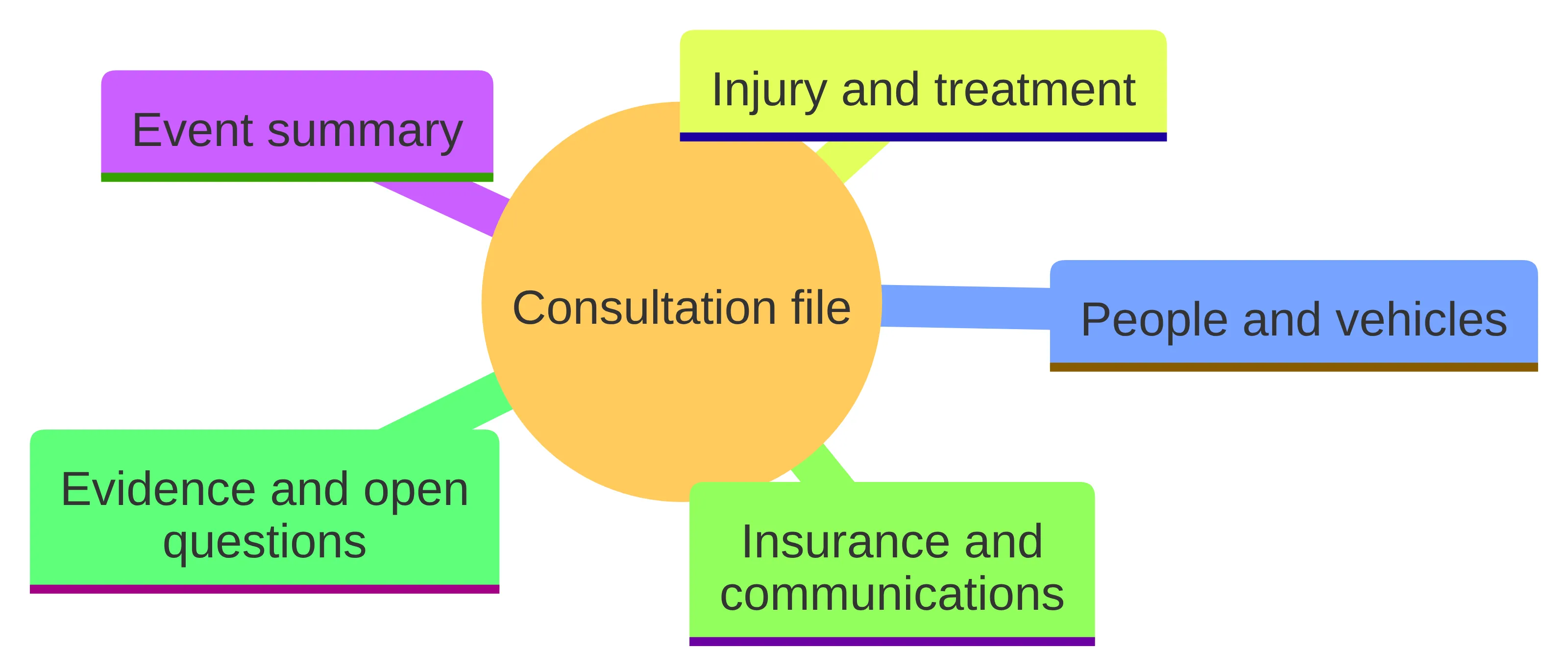
Use five short sections:
1. Event summary
Write the date, approximate time, location, direction of travel, travel mode, vehicle or roadway feature involved, impact sequence, and immediate aftermath. Include the cross street, borough, bike lane, crosswalk, sidewalk, parking area, or other location detail you remember. Add a simple sketch if it clarifies positions.
2. People and vehicles
List the driver, vehicle, plate number, owner, passengers, witnesses, responding officers, property representatives, and anyone who contacted you. Mark each entry as confirmed, estimated, or unknown. For a hit-and-run, describe the vehicle and direction of travel even if you do not know the driver’s identity.
3. Injury and treatment
List the symptoms you reported, the care you received, providers or facilities involved, appointments, records in your possession, and treatment that remains scheduled. Do not diagnose yourself or minimize an injury because the first record is brief.
4. Insurance and communications
Keep policy information, claim numbers, letters, emails, text messages, recorded statements, and notes of phone calls together. Record the sender, date, and subject of each communication. Do not summarize away a disagreement; preserve the actual wording when possible.
5. Evidence and open questions
List photos, video, camera locations, witness contacts, police reports, medical records, vehicle damage, clothing or equipment, and roadway photographs. Beside each item, write whether you have it, requested it, or believe someone else holds it. Finish with the questions that you want the consultation to address.
You do not need every section to be complete before making contact. A one-page summary with the date, location, travel mode, vehicle involvement, injury status, insurer communications, and missing records is enough to begin organizing the conversation. Add supporting documents behind it and keep a separate page for questions.
Accuracy matters more than length. Use phrases such as I remember, I am not sure, and I need to locate the record when appropriate. A careful account gives the attorney room to investigate without treating an estimate as a confirmed fact.
Ask questions that expose the unresolved issues
A focused consultation should answer the questions your file cannot answer by itself. New York accident-claim guidance states that a lawyer can review evidence, identify missing records, handle communications with insurers, and explain available choices. Consultation guidance also recommends bringing police reports, medical records, and insurance communications so the discussion can begin with the available record.
Write questions under four headings:
Accident and responsibility
- What facts about the intersection, crosswalk, bike lane, door, turn, passing movement, or road condition need further investigation?
- Which accounts conflict, and what evidence could help compare them?
- Does the event involve a driver, passenger, vehicle owner, business, government entity, or another possible participant?
- What witnesses, camera footage, police records, photographs, or vehicle information should be pursued?
Injury and records
- Which medical records, bills, treatment notes, or work records should be collected?
- What should be added if treatment continues or the effects on work and daily life change?
- Which parts of the injury timeline need clarification?
Insurance and communications
- Which insurer or self-insurer may be relevant to the facts provided?
- How should an unknown driver or vehicle be handled in the insurance analysis?
- What should you do with a request for a statement, an insurer’s disagreement, or another written communication?
- Which documents or policy information are still missing?
Timing and next steps
- Which deadlines or notice questions should be reviewed first?
- Which date or event may affect the timing analysis?
- What should you preserve or obtain before the next conversation?
- What choices are available after the facts and records are reviewed?
Do not treat a question list as a prediction of the answer. Its purpose is to prevent the conversation from staying at the level of a general crash description. Put the two or three questions that worry you most at the top, then use the supporting facts below each question.
If an attorney cannot answer a question immediately, ask what fact or document is needed before it can be evaluated. Record that follow-up item in your file. This turns uncertainty into a concrete next step without requiring you to decide the legal issue yourself.
Compare the prepared facts with the firm’s stated experience
The Law Offices of Evan W. Kohn handles pedestrian accident cases involving crosswalk accidents and hit-and-run crashes. At The Law Offices of Evan W. Kohn, we also handle rear-end, intersection and left-turn crashes, hit-and-runs, drunk- or distracted-driver incidents, uninsured-driver crashes, and claims involving injured passengers. We offer free consultations for electric-bicycle accident cases 24/7 in English and Spanish.
Compare those stated categories with your own summary. The comparison is a way to describe the event accurately, not a conclusion that the office will accept the matter or that the claim will succeed.
Use a plain-language match:
- If you were walking in a crosswalk, place the crosswalk, vehicle movement, and any witness or video information first.
- If the driver left, place the vehicle description, direction of travel, plate information, police contact, and possible camera locations first.
- If you were cycling, riding an e-bike, or using a scooter, identify the device, route, lane or roadway position, vehicle involved, and point of contact.
- If the crash involved an intersection, left turn, rear-end impact, distracted driving, an uninsured driver, or an injured passenger, name that pattern without deciding its legal effect.
- If the event involved more than one category, list all of them rather than forcing the facts into one label.
The purpose of this comparison is to make your first conversation specific. The stated case categories do not establish liability, coverage, a deadline, or an outcome. Bring the facts that fit and the facts that do not fit; both can matter to the discussion.
Use investigation and access needs to shape the request
Investigation needs belong in your opening summary. The Law Offices of Evan W. Kohn states that it investigates pedestrian accidents by obtaining police reports, finding camera footage, talking to witnesses, and identifying drivers. At The Law Offices of Evan W. Kohn, we also describe gathering police reports, photos, witness statements, and medical records when investigating cases.
Tell the office which of those items you already have and which may require follow-up. For example, identify a nearby storefront camera, a witness whose name you know but whose contact information you do not have, or a police report you have not yet obtained. That detail gives the conversation a concrete starting point.
Access details can shape how you make contact. The Law Offices of Evan W. Kohn offers free consultations and operates 24/7. We can arrange home or hospital visits for clients who cannot travel. We serve clients in all five boroughs, Westchester, Putnam, Rockland, Nassau, and New Jersey.
Include your preferred language and access limitation when you make contact. The office states that electric-bicycle accident consultations are available 24/7 in English and Spanish. If you are in a hospital or unable to travel, say so directly and identify a practical way to communicate.
Your access request should be factual and brief: where you are, whether you can travel, which language you prefer, how the office can reach you, and whether someone is helping you organize records. You do not need to explain the entire case before asking about a workable conversation format.
End your prepared summary with three lines: the unresolved legal question, the most useful evidence you have, and the access arrangement you need. Those lines connect the crash facts to the practical conditions for a consultation.
Request a free consultation with the prepared summary
A prepared consultation file does not need to prove your case. It should tell the story of the crash, identify the injury and insurance records available, flag missing evidence, and list the questions about responsibility, coverage, and timing that remain open. That is enough to make the first conversation focused rather than forcing you to solve the legal issues alone.
Before you submit your information, have these points ready:
- Your name and reliable contact details.
- The date, location, travel mode, and vehicle or roadway condition involved.
- A short factual description of the impact and what happened afterward.
- Your treatment status and the records you have.
- Any insurer, police, driver, business, or government communication.
- The strongest unresolved question and any access or language need.
A qualified attorney must decide what legal options and next steps fit your individual facts. Share the summary as it is, including uncertainty and missing records.
At The Law Offices of Evan W. Kohn, we offer free consultations for people injured in transportation accidents.
Questions to raise before requesting vehicle-accident legal review
When should I consider contacting a vehicle-accident attorney after an accident?
Consider reaching out to an attorney if you have significant injuries, ongoing treatment, missed work, conflicting accounts of the accident, multiple vehicles involved, or if an insurer disputes fault.
What documents should I gather before my consultation with an attorney?
Prepare to bring police reports, medical records, and any communications with insurance companies to your consultation.
How can I prepare for my initial consultation with a vehicle-accident attorney?
Create a concise summary of the accident, including details about the event, injuries, insurance communications, and any evidence you have.
What should I do if I cannot travel to the attorney's office for a consultation?
The Law Offices of Evan W. Kohn can arrange home or hospital visits for clients who are unable to travel.
What is the process for a free consultation with The Law Offices of Evan W. Kohn?
You can request a free consultation by providing your contact information and a brief summary of your accident details.
What should I include in my summary for the consultation?
Include the date, location, travel mode, vehicle involvement, injury status, and any communications with insurers.
Hurt like this?
We handle Pedestrian Accidents cases in the Bronx.
Evan W. Kohn, Esq. — more than 35 years of Bronx personal-injury practice. Reading about it only goes so far; a free consultation tells you what actually applies to your case.